

TSLL ETF analysis with price trend, technicals, earnings context, analyst sentiment, risks, and outlook for investors.
Data as of April 20, 2026, 4:00 PM ET — using last market close data.
Introduction
The TSLL ETF is a leveraged fund designed to deliver about 2x the daily move of Tesla shares. That makes the TSLL ETF a fast-moving trading tool, not a plain long-term holding. Investors are watching it now because Tesla remains highly sensitive to earnings, delivery trends, and broad tech sentiment.
Broader market conditions matter a lot here. When growth stocks are strong, leveraged funds like TSLL can rise quickly. When volatility increases, losses can also deepen fast.
Latest ETF Price & Trend
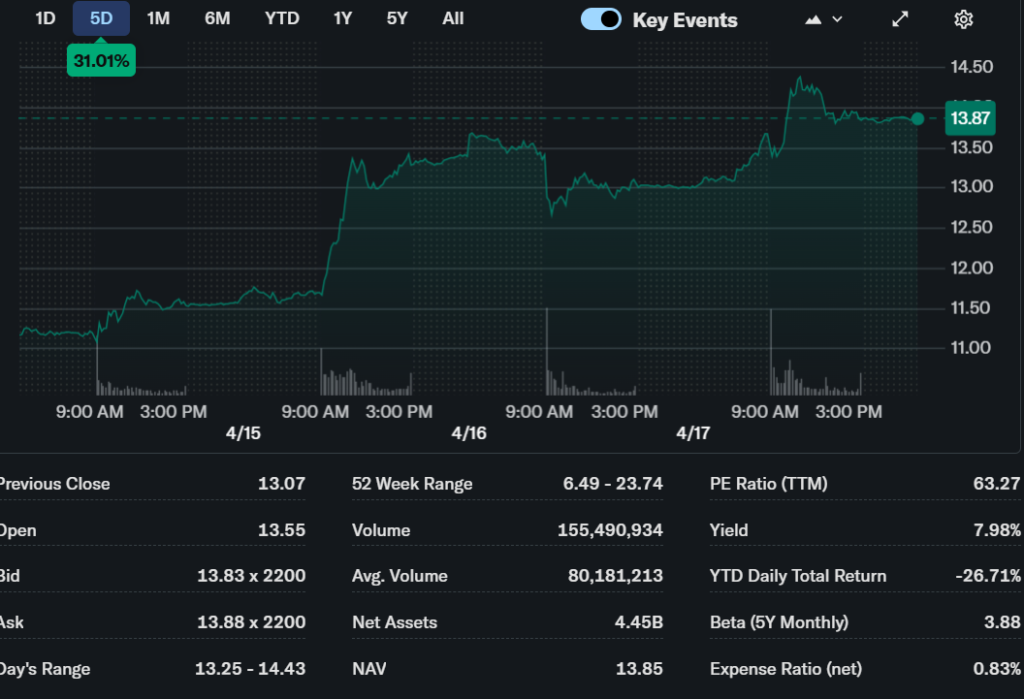
The latest TSLL ETF price was $13.85 at the last market close on April 17, 2026, after moving up 5.92% on the day. One source also showed a close near $13.87, which is consistent with the same session’s pricing range. The ETF traded between $13.10 and $14.43 during that session, showing wide intraday movement.
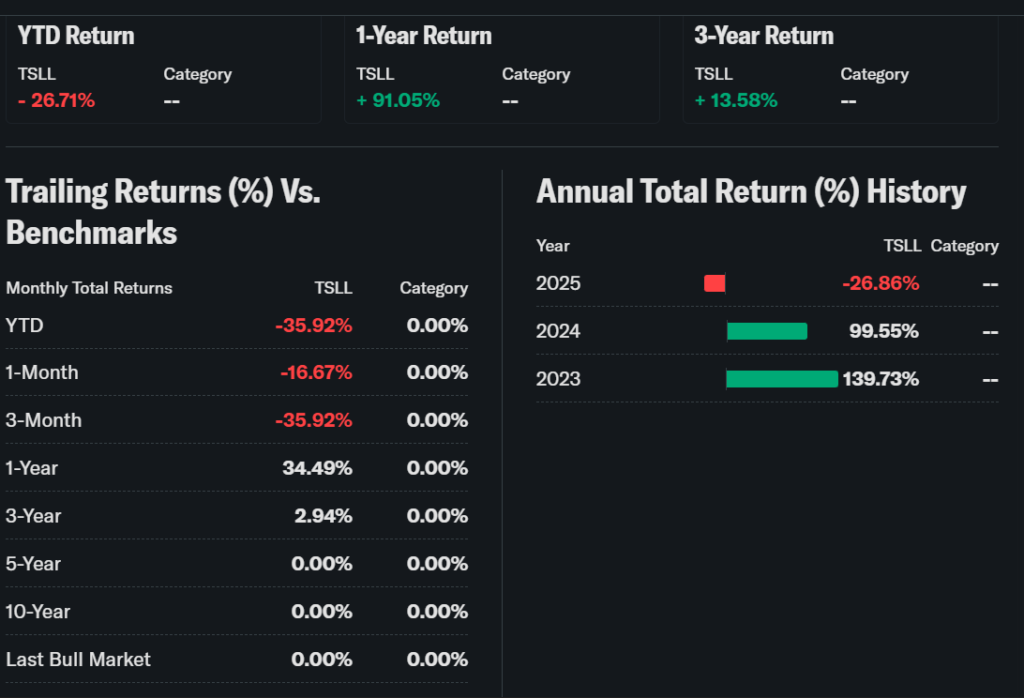
Short-term momentum looks positive, but the trend still reflects high volatility rather than a smooth climb. Over the past year, one source reported a total return of 60.92%, while another showed 90.62%, both including dividends. Since inception, performance has been negative on an annualized basis, which reflects the cost and decay risk of leveraged exposure.
The 52-week low was $6.29 to $6.49, while the 52-week high was $23.74. That range shows how aggressively the fund can swing with Tesla’s moves. Overall, the trend is bullish but unstable, which means traders may see opportunity, while long-term investors should stay cautious.

Technical Analysis
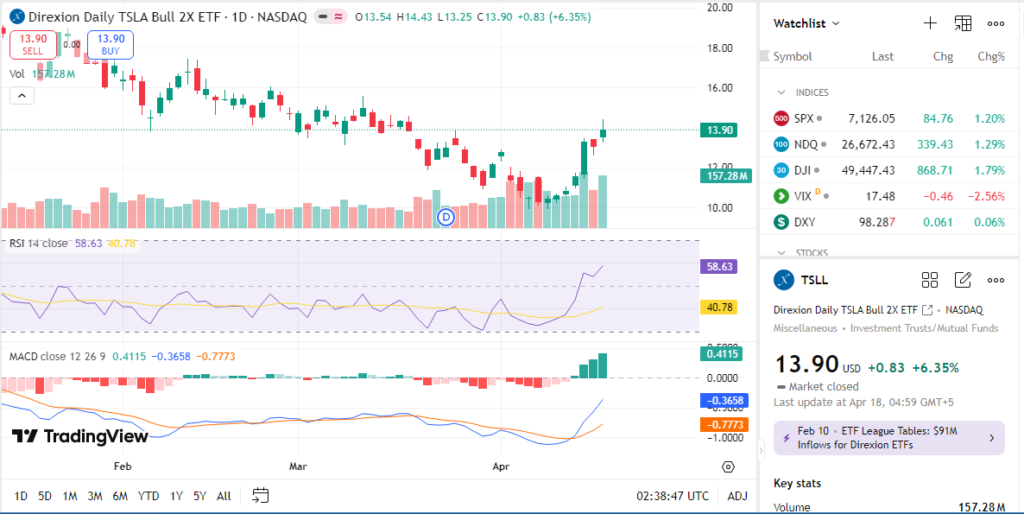
Support is the price area where buyers tend to step in. For TSLL, the recent intraday low near $13.10 is a near-term support reference. Resistance is where selling often appears, and the recent high near $14.43 is the first level to watch.
RSI, or Relative Strength Index, helps show whether a fund may be overbought or oversold. A high RSI often suggests the move has become stretched, while a low RSI can hint at exhaustion on the downside. I could not verify a current RSI reading from the allowed sources, so the safest view is that TSLL is trading in a momentum-driven zone.
MACD, moving averages, and crossover signals are useful for trend direction. I could not verify exact 50-day or 200-day moving average values from the allowed sources, so I will not guess them. Based on the recent price rebound and sharp daily range, the setup suggests a short-term bullish bias, but not a stable long-term trend.
Trading volume matters because strong volume confirms conviction. TSLL has shown very heavy trading activity, including 1D volume above 27 million shares on one source and an average daily volume above 71 million shares on another. That level of activity usually means active speculation, fast repositioning, and high trader interest.

Analyst Ratings & Price Targets
TSLL is a leveraged ETF, so traditional analyst coverage is limited compared with single stocks. That means there is no reliable consensus count of Buy, Hold, or Sell ratings from major Wall Street firms in the way investors expect for operating companies. The same issue applies to standard price-target coverage.
Some third-party forecast sites publish estimates, but these are not the same as formal analyst targets from major banks. One forecast page projected a near-term average price target of $8.3075, with a high of $10.52 and a low of $6.092. Because that source is not a top-tier institutional research provider, it should be treated cautiously.
For investors, the key message is simple. TSLL sentiment is driven more by Tesla’s price action than by classic analyst opinion. That makes the fund more suitable for tactical traders than for investors seeking steady research-backed targets.finance.
Insider Activity
Insider activity is not meaningful for TSLL in the normal stock sense. An ETF does not have management insiders buying or selling shares the way a company does. What matters more is fund creation, redemption, and sponsor activity, not executive stock transactions.
Because of that structure, there is no standard insider buying or selling signal to read here. Investors should focus instead on Tesla’s corporate earnings, delivery trends, and the ETF’s own flow data. That provides a better picture of demand and sentiment.
Valuation Analysis
Traditional valuation metrics like trailing P/E, forward P/E, price-to-sales, revenue growth, EPS growth, free cash flow, debt, and cash position do not apply directly to TSLL. TSLL is a leveraged ETF, not an operating business. Its value comes from Tesla exposure, not from its own revenues or earnings.
That means comparing TSLL to Microsoft, Zoom, or other companies is not appropriate on a valuation basis. A better comparison is to other leveraged trading products, where expense ratio, tracking, liquidity, and decay matter more than business fundamentals. TSLL’s expense ratio was listed at 0.83% on one source and 0.95% on another, which is high enough to matter for longer holding periods.
So is TSLL undervalued, fairly valued, or overvalued? That question does not fit the fund well. For traders, the better framing is whether Tesla’s next move is likely to continue or reverse.
Recent Earnings & Catalysts
TSLL itself does not report earnings, because it is an ETF. Its performance is tied to Tesla’s earnings, guidance, delivery data, and investor reaction to those events. That is why the keyword TSLL ETF earnings really refers to Tesla’s earnings impact on the fund.
Major catalysts usually include Tesla quarterly results, margin commentary, vehicle delivery figures, product updates, and any major strategic news. When Tesla beats or guides positively, TSLL often reacts sharply because of its 2x daily design. When Tesla disappoints, downside moves can be equally sharp.finance.
The practical lesson is that earnings season can create both opportunity and risk. Traders may use TSLL around catalysts, but they should expect amplified volatility and rapid reversals.
Bullish Case
The bullish case for TSLL depends on continued strength in Tesla shares. If Tesla posts better-than-expected earnings, stronger demand, or improving margins, the ETF can rise quickly because of its leverage. Strong growth sentiment in the broader tech market can also support the fund.finance.
Another positive factor is liquidity. TSLL trades heavily, which makes it easier to enter and exit than many niche funds. For short-term tactical traders, that can be useful during high-volume market sessions.
Bearish Case
The main risk is decay from daily leverage. TSLL resets exposure every day, so choppy markets can hurt returns even if Tesla ends up flat over time. That structure is a serious weakness for buy-and-hold investors.
Competition, slowing Tesla momentum, and weak sentiment toward growth stocks can all pressure the ETF. Higher volatility can also magnify losses very quickly. In plain terms, this is a product where timing matters a great deal.finance.
Market Sentiment & Investor Psychology
TSLL is often driven by momentum traders, not patient income investors. The heavy volume suggests strong retail participation and active speculation. The ETF’s large swings also attract options-focused traders and short-term market watchers.
Short interest, options positioning, and institutional ownership are not cleanly reported in the sources used here, so I will not guess. Still, the price behavior points to a neutral to optimistic sentiment profile, with more excitement than fear when Tesla is trending higher.

Short-Term Outlook
Over the next few days or weeks, TSLL looks sensitive to Tesla headlines, market breadth, and risk appetite. The recent rebound and strong session range suggest near-term bullish momentum. Still, the wide intraday move shows that reversals can happen fast.
For traders, the setup is attractive only if they can tolerate sharp swings. For conservative investors, the same volatility makes the fund hard to hold comfortably.
Medium to Long-Term Outlook
Over 6 to 24 months, TSLL should be viewed as a tactical vehicle, not a core portfolio holding. Its outcome depends almost entirely on Tesla’s path and the effects of daily leverage. That makes the fund suitable for short-term views, not steady compounding.
Long-term investors should usually watch rather than accumulate. If you want Tesla exposure, TSLL can be useful at the right moment, but it is not designed for long holding periods. The biggest advantages are liquidity and leverage; the biggest risks are decay and volatility.
FAQ
Is TSLL ETF a buy right now?
It can be a tactical buy for traders who expect Tesla strength, but it is not ideal for long-term passive investors.
What is the price target for TSLL ETF?
Traditional institutional price targets are limited for leveraged ETFs. Third-party forecasts vary widely and should be used cautiously.
What are the major risks for TSLL ETF?
The biggest risks are leverage decay, high volatility, and sharp losses when Tesla weakens.
What does TSLL ETF earnings mean?
It refers to Tesla’s earnings impact on TSLL, since the ETF itself does not report earnings.
What is TSLL ETF forecast?
Forecasts are highly uncertain because the fund depends on Tesla’s daily price moves. Short-term direction is more relevant than long-range predictions.
Suggestions
Use these related links to support SEO and reader flow: “Compare with Zoom ETF,” “See our Microsoft ETF forecast,” and “Read our tech sector valuation breakdown.” These anchors fit naturally with broader growth-stock and tech-investing coverage. They also help readers compare TSLL with less volatile alternatives.
Conclusion
TSLL is best rated Watchlist for most investors, and Buy only for traders with a clear short-term Tesla view. The fund has strong liquidity and upside potential, but leverage makes it risky and hard to hold for long periods. Its recent momentum is encouraging, yet the structure still demands discipline and timing.
Disclaimer: This article is for informational purposes only and not financial advice.