

TZA ETF analysis with price trend, technicals, valuation, sentiment, risks, and forecast for investors.
Data as of April 20, 2026, 7:12 AM PKT.
Introduction
The TZA ETF is designed to deliver 3x the inverse daily return of small-cap U.S. stocks. In simple terms, it tends to rise when small caps fall, and it tends to fall when small caps rise. That makes the TZA ETF a short-term trading tool, not a long-term buy-and-hold fund. The market focus around this ETF is strong because small-cap stocks remain sensitive to interest rates, growth expectations, and risk sentiment.
Investors are watching this TZA ETF more closely because small caps often react quickly to macro shifts. When markets expect slower growth or tighter financial conditions, bearish small-cap funds can gain attention. Broader equity volatility also matters, since leveraged inverse ETFs move sharply when the underlying index swings. For that reason, TZA needs to be read through both market trend and timing.
Latest ETF Price & Trend
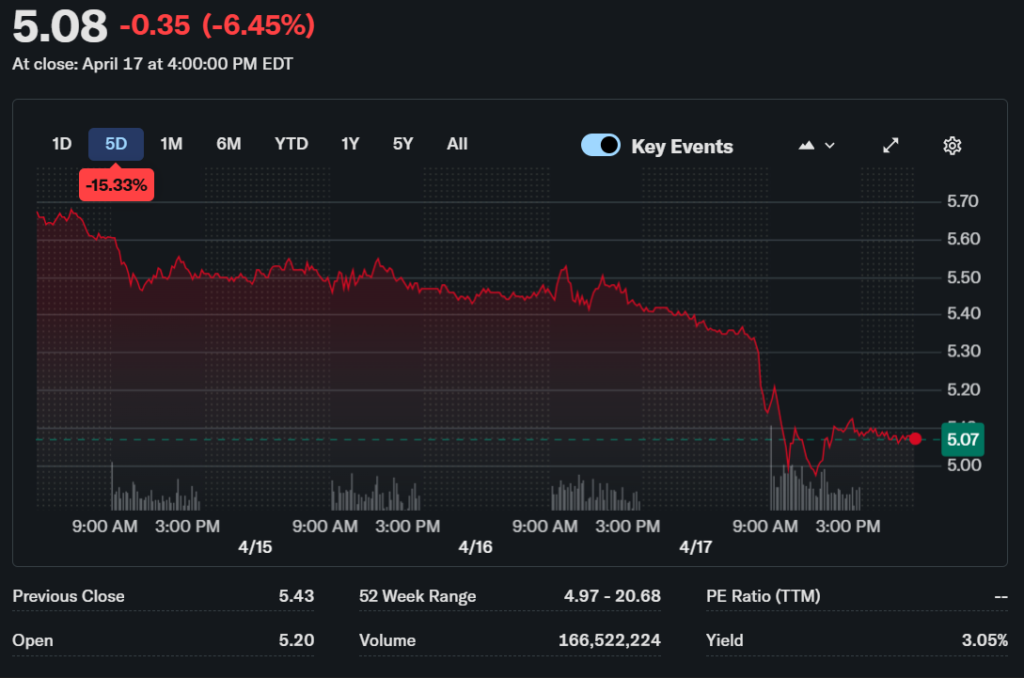
The latest available TZA price data shows the ETF trading around $5.07 on April 19, 2026, after moving between $4.97 and $5.37 during that session. The same source shows a market capitalization of about $281.32 million and a 52-week range of roughly $5.59 to $25.70. Another source shows the ETF above its low by about 100%, but the price field there was not populated cleanly, so the more direct quote is the better reference. The latest TZA ETF price data suggests the fund has been under clear pressure compared with its yearly peak.
The short-term trend is weak to mixed. The daily move was positive in the latest snapshot, but the broader picture still looks bearish because the fund is far below its 52-week high. Since TZA is an inverse leveraged product, its trend can change quickly when the underlying small-cap market turns. For investors, that means the recent TZA ETF price action signals a tactical trading setup, not a stable long-term trend.

Technical Analysis
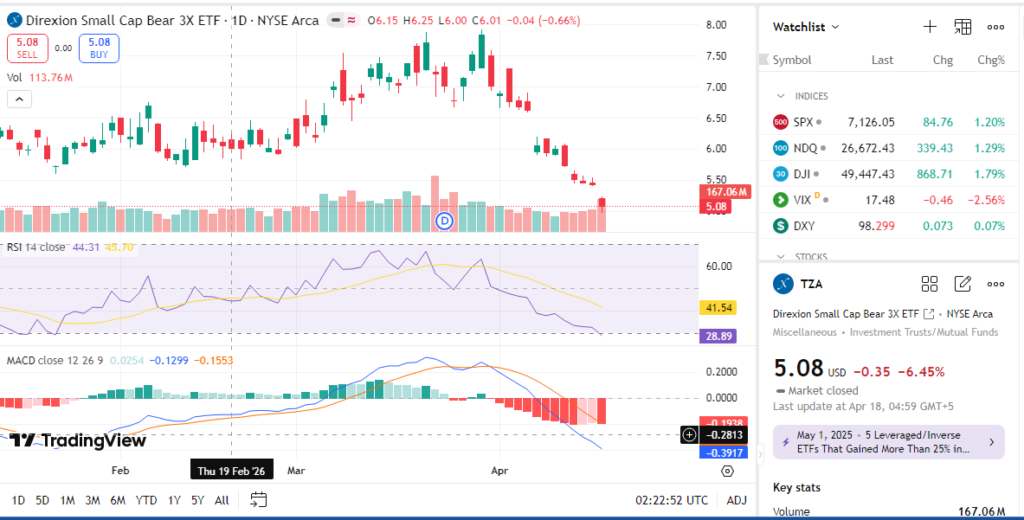
Technical analysis helps investors judge momentum, trend strength, and possible turning points. Support is the price area where buyers may step in, while resistance is where selling often appears. For TZA, one technical source listed support near 10.41, 10.27, and 10.14, with resistance near 10.69, 10.82, and 10.96, though those levels came from a different date and price regime. More recent pricing around $5.07 means traders should treat those older levels carefully.
RSI measures whether an asset is overbought or oversold. A high RSI can suggest a stretched move, while a low RSI may indicate weak momentum. MACD tracks trend direction and crossover strength, while the 50-day and 200-day moving averages show medium-term and long-term direction. Publicly available technical summaries currently lean bearish, with one source rating TZA as a strong sell and another noting bearish setups and above-average volume in earlier trading data. That combination usually points to weak momentum rather than a clean reversal.
A golden cross happens when the 50-day average moves above the 200-day average, which is often bullish. A death cross is the opposite and usually reflects a bearish trend. For TZA, the available market tone suggests the ETF is not showing a strong bullish technical structure right now. Volume has been active, which matters because leveraged ETFs often move faster when trading interest rises.

Analyst Ratings & Price Targets
Traditional Wall Street analyst coverage is limited for the TZA ETF because it is a leveraged fund rather than an operating company. That means you usually will not see a normal Buy, Hold, or Sell breakdown with standard price targets like a stock would have. Instead, investors rely more on fund structure, sector direction, and technical behavior. In practice, the absence of broad analyst coverage is normal for this type of product.
Because TZA tracks inverse exposure to small caps, sentiment is better measured through market expectations for the Russell 2000 and small-cap volatility. When analysts expect stronger growth or lower rates, inverse small-cap funds usually face pressure. When they expect weaker growth or tighter financial conditions, sentiment can improve for TZA. So for this ETF, “ratings” matter less than macro positioning and trading momentum.
Insider Activity
Insider activity is not a meaningful signal for the TZA ETF itself because ETFs do not have the same insider structure as operating companies. There is no normal executive share accumulation or disposal pattern to interpret the way you would with a stock. Large transactions inside the fund are also not comparable to insider trades. For this reason, insider buying and selling do not provide a useful confidence or caution signal here.
What does matter is fund flow and trading volume. A leveraged ETF like TZA can attract short-term speculative activity when traders expect small-cap weakness. That can create bursts of demand without reflecting long-term conviction. So the better way to read activity in TZA is through volume and price action, not insider behavior.
Valuation Analysis
Valuation metrics like trailing P/E, forward P/E, and price-to-sales are not useful in the usual way for the TZA ETF. That is because TZA is a fund, not a business that generates its own earnings and revenue. One data source listed no P/E ratio for the ETF, which is expected for this structure. Another source showed portfolio-level metrics, including earnings-related and price-based measures at the fund portfolio level rather than as a company valuation.
The more relevant comparison is not with operating companies like Microsoft or Zoom, but with other leveraged or inverse ETFs. TZA also carries a 0.99% net expense ratio, which is relatively high versus plain index ETFs but common for leveraged products. On that basis, TZA is not “cheap” in a classic valuation sense. It should be viewed as a tactical instrument whose value depends on timing, not intrinsic business earnings.
Recent Earnings & Catalysts
The TZA ETF earnings concept is different from a stock’s earnings report. TZA does not publish quarterly revenue or EPS in the usual way because it is an ETF. Instead, its performance depends on the daily movement of the underlying small-cap index. So for this fund, “earnings” really means performance drivers, tracking accuracy, and market conditions.
The biggest catalysts are Federal Reserve expectations, small-cap earnings trends, inflation data, and risk-on or risk-off market behavior. If investors expect slower growth or higher financing pressure for smaller companies, TZA can benefit. If the market turns toward lower rates, better growth, or stronger risk appetite, TZA often weakens. That means the fund is highly sensitive to macro news rather than company-specific results.
Bullish Case
The bullish case for the TZA ETF starts with weakness in small-cap stocks. If credit conditions stay tight, borrowing costs remain elevated, or economic growth slows, small companies may underperform. In that setup, an inverse small-cap ETF can serve as a hedge or a tactical trade. This can be useful during periods of market stress or sharp rotation away from risky assets.
TZA can also work when traders expect more downside in the Russell 2000. The ETF’s 3x inverse structure can amplify the move, which is attractive for short-term traders with a strong thesis. Active volume and bearish technical signals can support near-term trade setups. Still, the bullish case depends heavily on timing and discipline.
Bearish Case
The main risk is that TZA decays over time because it resets daily. That means long holding periods can produce results that differ sharply from the simple inverse of small-cap performance. If the market trends upward or moves sideways, leveraged inverse ETFs can lose value even without a dramatic index rally. This structure makes TZA a poor fit for passive investors.
There is also the risk of sudden short squeezes in small caps, better-than-expected economic data, or faster rate cuts than the market expects. Those factors can hurt TZA quickly. Competition is not the main issue here, but product complexity is. Many investors underestimate how fast leverage and daily resets can erode returns.
Market Sentiment
Market sentiment around TZA looks cautious and somewhat bearish. One technical source labels the fund a strong sell, and another describes bearish setups alongside active volume. That does not mean the ETF cannot bounce, but it does show weak trend quality in the latest available data. Overall, sentiment appears more fearful than optimistic.
Short interest, options activity, and institutional ownership data are harder to interpret for this ETF in the same way as for stocks. Because TZA is a leveraged instrument, retail traders often use it for short-term speculation or hedging. That means sentiment can shift quickly and may not reflect a stable conviction trade. The current tone is best described as neutral to cautious.

Short-Term Outlook
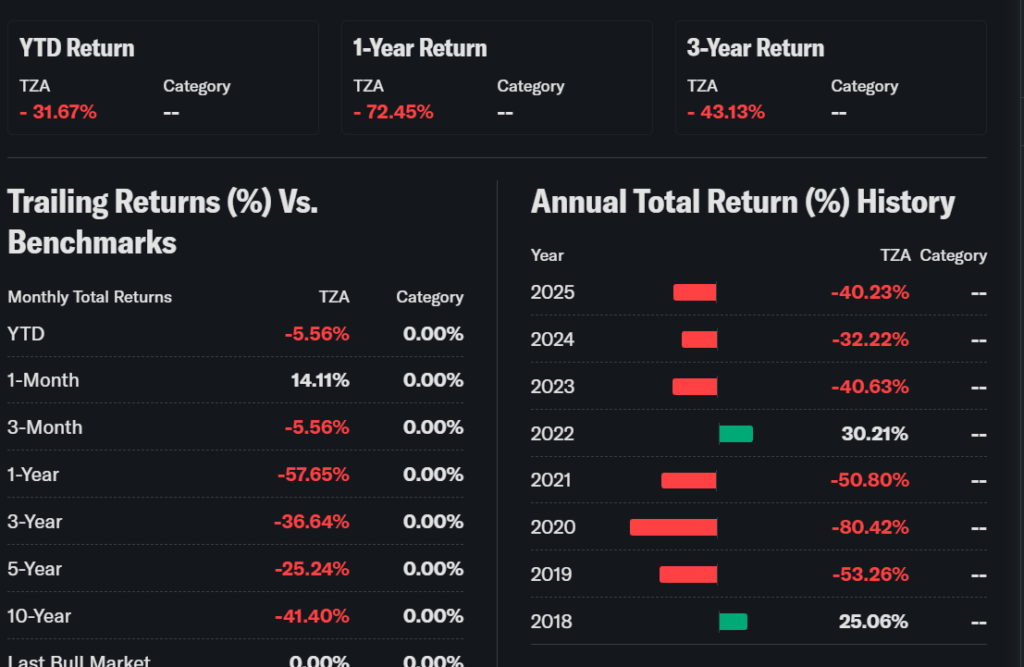
Over the next days and weeks, the TZA ETF forecast depends mainly on small-cap market direction and macro headlines. The recent price action shows weakness relative to the yearly high, but also enough intraday movement to support trading opportunities. If volume expands and small caps sell off, TZA may continue to attract attention. If risk appetite improves, the ETF could lose momentum fast.
From a technical view, the setup is not strongly bullish yet. Traders should expect sharp swings rather than smooth gains. This is a product for active timing, not patience. The best near-term description is volatile and event-driven.
Medium to Long-Term Outlook
Over 6 to 24 months, the long-term case for TZA is weaker than the short-term case. The fund is built for daily inverse exposure, so holding it for long periods can be inefficient. Its performance depends more on market path than on final direction alone. That makes it best suited for tactical use, not strategic allocation.
For long-term investors, TZA is usually a watchlist name rather than a core holding. It can be useful as a hedge during periods of small-cap stress, but it is not ideal as a permanent position. The underlying risk is structural, not just market-based. Investors should treat it as a short-duration tool.
FAQ
Is TZA ETF a buy right now?
For short-term traders, TZA can be a buy only if you expect small-cap weakness soon. For long-term investors, it is usually not a buy because of daily leverage decay.
What is the TZA ETF price target?
There is no standard Wall Street price target for TZA like a stock. The more useful target is the direction of the Russell 2000 and the timing of your trade.
What are the major risks for TZA ETF?
The biggest risks are daily leverage decay, sudden rallies in small caps, and timing error. Macro surprises can also reverse the trade quickly.
What does TZA ETF earnings mean?
TZA does not have company-style earnings. In practice, the phrase refers to the fund’s performance and how well it tracks its stated objective.
Suggestions
- Compare with Russell 2000 hedge ETFs.
- See our leveraged ETF risk guide.
- Read our small-cap market outlook.
Conclusion
The TZA ETF is best viewed as a tactical bearish small-cap tool, not a long-term investment. The latest price trend, technical tone, and leveraged structure all point to caution. For traders who expect near-term weakness in small caps, it can be useful. For most investors, the better stance is Watchlist until the macro and technical picture improves.
Disclaimer: This article is for informational purposes only and not financial advice.