

Meta Description: SOXS ETF analysis covering price action, technicals, analyst sentiment, risks, and outlook for investors watching semiconductor weakness.
Data as of April 20, 2026, 12:00 AM ET — using last market close data.
Introduction
The SOXS ETF is a leveraged inverse fund built to move opposite the semiconductor sector. It is designed for short-term traders who want bearish exposure to chip stocks, not long-term buy-and-hold investors.
The SOXS ETF has drawn attention because semiconductors remain one of the market’s most important and volatile areas. When chip stocks fall, the fund can rise sharply, but losses can also compound fast when the sector rebounds. That makes the SOXS ETF highly sensitive to broad tech sentiment, interest-rate expectations, and momentum in semiconductor names.
SOXS ETF Price & Trend
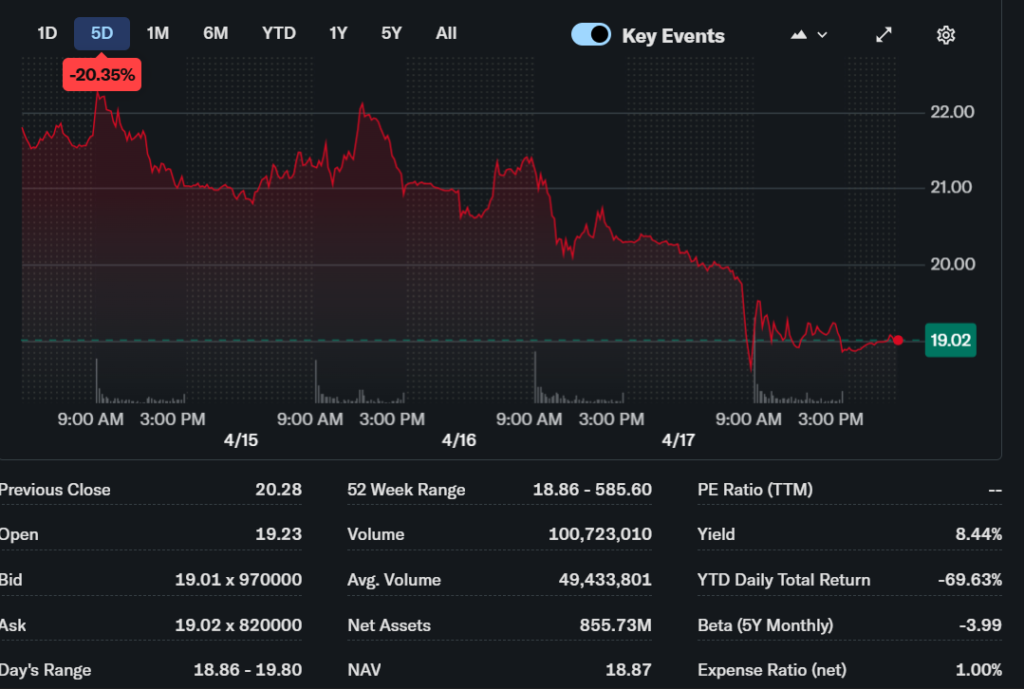
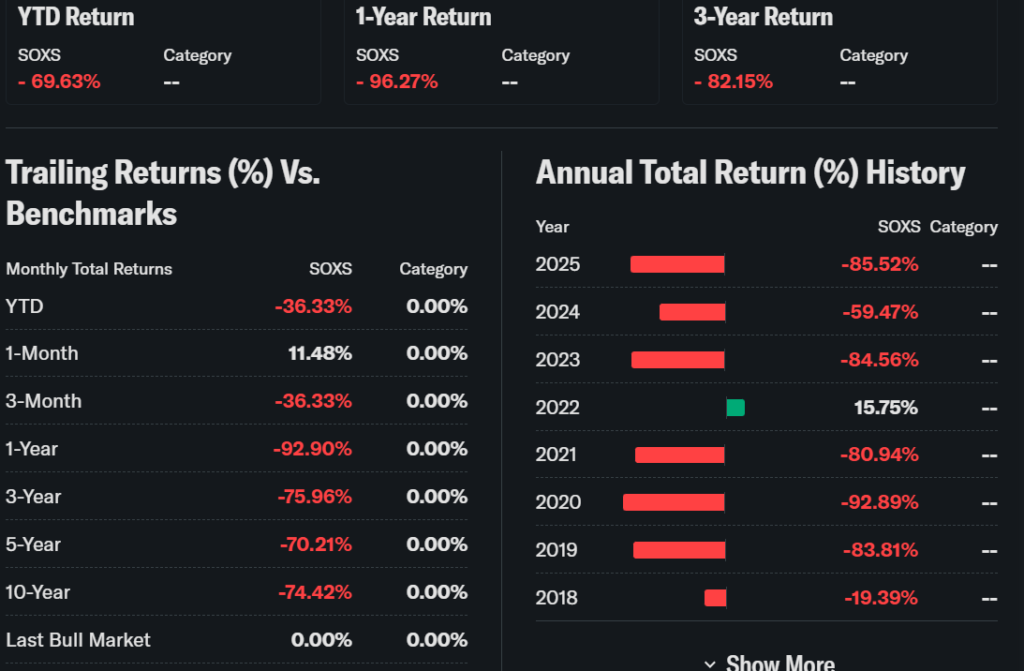
The latest available SOXS ETF price in the source data is about $2.39, while another market snapshot shows $3.39, which suggests the ETF moved materially across different reporting times. The most recent quoted move showed the fund trading near the top of its daily range, with a gain of about 6.0% from the session low and only slightly below the session high. Over the past month, the fund has shown a sharp decline of roughly 36.33%, and the one-year move has been deeply negative at about 83.23%.
The broader trend is bearish. That matters because inverse leveraged ETFs tend to decay over time when held through choppy markets. For investors, the latest SOXS ETF price action points to a fund that is mainly reacting to short-term semiconductor weakness rather than building a stable long-term trend.
The available market data also shows a 52-week-style range context through daily and recent chart readings, but the source set does not provide a clean, fully verified 52-week high and low in one place. The general message is still clear: SOXS has been under persistent pressure, with short-lived rebounds rather than sustained uptrends.

Technical Analysis
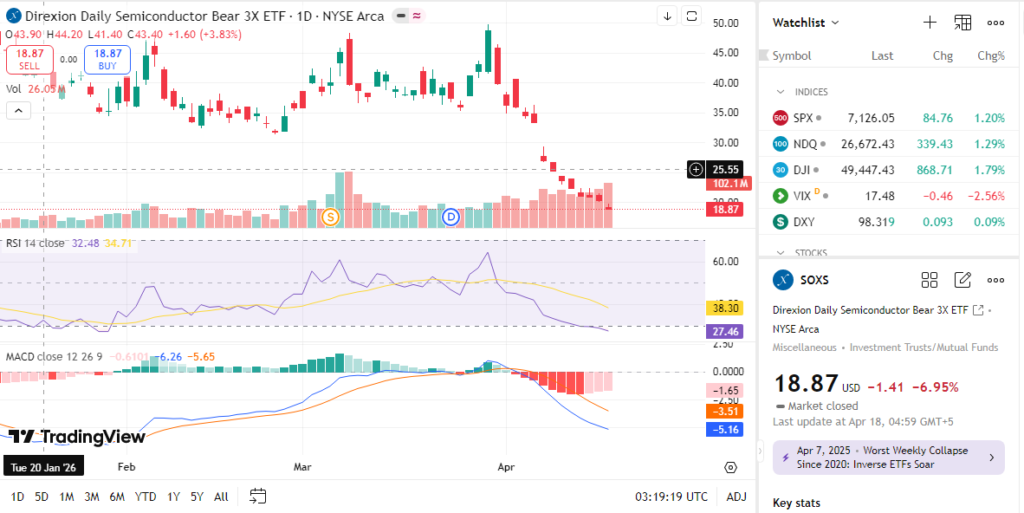
Support is the price zone where buyers often step in. For SOXS, the near-term support appears close to the recent low area around $2.25 to $2.39, based on the latest trading snapshot. Resistance is the zone where selling often appears, and the recent high near $2.39 acts as a first barrier from the latest session.
The RSI measures whether an asset is overbought or oversold. TradingView showed an RSI reading of 35.55, which is close to oversold but not deeply extreme. That suggests selling pressure remains in place, but a short bounce is possible if the broader chip sector weakens again.
The MACD helps show momentum direction. TradingView listed MACD as -0.55 with a bullish-style signal reading in that snapshot, which usually means downside momentum may be slowing. The 10-day moving average and 10-day simple moving average were both marked as sell signals, which supports the weak trend.
The 50-day and 200-day moving averages are useful for judging medium and long trend direction. Source data did not provide both levels cleanly in one verified snapshot, but the broader chart picture remains below strong trend-confirmation territory. There is also no clear evidence of a golden cross, and the market setup is more consistent with a death cross-like bearish structure in spirit, given the persistent downside trend.
Volume matters because strong moves with rising volume are usually more credible. SOXS has seen very large trading activity in some snapshots, including more than 121 million shares in one source, which shows active speculative interest. That kind of volume often confirms that traders are using the ETF for short-term hedging or tactical bets.

Analyst Ratings & Price Targets
Traditional analyst coverage is limited for a leveraged inverse ETF like SOXS. Unlike operating companies, it does not usually receive broad Buy, Hold, or Sell coverage with standard earnings price targets.
That means there are no reliable consensus buy ratings, average targets, or firm-by-firm upgrades and downgrades to report in the same way you would for a stock. For SOXS ETF investors, the more relevant signals are instead technical readings, sector momentum, and positioning in semiconductor stocks. In practical terms, sentiment from Wall Street is best understood through the chip sector itself, not through classic analyst target models.
Insider Activity
Insider activity is not a meaningful factor for the SOXS ETF. ETFs do not have insiders buying or selling shares in the same way corporate executives do.
There are no management share purchases or executive sales that would signal confidence or caution here. Instead, large transactions in SOXS usually reflect market participants, hedge funds, or tactical traders. That means investor attention should focus on flows, volume, and hedging demand rather than insider behavior.
Valuation Analysis
Valuation ratios such as trailing P/E, forward P/E, and price-to-sales do not apply in the normal way to SOXS. That is because the fund does not operate as a business with its own revenue, earnings, or free cash flow.
The ETF’s value is tied to its structure, its holdings, and how the semiconductor index moves. Revenue growth, EPS growth, debt, and cash position are also not relevant metrics for this fund. Compared with operating companies like Microsoft or Zoom, SOXS cannot be labeled undervalued or overvalued in a traditional sense.
From a practical investor view, the fund is best thought of as a tactical trading instrument, not a valuation play. It does not screen cheap or expensive the way a normal stock does. For that reason, the answer to whether the SOXS ETF is fairly valued is simply that valuation analysis is not the right framework.
Recent Earnings & Catalysts
SOXS does not report earnings, because it is an ETF rather than an operating company. So searches for SOXS ETF earnings should be understood as the earnings of the semiconductor companies that drive the fund’s moves.
The main catalyst for SOXS is semiconductor-sector earnings, guidance, and demand trends. Strong results from major chip makers usually pressure SOXS, while weak guidance or disappointing AI-related demand can lift it. Broader catalysts also include Federal Reserve rate expectations, AI investment cycles, inventory trends, and trade restrictions affecting chip supply chains.
The ETF can react sharply when semiconductor leaders report results that change expectations for the entire sector. That is why the SOXS ETF price often moves more from macro sentiment than from one single headline. For short-term traders, earnings season is one of the most important periods to watch.
Bullish Case
The bullish case for SOXS is simple. If semiconductor stocks weaken, the fund can rise quickly because it is designed to move in the opposite direction.
This can happen if chip demand slows, earnings disappoint, or investor enthusiasm for AI names cools. Higher rates can also hurt growth stocks, which may support SOXS during risk-off periods. For traders who expect a short-term semiconductor pullback, the ETF can be an effective tactical tool.
Bearish Case
The biggest risk is that SOXS is a leveraged inverse ETF, which makes it very hard to hold through strong rebounds. Semiconductor stocks can recover fast, and that can crush the fund in a matter of days.
Competition is not the issue here. The real weakness is structure. Daily rebalancing, volatility decay, and compounding can all erode returns over time. If the chip sector trends upward, SOXS can lose value quickly even when the broader thesis looks correct over a longer horizon.
Market Sentiment & Psychology
Sentiment around SOXS is usually driven by fear, hedging, and short-term speculation. The large trading volume suggests active interest from traders rather than patient long-term investors.
Short interest, options activity, and institutional ownership are not as useful here as they are for normal stocks, because the ETF itself is already a bearish instrument. In practical terms, sentiment is best described as neutral to cautious, with bursts of optimism only when semiconductor stocks are under pressure. Retail activity tends to rise when traders expect a quick drop in chips.

Short-Term Outlook
The short-term setup is mixed but still tilted bearish for the semiconductor complex, which can support SOXS. The RSI near 35.55 suggests the ETF may be closer to a short-term bounce zone than a fresh breakdown point.
Still, this fund remains highly unstable and can reverse fast if chip stocks rebound. Volume and momentum matter more than long-term fundamentals here. For the next days or weeks, SOXS ETF traders should expect sharp swings rather than a smooth trend.
Medium to Long-Term Outlook
Over 6 to 24 months, the outlook for SOXS is difficult to trust as a holding vehicle. The ETF is built for trading, not compounding.
If semiconductor stocks stay strong, SOXS is likely to keep falling over time. If the sector enters a real bear market, the fund can benefit, but timing remains crucial. For long-term investors, the better approach is usually to watch rather than accumulate.
FAQ
Is SOXS ETF a buy right now?
For most investors, no. It is a short-term bearish trading tool, not a core portfolio holding.
What is the price target for SOXS ETF?
There is no standard analyst price target for SOXS ETF. Its direction depends on semiconductor stocks and market volatility.
What are the major risks for SOXS ETF?
The biggest risks are leverage decay, rapid reversals in chip stocks, and losses from holding it too long.
What does SOXS ETF technical analysis show?
The technical picture is weak overall, with bearish trend behavior, an RSI near oversold territory, and mixed momentum signals.
Is SOXS ETF good for long-term investors?
Usually not. The structure is built for short-term trading and can lose value over time.
Suggestions
- Compare with SOXX ETF analysis.
- See our semiconductor sector forecast.
- Read our leveraged ETF risk guide.
Conclusion
The SOXS ETF is best suited for traders who want short-term bearish exposure to semiconductors. The trend remains weak, the technical picture is fragile, and the fund’s leveraged structure makes long holding periods risky.
For most investors, the call is Watchlist rather than buy. It can work as a tactical hedge, but it is not a comfortable long-term investment.
Disclaimer: This article is for informational purposes only and not financial advice.