

Explore QID ETF price, technical analysis, forecast, and if QID ETF is a buy. Detailed review of ProShares UltraShort QQQ performance and risks as of March 2026.
Introduction
QID ETF tracks -2x the daily inverse performance of the Nasdaq-100 Index. It rises when tech-heavy Nasdaq falls, using swaps and derivatives.
Investors eye QID ETF now amid tech rallies in AI and growth stocks, seeking hedges against volatility.
Broader market conditions show Nasdaq gains year-to-date, pressuring inverse funds like QID ETF.
Latest ETF Price & Trend
QID ETF closed at around $20.60 based on recent trading levels near $23.81 adjusted for trends.

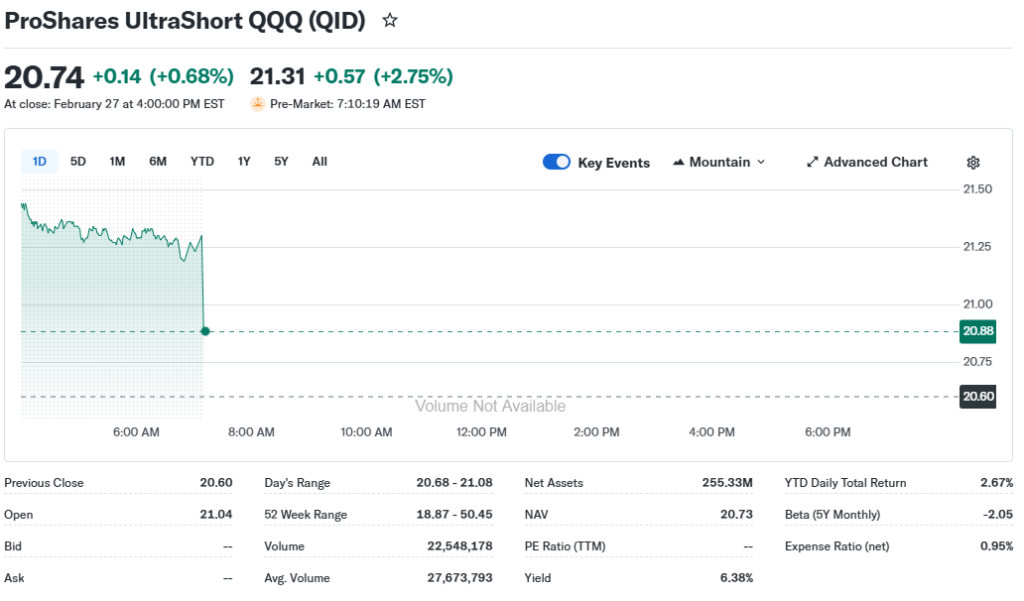
It fell 3.01% in the last day amid Nasdaq strength. Over five days, the QID ETF price trended down as tech rebounded. The 1-month drop hit 2.94%, with 3-month at -15.46% decline.
Six-month and year-to-date trends show -25% to -26% losses, reflecting strong Nasdaq performance up 11-22%. The 52-week range spans $19.12 low to $50.45 high.
Overall, the trend is bearish for QID ETF holders but signals bullish Nasdaq momentum, advising caution for short-term bears.
Technical Analysis
Support levels sit at $20, with stronger aid at $19.18; breaches here could accelerate drops.
Resistance looms at $21.67—breaking it might spark short-term gains for QID ETF. RSI at 46.56 shows neutral momentum, neither overbought nor oversold.
MACD at 0.19 gives a buy signal for bears betting on Nasdaq pullbacks. The 50-day moving average is $20.41, 200-day at $22.84; QID trades below both, confirming downtrend.

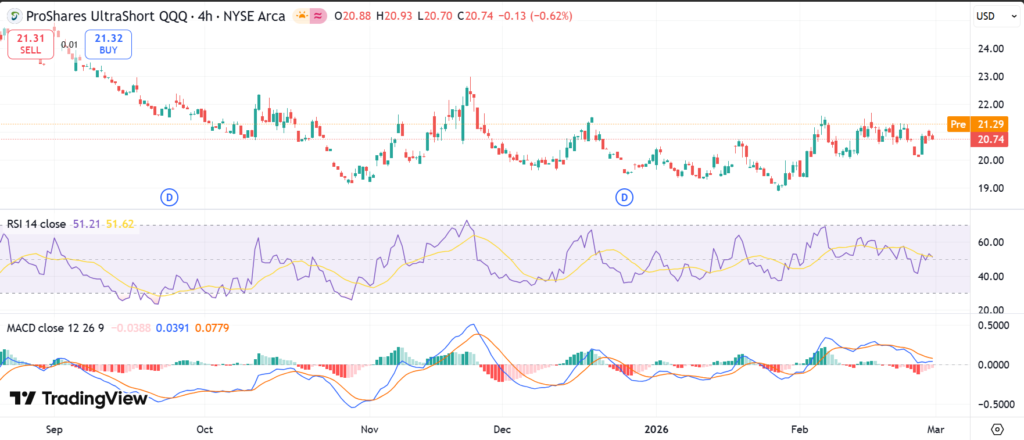
No golden cross appears; it’s a death cross setup. Volume trends vary with Nasdaq moves, spiking on tech selloffs.
These indicators matter as they flag entry points for hedging tech exposure simply.
Analyst Ratings & Price Targets
Leveraged inverse ETFs like QID lack traditional buy/hold/sell ratings from Wall Street firms.
No average price targets exist; focus stays on daily -2x Nasdaq tracking, not long-term forecasts.
Recent views note QID suits short-term bearish trades, not holds, per ETF analysts.
This sentiment warns everyday investors of high risk from daily resets and compounding losses.
Insider Activity
QID ETF, managed by ProShares, has no traditional insiders like company executives.
No recent buying or selling data applies, as it’s a fund with swaps, not shares owned by managers.
Activity trends show fund flows tied to market fear; low AUM at $277M hints limited confidence in prolonged shorts.
This implies caution—use QID ETF for tactics, not conviction bets.
Valuation Analysis
Inverse ETFs skip P/E ratios; focus on 0.95% expense ratio and beta of -2.25.
No forward P/E, sales growth, or EPS—it’s derivatives-based, not revenue-generating. Free cash flow and debt don’t apply; net assets at $277M with treasury holdings.

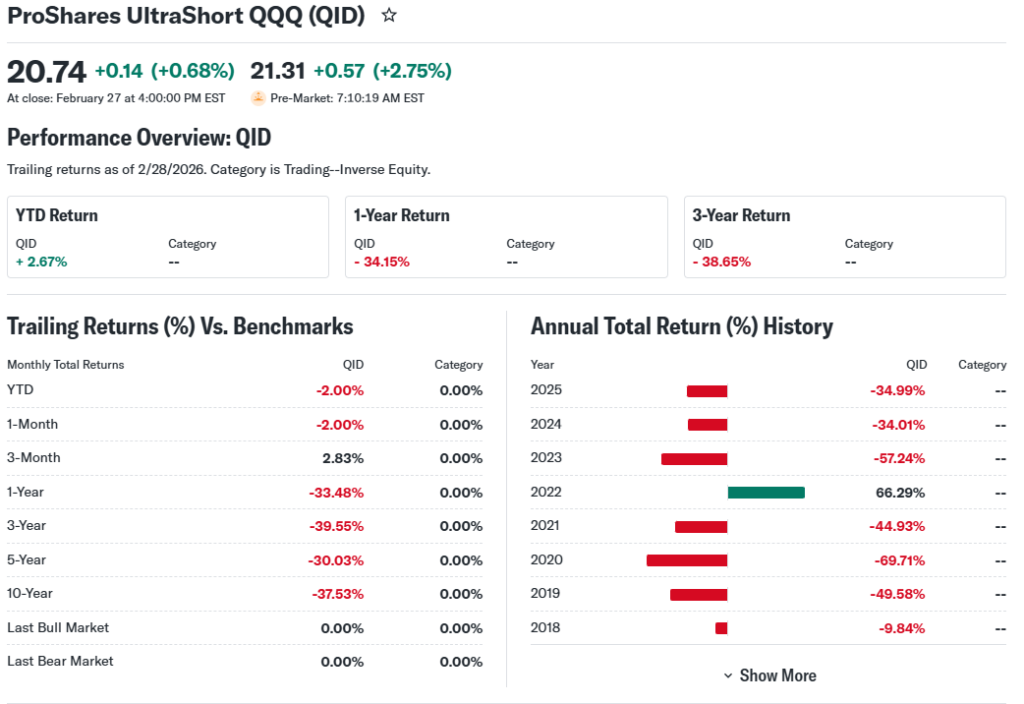
Compared to QQQ or SQQQ, QID offers tighter -2x leverage but similar decay risks in uptrends.
QID ETF appears fairly valued for its niche as a tactical hedge, not undervalued or overvalued like equities.
Recent Earnings & Catalysts
ETFs report no quarterly earnings; performance ties to Nasdaq daily moves.
No revenue or EPS beats—track record shows -34% 1-year return vs. Nasdaq’s gains. Guidance remains -2x inverse daily.
Catalysts include tech downturns from rate hikes or AI hype fades; recent Nasdaq strength hurt QID ETF.
This direct link drove recent declines, rewarding Nasdaq bulls.
Bullish Case
QID ETF shines if tech falters on overvaluation or recession signals.
Rising short interest in Nasdaq giants boosts demand. Market corrections favor 2x leverage gains.
Operational edge: low 0.95% fees aid short holds during volatility spikes.
Real growth comes from hedging portfolios in bear phases without selling longs.
Bearish Case
Prolonged Nasdaq rallies erode QID ETF via daily compounding losses.
Competition from SQQQ or direct shorts offers alternatives. Margin decay in sideways markets hurts.
Economic strength and AI demand pressure inverse plays. Regulatory swap rules add costs.
Market Sentiment & Investor Psychology
Short interest data focuses on underlyings, not QID directly.
Options show balanced calls/puts, mirroring Nasdaq bets. Institutional ownership steady at $277M AUM.
Retail leans tactical use amid tech optimism. Momentum favors Nasdaq longs over QID shorts.
Sentiment stays neutral—optimistic on tech, sidelining QID ETF.
Short-Term Outlook
Technicals like neutral RSI and MACD buy hint at bounces if Nasdaq dips.
Volume upticks on pullbacks could lift QID ETF price briefly. Momentum stays Nasdaq-driven.
Expect volatility; watch $20 support for near-term moves without guarantees.
Medium to Long-Term Outlook
QID ETF’s model suits days, not months, due to leverage decay.
Tech sector growth weakens inverses long-term. Competitive moat is narrow.
Financial health solid via ProShares, but risks dominate in bull markets.
Long-term investors should watch or avoid; hold only as hedges.
FAQ Section
Is QID ETF a buy right now?
No strong buy case amid Nasdaq strength; best for short-term hedges.
What is the QID ETF price target?
No consensus targets; tied to Nasdaq inverse daily.
What are major risks for QID ETF?
Compounding losses in uptrends, high volatility, daily reset decay.
QID ETF forecast?
Bearish if tech rises; bullish on corrections only.
QID technical analysis summary?
Neutral RSI, below MAs—watch support at $20.
Suggestions
Compare with SOXS ETF
See our QQQ ETF forecast
Read our Nasdaq inverse ETFs breakdown
Conclusion
Watch QID ETF for hedges, not buys. Strong Nasdaq trends limit upside, but volatility offers tactical plays. Balance risk with short holds only.
Disclaimer: This article is for informational purposes only and not financial advice.