
XLF Technical Analysis: Trend, Levels & Outlook March 2026
The Financial Select Sector SPDR Fund (XLF) is one of the most widely traded sector ETFs tracking the financial sector within the S&P 500. The fund includes major U.S. banks, insurance companies, asset managers, and diversified financial institutions, making it a key benchmark for traders monitoring the performance of the financial industry.
In March 2026, XLF has been drawing attention as investors assess the impact of interest rates, economic growth expectations, and banking sector developments. Financial stocks often respond strongly to changes in monetary policy because higher interest rates can influence bank profitability. This article examines XLF’s current price trend, key support and resistance levels, technical indicators, and the short-term outlook for March 2026.

Current Price Trend in March 2026
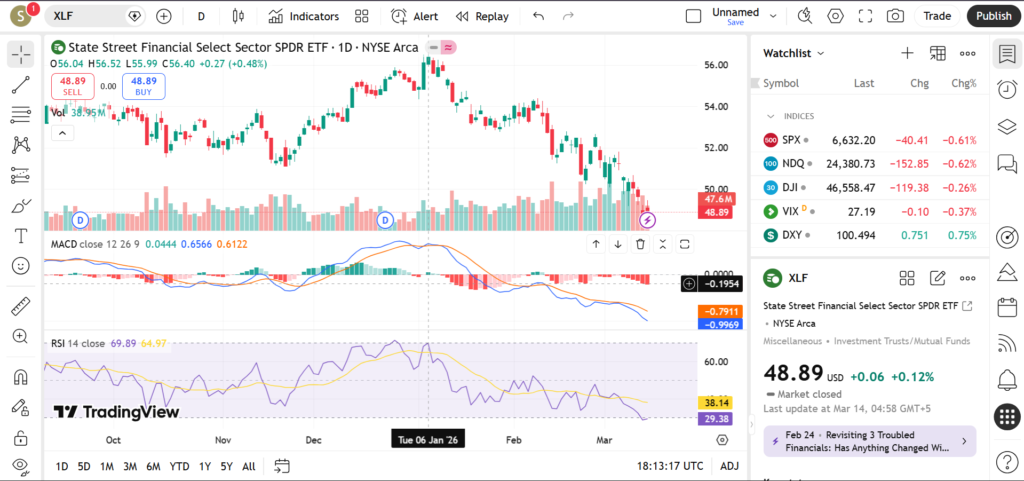
During March 2026, XLF has been trading in a moderate uptrend with occasional pullbacks, reflecting steady demand for financial stocks amid evolving economic conditions.
The 20-day moving average has been acting as a short-term trend indicator, with price generally staying close to this level during recent trading sessions. When an ETF consistently holds above this moving average, it often signals stable bullish momentum.
The 50-day moving average continues to act as an important medium-term support level. Pullbacks toward this average have historically attracted buyers during ongoing sector uptrends.
The 200-day moving average remains significantly below recent price levels, indicating that the long-term trend has been relatively strong compared with previous months.
Recent price action has shown higher lows forming after pullbacks, a common characteristic of strengthening market trends. However, the ETF has also encountered resistance near prior highs, suggesting that traders are cautious about pushing prices significantly higher without new catalysts.
Key Support and Resistance Levels
Important support levels for XLF include:
- Recent pullback low: A level where buyers recently stepped in during a correction.
- 50-day moving average area: A commonly watched support zone during uptrends.
- Prior breakout level: A level where the ETF previously moved sharply higher.
Key resistance levels include:

- Recent swing high: The highest level reached during the current rally.
- Previous consolidation ceiling: A level where price struggled to move higher.
- Psychological round-number resistance levels: Frequently monitored by traders.
A breakout above recent highs could suggest renewed strength in financial stocks. On the other hand, a move below the 50-day moving average might indicate a period of consolidation or sector rotation.
Indicators – RSI, MACD, Volume
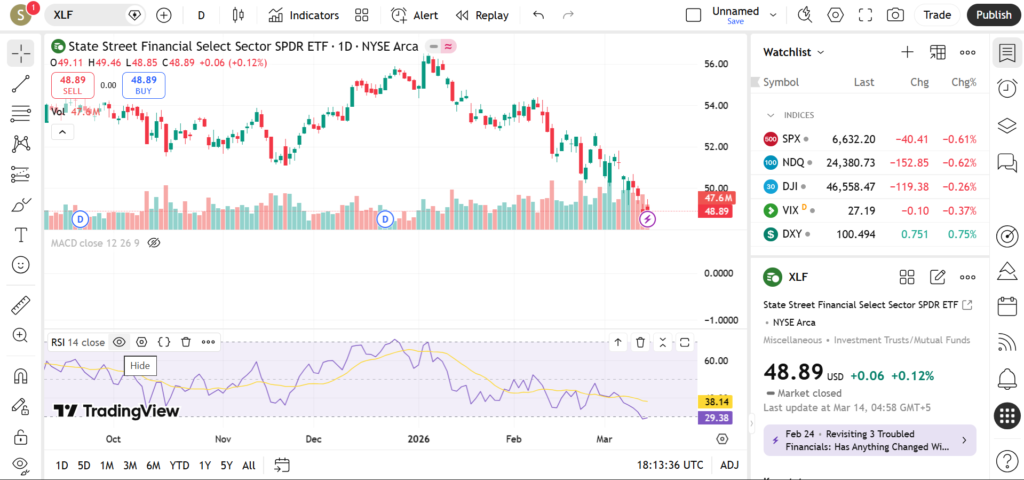
RSI currently appears near neutral-to-slightly bullish territory, indicating moderate upward momentum without reaching overbought levels.
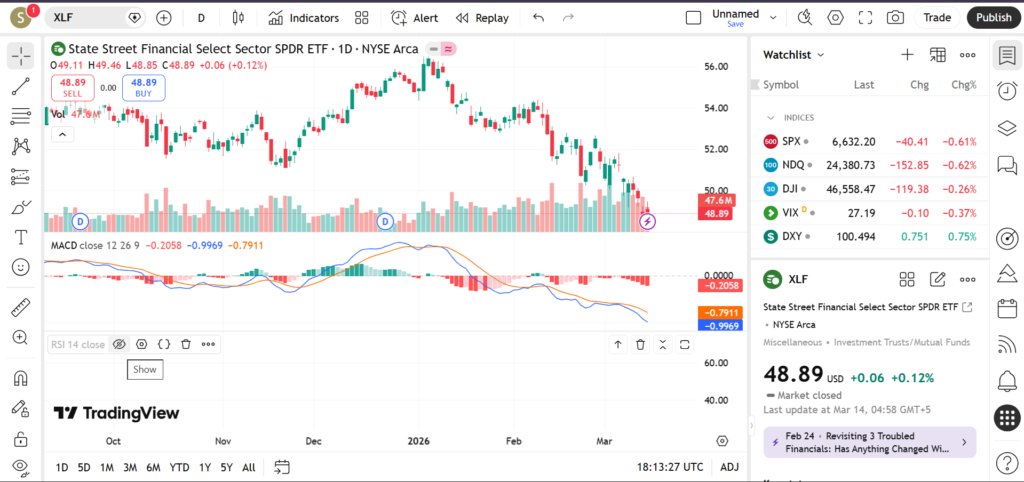
MACD signals have shown gradual positive momentum, with the MACD line remaining above the signal line during several recent sessions.

Volume patterns show relatively stable participation, with moderate increases during rallies and slightly lighter volume during pullbacks. This behavior can sometimes suggest that buyers remain active in the sector.
Short-Term Outlook for XLF in March 2026
The technical outlook for XLF in March 2026 appears constructive but cautious, with the ETF maintaining an upward structure while facing resistance near previous highs.
What traders are watching:
- Break above recent highs confirming continuation of the uptrend
- Reaction to interest rate announcements
- Earnings reports from major financial institutions
- Credit market conditions and lending activity
- Economic growth expectations influencing bank performance
Risks and Important Notes
Financial sector ETFs can be influenced by unexpected changes in interest-rate policy, economic conditions, or regulatory developments affecting banks and financial institutions.
Technical levels may fail during major macroeconomic announcements or sudden market shifts.
This article is provided for educational purposes only and should not be considered financial advice. Traders should always evaluate risk and consider broader market conditions before making decisions.
For more market insights, readers may also explore analysis of index ETFs, bond ETFs, and other sector funds to understand how different areas of the market interact.