

SLV stock analysis with price trend, earnings proxy, valuation, and forecast. Learn if iShares Silver Trust SLV stock is a buy now for silver exposure.
Introduction
SLV stock represents the iShares Silver Trust, an exchange-traded fund that holds physical silver bullion to track the price of silver. Instead of running a traditional business with revenue and profits, this vehicle simply gives investors direct exposure to silver prices in a single trade.
Investors are focused on SLV stock now because silver has shown sharp moves driven by inflation concerns, safe‑haven demand, and growing industrial use in solar, electronics, and electric vehicles. Recent volatility has taken SLV near multi‑year highs before a sizeable pullback, creating debate over whether this is the start of a longer bull market or a topping phase.
Broader markets are still reacting to shifting interest‑rate expectations and a stronger or weaker dollar, both of which heavily influence precious metals prices. When rates fall or the dollar softens, silver and SLV stock often benefit as investors seek diversification and inflation protection.
Latest Stock Price & Trend
As of the last available close, SLV stock was trading around the mid‑70s per share, with one recent quote near 75.9 dollars after a positive daily move. This price is well below the recent 52‑week high above 100 dollars but far above the 52‑week low in the mid‑20s, underlining how intense the rally in silver has been over the past year.
On a 1‑day basis, SLV stock price has shown strong intraday swings, with single‑session drops of more than 7–10 percent in early March followed by sharp rebounds. Over the last 5 days, the ETF has moved in a wide range as traders react to macro headlines and shifting expectations for silver demand, creating a choppy short‑term pattern.
Looking at the 1‑month and 3‑month picture, SLV stock remains significantly higher than it was earlier in the year, but it has already corrected meaningfully from its peak, suggesting that some speculative froth has come out of the market. Over 6 months and year‑to‑date, the trend is still clearly upward, with SLV vastly outperforming many traditional equity indexes as silver benefited from supply deficits and industrial demand.
With a 52‑week range roughly from the mid‑20s to above 100 dollars, current prices around the mid‑70s place SLV stock in the upper half of its range yet below recent extremes. Overall, the direction appears to be bullish on a medium‑term basis but tactically volatile and prone to pullbacks, which means investors should expect sharp swings even if the longer trend remains positive.
Technical Analysis
Technical analysis looks at the price chart and trading behavior of SLV stock rather than its fundamentals, because this ETF primarily mirrors silver prices. Support levels are price zones where buyers have recently stepped in, and for SLV these tend to form near recent pullback lows and psychological round numbers such as 70 or prior breakout levels.

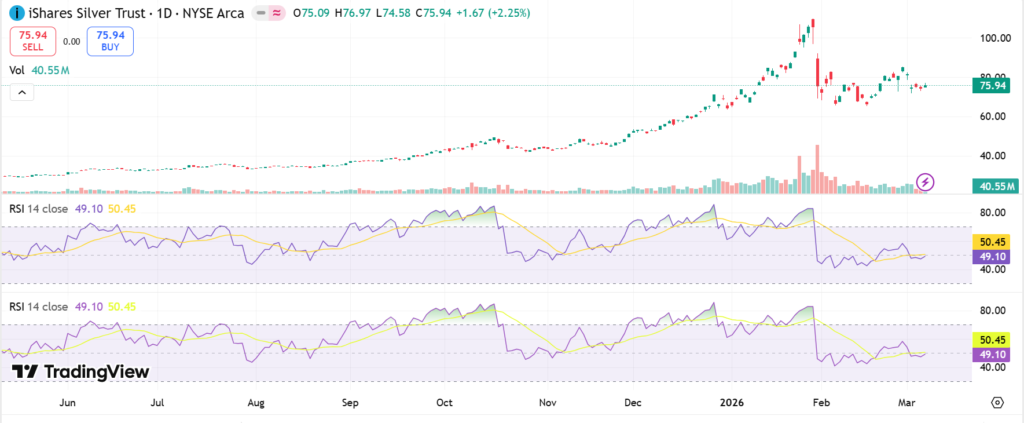
Resistance levels are zones where sellers previously took profits, and for SLV those include areas near the recent 52‑week high above 100 dollars and any failed rallies after the big correction. When SLV stock price approaches resistance, traders often become cautious, while breaks above resistance can signal renewed upside momentum.
The Relative Strength Index (RSI) measures whether a security is overbought or oversold on a scale from 0 to 100, with readings above 70 often viewed as stretched to the upside and below 30 as oversold. A powerful run in SLV likely pushed RSI into overbought territory around the peak, followed by a reset as prices corrected, which helps shake out weaker hands.
The Moving Average Convergence Divergence (MACD) indicator compares short‑term and long‑term moving averages to show trend strength and direction. A bullish MACD occurs when the shorter average moves above the longer one, while a bearish MACD shows the opposite, and recent volatility in SLV suggests the indicator may be rolling over from a strong bullish phase toward a more cautious stance.
Many analysts also watch the 50‑day and 200‑day moving averages to judge the core trend. When the 50‑day moves above the 200‑day, it forms what traders call a golden cross, usually seen as a bullish sign, and SLV’s longer‑term surge suggests it has been trading above these key averages. Trading volume has been heavy during both rallies and sell‑offs, showing strong interest from institutions and retail traders, which can amplify price swings but also confirms that the move is driven by real capital flows.
Analyst Ratings & Price Target
Because SLV is an ETF tracking silver rather than a traditional operating company, coverage by large Wall Street equity analysts is more limited than for big technology or industrial stocks. Instead, many analysts publish views on silver itself and on commodity ETFs broadly, which indirectly influence sentiment toward SLV stock.
Where ratings do exist, they usually lean on whether silver is attractive at current levels and on the role of precious metals in diversified portfolios. Commentary from banks and research firms has recently highlighted both positive long‑term drivers like industrial demand and supply deficits, and near‑term risks from a strong dollar or higher real yields, leading to a mix of Buy and Hold stances rather than clear consensus.
Some institutional outlooks project that silver prices could move notably higher over the longer term if structural deficits persist, while more cautious models warn of deep downside if sentiment turns. Instead of a single average price target for SLV stock, investors often rely on silver price forecasts and convert them into potential ETF levels, using current holdings and expense ratios as a guide.
For everyday investors, this means analyst sentiment on SLV is best interpreted as a reflection of broader views on silver and macro conditions rather than detailed company‑specific research.
Insider Activity
SLV stock is a trust structure holding physical silver, so it does not have corporate insiders in the traditional sense of executives receiving stock grants and selling shares. There are therefore no classic insider buying or selling filings like you would see with a regular operating business.
However, large institutional holders, such as major banks or trading firms, regularly adjust their positions in SLV based on their commodity outlook and risk management. Public disclosures and commentary have highlighted active positioning by hedge funds and trading desks, with some “buying the dip” after big selloffs and others trimming exposure after sharp rallies.
For investors, this pattern suggests professional players are treating SLV as a tactical tool rather than a simple buy‑and‑forget holding, and their activity can significantly influence short‑term price action.
Valuation Analysis
Traditional valuation metrics like trailing price‑to‑earnings or forward price‑to‑earnings ratios do not apply directly to SLV, because the trust does not generate earnings in the same way a company like Microsoft or Zoom does. There is no revenue line, no operating margin, and no free cash flow in the classic corporate sense; instead, the value of SLV stock reflects the underlying silver holdings minus fees.

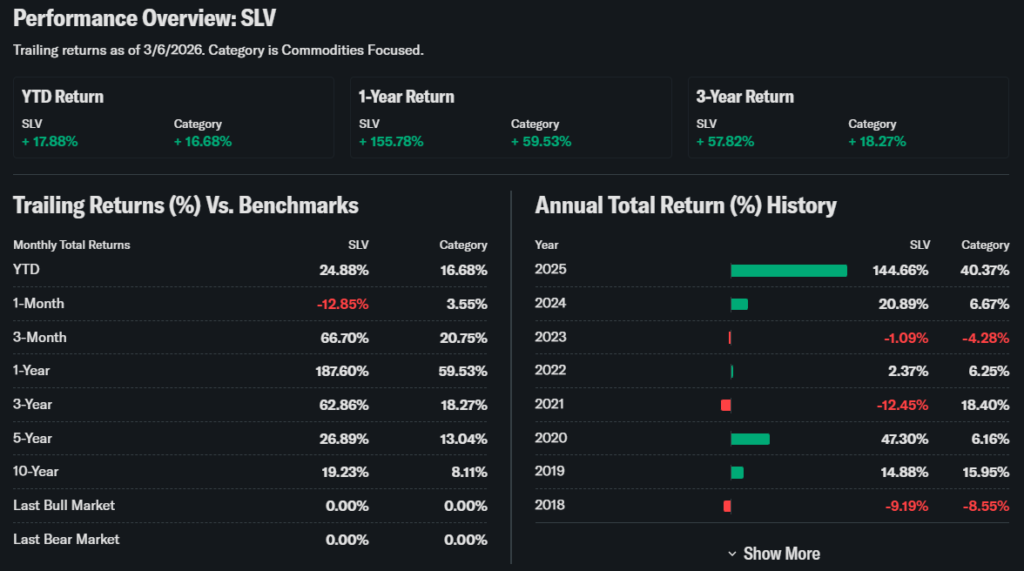
Investors therefore think of SLV’s “valuation” relative to the spot price of silver, the cost of holding physical bullion, and alternative vehicles such as silver mining stocks, futures, or other ETFs. The trust charges a modest annual fee, which slightly drags performance versus spot silver over long periods, but offers liquidity and ease of trading that physical metal cannot match.
Compared with miners, SLV avoids operational risks like cost overruns, mine disruptions, or hedging losses, but it also lacks leverage to rising prices that a well‑run miner might provide. Against broad tech names such as Microsoft or communication tools like Zoom, SLV behaves more like a commodity asset class than a growth stock, making direct valuation comparisons less meaningful.
Given its structure, SLV stock appears fairly valued when it closely tracks the net asset value of its silver holdings, with small discounts or premiums arising from market conditions. Whether it is attractive now depends mainly on an investor’s view of silver’s future price path, interest rates, and inflation dynamics rather than on conventional multiples.
Recent Earnings & Catalysts
Because SLV is a trust, it does not report quarterly earnings in the way an operating company does, and there is no EPS to compare with analyst forecasts. Instead, the key “results” are periodic updates on silver holdings, flows into or out of the ETF, and changes in net asset value as silver prices move.
Major catalysts for SLV stock in recent months have included surging industrial demand for silver, increasing use in solar panels and EVs, and ongoing talk of supply deficits that have persisted for several years. Macro events such as shifting expectations for central bank policy, moves in the U.S. dollar, and geopolitical tensions have also driven safe‑haven buying, lifting both silver and SLV.
These forces helped push SLV to new highs before volatility spiked and profit‑taking triggered a sharp correction, which in turn drew fresh attention from traders looking for both momentum and mean‑reversion opportunities. Short‑term price reactions after these catalysts have been dramatic, underscoring the need for position sizing and risk management.
Bullish Case
A constructive case for SLV stock centers on sustained strength in silver demand and constrained supply. Industrial uses in solar power, electronics, and electric vehicles continue to expand, while mine output has not kept pace, creating the possibility of ongoing structural deficits.
If inflation remains a concern or if central banks move toward more accommodative policies, investors may increasingly view silver as a hedge alongside gold, supporting higher prices. Strong institutional interest and high liquidity make SLV an efficient way for large pools of capital to gain exposure, which can magnify moves when sentiment turns positive.
From a portfolio perspective, moderate allocations to SLV can diversify equity‑heavy holdings and potentially improve risk‑adjusted returns during periods of market stress.
Bearish Case
On the downside, SLV stock faces the classic risks of any commodity‑linked asset: it can be extremely volatile, and sharp corrections can occur with little warning. If interest rates stay higher for longer or the dollar strengthens, precious metals often struggle as investors favor yield‑bearing assets instead.
Competition also comes from other vehicles like futures, leveraged products, and alternative precious metals ETFs, which can divert flows away from SLV. A slowdown in global manufacturing or renewable energy investment could reduce industrial demand for silver, undermining some of the bullish growth narrative.
Because SLV lacks underlying earnings or dividends, there is no cash‑flow support to cushion drawdowns, and declines can overshoot fair value on the downside during risk‑off episodes.
Market Sentiment & Investor Psychology
Recent market sentiment around SLV stock has been highly emotional, swinging from euphoria near the highs to fear after rapid sell‑offs. Short‑term traders and algorithmic strategies have added to volatility, reacting quickly to technical levels and macro headlines.
Short interest and options activity, including aggressive call and put buying, indicate that both bulls and bears are actively trading SLV for tactical gains. Institutional ownership appears significant, with large funds using the ETF as a core precious‑metals tool, while retail investors often chase momentum or hedge portfolios.
Overall, sentiment at current levels can be described as cautiously optimistic but fragile, with momentum‑oriented traders still active and long‑term holders focused on the broader silver cycle rather than day‑to‑day moves.
Short-Term Outlook
In the near term, the path for SLV stock will likely be dominated by technical factors, macro data releases, and shifts in risk appetite. After a large rally and subsequent correction, markets often enter a consolidation phase where prices move sideways within a range as buyers and sellers battle for control.
Given the recent wide daily swings and heavy trading volume, investors should be prepared for further volatility, including quick rallies that test resistance and pullbacks toward support. Short‑term traders may find opportunities using support and resistance, RSI, and moving averages, while long‑term investors might choose to scale in gradually rather than commit capital all at once.
Medium to Long-Term Outlook
Over a 6‑ to 24‑month horizon, the outlook for SLV stock hinges on silver’s role in the global economy and financial system. If industrial demand from sectors like solar energy and EVs continues to expand while mine supply remains constrained, silver prices could stay elevated or move higher, supporting SLV.
The trust’s business model is simple and robust, with physical backing and no operating business risk, making it a straightforward way to express a view on silver. However, competition from other metals, changes in technology, or a sustained shift toward higher real interest rates could reduce precious‑metals appeal.
For long‑term investors who believe in the structural case for silver, SLV stock can be considered a hold or gradual accumulate, but position sizes should reflect personal risk tolerance and the understanding that drawdowns can be large.
FAQ Section
Is SLV stock a buy right now?
SLV stock may be attractive for investors who are bullish on silver and comfortable with commodity‑style volatility, but conservative investors may prefer to wait for clearer technical support or smaller position sizes.
What is the price target for SLV stock?
There is no single consensus SLV stock price target, so investors typically translate silver price forecasts into potential ETF levels based on current holdings and fees.
What are major risks for SLV stock?
Key risks include sharp price swings, a stronger U.S. dollar, higher real interest rates, weaker industrial demand, and the absence of earnings or dividends to support valuation.
Is SLV stock good for long‑term investing?
SLV can play a role in long‑term portfolios as a precious‑metals allocation, but its suitability depends on an investor’s view of silver, tolerance for volatility, and need for income.
How does SLV compare with silver mining stocks?
SLV provides direct exposure to silver prices without company‑specific risks, while miners can offer leverage to silver but add operational and balance‑sheet uncertainty.
Suggestions
You could internally link to related content such as:
- “Compare with Opendoor” stock analysis.
- “See our Microsoft stock forecast” for investors balancing defensive large caps and metals exposure.
- “Read our tech sector valuation breakdown” to help readers understand how SLV fits alongside high‑valuation growth names.
Conclusion
SLV stock offers a clean, liquid way to gain exposure to silver’s dual role as an industrial metal and a store of value. Recent price action has been strong but volatile, reflecting both powerful long‑term drivers and meaningful short‑term risks.
Given these factors, a balanced view is that SLV is best suited as a hold or selective accumulate for diversified portfolios that can tolerate swings, rather than a high‑conviction all‑in position at current levels. Investors should align any SLV allocation with their time horizon, risk tolerance, and overall asset mix.
Disclaimer: This article is for informational purposes only and not financial advice.