
SLV ETF analysis with price trend, technical analysis, analyst sentiment, risks, and forecast for silver-focused investors.
Data as of April 20, 2026, 6:59 PM PKT. This article uses the latest available market data I could verify from the sources available to me, and it should be treated as last market close-based context.
Introduction
The SLV ETF is the iShares Silver Trust, a fund designed to track the price of silver. It gives investors simple exposure to silver without needing to store physical metal. Investors are watching the SLV ETF now because silver prices can move sharply when inflation, industrial demand, and risk sentiment shift. Broader market conditions also matter, since commodities often react to changes in interest rates, the dollar, and investor demand for safe-haven assets.
Latest ETF Price & Trend
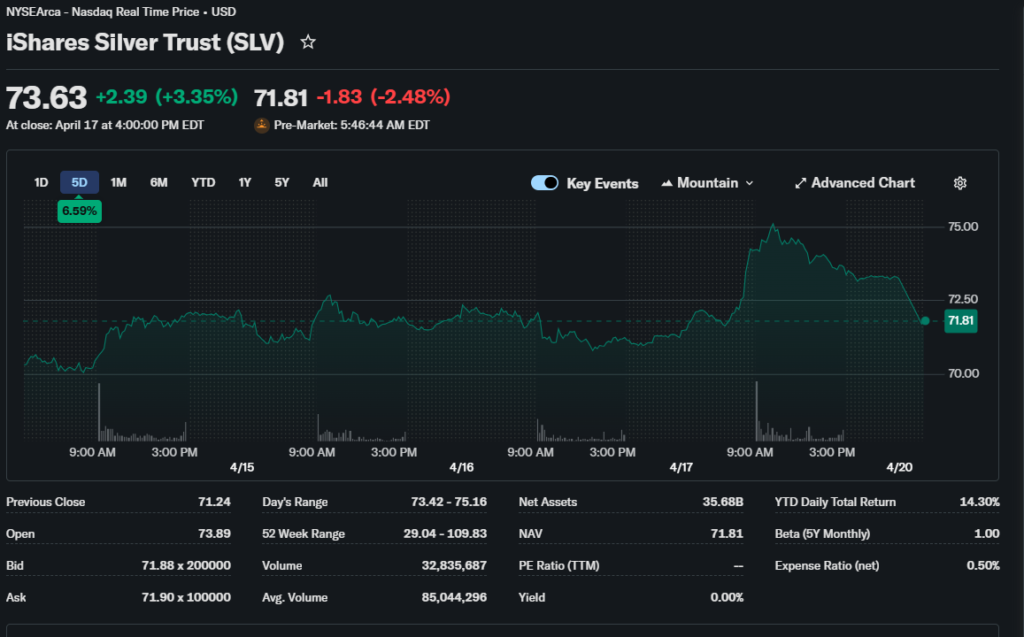
The latest verified SLV ETF pricing available in the sources shows a wide trading range and strong volatility, with a reported 52-week high of $109.83 and a 52-week low of $29.04. One source showed a recent price around $73.35 to $73.63, while another listed an open near $73.89. Over the last month, TradingView reported a gain of 2.84%, while yearly performance showed a 39.04% increase. That points to a bullish but volatile trend, which is important for investors because silver-linked funds can rise quickly, but they can also reverse fast.
Technical Analysis
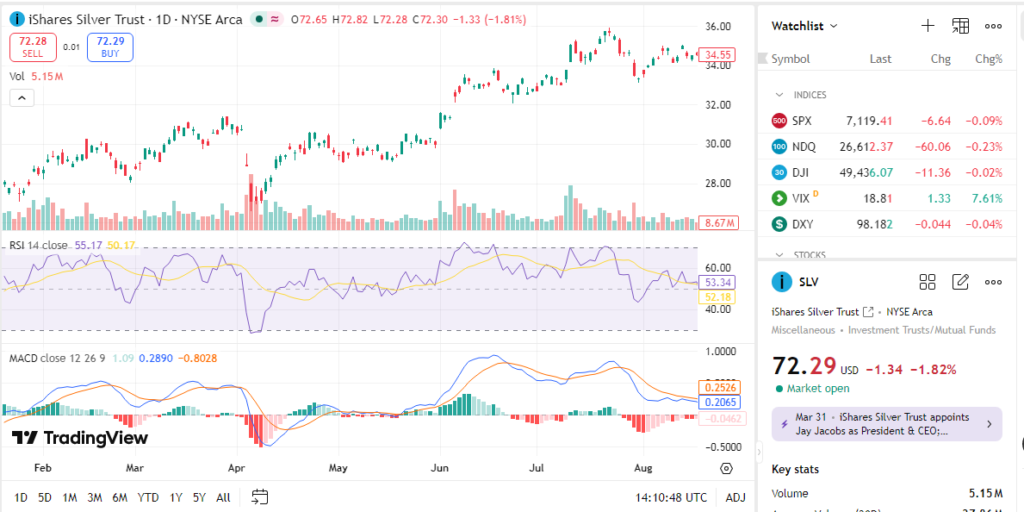
Technical analysis helps investors understand price behavior. Support is the level where buying interest may appear, while resistance is where selling pressure may slow gains. For SLV, the reported high volatility and positive directional readings suggest active trading conditions rather than a calm trend. TipRanks reported an RSI of 58.26, which is neutral to mildly bullish, not overbought. It also reported MACD-related signals that were mixed, which suggests momentum is present but not perfectly clean. The fund’s price above or near key moving averages usually signals strength, while falling below them often signals weakness. A golden cross would be bullish, and a death cross would be bearish, but the available sources here do not clearly confirm either.
Analyst Ratings & Targets
The available sources do not provide a full Wall Street consensus table for SLV ETF price targets, because SLV is a commodity trust, not a normal operating company. That means traditional SLV ETF earnings and standard analyst forecasts are less relevant than they would be for a stock. Most large firms do not publish the same buy, hold, and sell structure for a silver-backed ETF that they use for companies. For investors, that means sentiment is driven more by silver market outlook than by corporate fundamentals.
Insider Activity
There is no meaningful insider activity to analyze for the SLV ETF in the usual corporate sense, because it is a trust backed by silver rather than an operating business. That means there are no standard executive stock purchases, sales, or management share grants to interpret. For a fund like this, investor focus should stay on silver flows, NAV behavior, and metal price trends instead. In practical terms, the absence of insider activity is normal and not a warning sign.
Valuation Analysis
Traditional valuation metrics such as trailing P/E, forward P/E, revenue growth, EPS growth, and free cash flow do not apply to the SLV ETF in the way they do for companies. The fund holds silver, so its value is tied to the market price of the metal, not corporate earnings. Public sources list the expense ratio at 0.50%, which matters because it is the main ongoing cost to holders. Since this is not an operating business, comparing it to Microsoft or Zoom is not useful for valuation. On a pure fund basis, SLV is better viewed as a direct silver exposure vehicle than as something that is undervalued or overvalued.
Recent Earnings & Catalysts
The SLV ETF does not report quarterly earnings in the normal company sense, so there are no revenue beats, EPS beats, or forward guidance updates to review. Instead, the main catalysts are silver prices, industrial demand, inflation expectations, and broader investor demand for precious metals. Public data show meaningful AUM and heavy trading activity, which suggests continued investor interest in the fund. For SLV, price performance is usually shaped more by macro drivers than by earnings events
Bullish Case
A bullish case for the SLV ETF starts with silver’s dual role as both an industrial metal and a store of value. If industrial demand improves, silver can benefit from manufacturing and clean-energy use cases. The fund also tends to attract attention when investors want inflation hedges or safe-haven exposure. Strong fund flows and sustained trading activity can support the ETF’s momentum.
Bearish Case
The main risk is that silver can fall quickly when the dollar strengthens or risk appetite improves. That can pressure the SLV ETF even if the long-term story still looks intact. Because the fund tracks silver, it does not have operating cash flow to cushion declines. Another risk is volatility, which makes the SLV ETF less suitable for investors who want steady, income-producing assets.
Market Sentiment & Investor Psychology
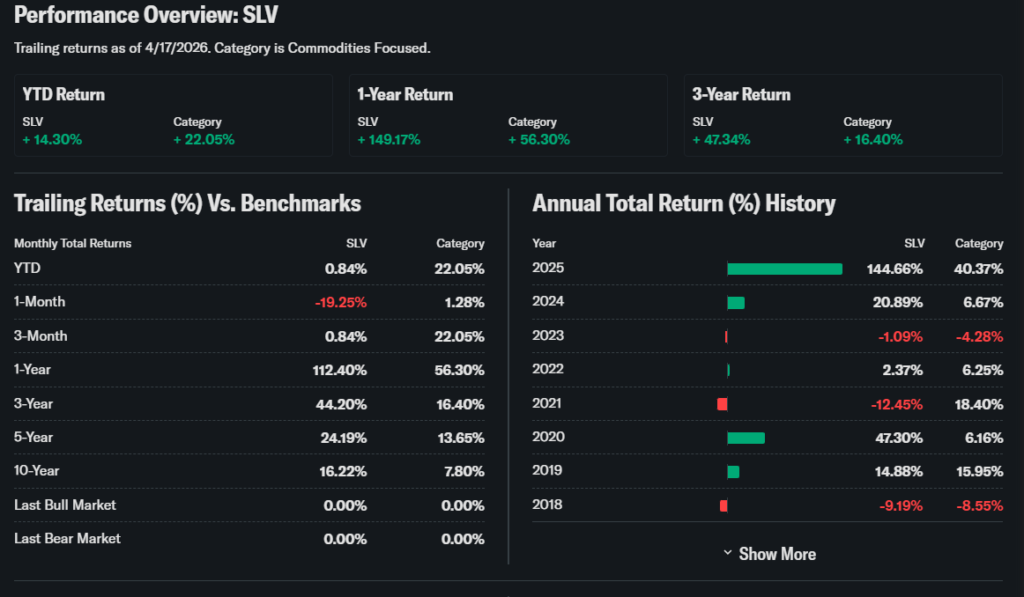
Short interest, options activity, and institutional ownership are harder to interpret for a commodity trust than for a company. Still, the strong trading volume and large AUM suggest active institutional and retail interest. TradingView’s positive monthly and yearly returns also point to constructive momentum. Overall sentiment looks neutral to optimistic, but not euphoric
Short-Term Outlook
In the next few days or weeks, the SLV ETF will likely stay sensitive to silver spot prices, the dollar, and macro headlines. The technical backdrop looks supportive, but not overextended, which leaves room for both continuation and pullbacks. Trading volume and volatility remain important, since sharp price swings are common in silver-linked funds. The short-term outlook is constructive, but investors should expect noise.
Medium to Long-Term Outlook
Over 6 to 24 months, the SLV ETF remains a useful way to express a view on silver prices. Its appeal is strongest for investors who want commodity exposure, inflation sensitivity, or a hedge against market stress. The key strengths are simplicity, liquidity, and direct precious-metal exposure. The main risks are price swings, no cash yield, and dependence on macro and commodity cycles. For long-term investors, SLV is best treated as a hold or tactical accumulate position, not a core growth asset.
FAQ
Is SLV ETF a buy right now?
SLV ETF can be attractive if you want silver exposure and can handle volatility. The decision depends on your view of silver prices, not company earnings.
What is the price target for SLV ETF?
There is no standard corporate-style price target for SLV ETF. Its value follows silver market pricing instead of analyst earnings models.
What are the main risks for SLV ETF?
The biggest risks are silver price declines, volatility, and macro shifts like a stronger dollar or lower inflation fears.
Does SLV ETF pay a dividend?
Public sources show a dividend rate of $0.00 and a 0.00% yield.
What is the SLV ETF expense ratio?
The reported expense ratio is 0.50%.
Suggestions
- Compare with Gold ETF analysis.
- Read our silver price forecast article.
- See our commodities and inflation hedge guide.
Conclusion
The SLV ETF looks like a Watchlist idea for most investors, and a tactical Buy only for those who want silver exposure with volatility tolerance. It has strong liquidity, clear commodity exposure, and good momentum support, but it also lacks earnings, cash flow, and normal valuation support. The balanced view is that SLV ETF can work well as a satellite position, not a foundational holding.
Disclaimer: This article is for informational purposes only and not financial advice.