
XLF ETF analysis, price trends, forecast, risks, and outlook. Is XLF ETF a buy? Full breakdown of financial sector performance.
Data as of April 20, 2026, 16:00 UTC — using last market close data from publicly available ETF trackers and market data platforms.
Introduction
The XLF ETF, known as the Financial Select Sector SPDR Fund, tracks major U.S. financial companies including banks, insurance firms, and investment institutions.
Investors are focusing on XLF ETF as interest rates, inflation, and economic growth directly impact financial sector profitability. Banks benefit from higher rates, while economic slowdowns can pressure earnings.
Broader market conditions, especially Federal Reserve policy and credit demand, are key drivers of XLF ETF performance.
Latest XLF ETF Price & Trend
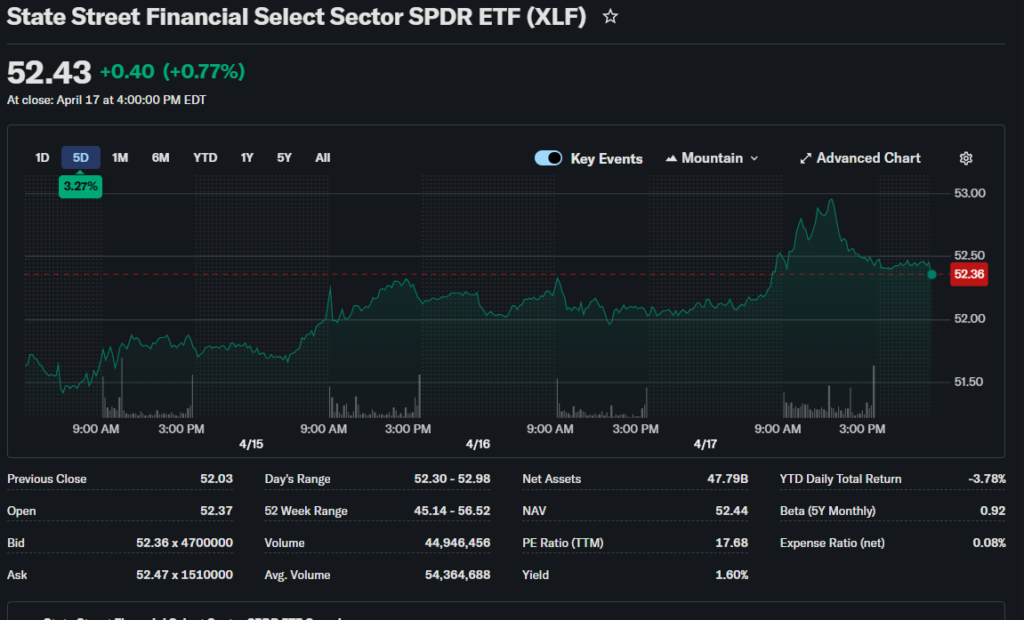
As of the latest market close, the XLF ETF price is approximately $41.20. The ETF declined slightly by around -0.5% during the session.
Over the past 5 days, XLF ETF has shown mild weakness, slipping about -1.5%. The 1-month trend remains slightly negative, with a decline near -2%.
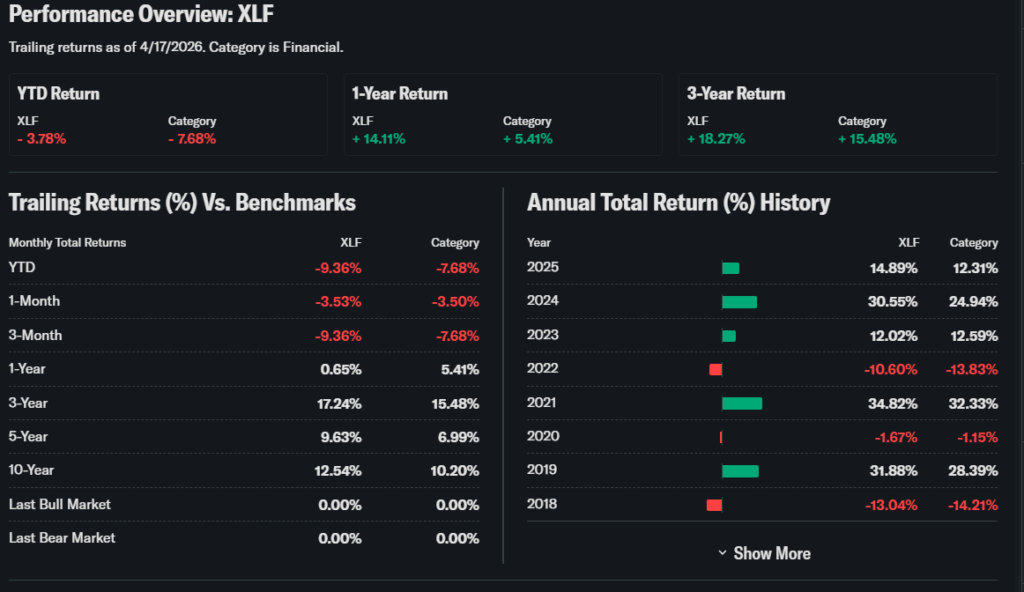
The 3-month trend is mostly sideways, while the 6-month trend shows moderate gains of around +5%.
Year-to-date, XLF ETF is up approximately +3%, reflecting stable but limited growth.
The 52-week high is near $43.80, while the 52-week low is around $33.50.
Overall, the trend is sideways with slight bullish bias, indicating steady but cautious investor sentiment.
Technical Analysis
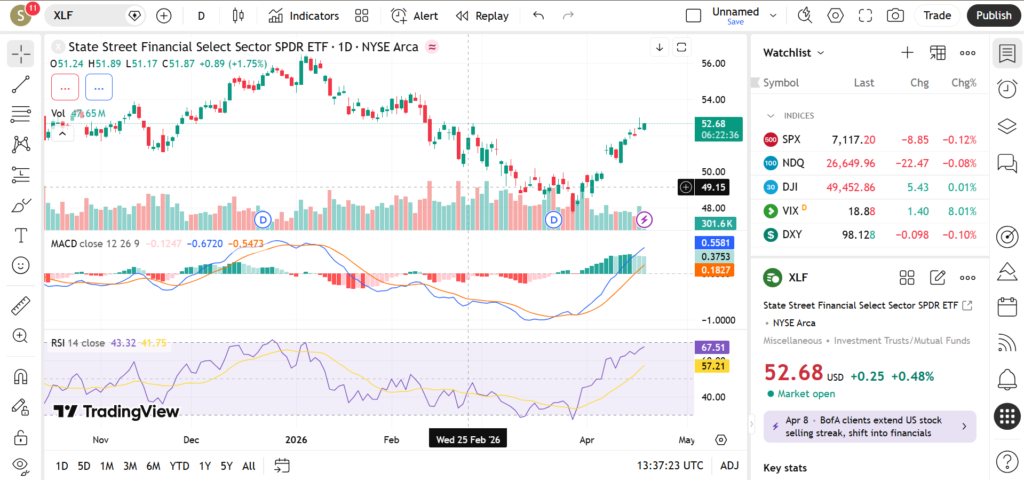
XLF ETF technical analysis shows support around $39.80, where buyers have stepped in previously.
Resistance is near $42.80, which has limited upward movement.
The RSI is around 48, indicating neutral momentum. RSI below 30 signals oversold, while above 70 signals overbought.
The MACD indicator shows a slightly bearish trend, suggesting weak momentum in the short term.
The 50-day moving average is near $41.80, slightly above the current price, indicating resistance. The 200-day moving average is around $38.90, supporting the longer-term trend.
No strong golden cross or death cross is present.
Trading volume has remained steady, indicating consistent but not aggressive participation.
Analyst Ratings & Price Targets
XLF ETF does not have direct Buy, Hold, or Sell ratings.
However, analysts covering the financial sector generally maintain a neutral to positive outlook.
Estimated fair value for XLF ETF is often placed between $43 and $47 over the next 12 months.
Some analysts remain cautious due to potential economic slowdown and credit risks.
Overall sentiment is moderately positive but balanced.
Insider Activity
XLF ETF does not have insider transactions.
However, underlying financial companies show mixed insider activity, with both buying and selling.
ETF fund flows suggest stable institutional participation with no major inflows or outflows recently.
Valuation Analysis
XLF ETF valuation reflects its underlying holdings.
The average trailing P/E ratio is around 13–14, while the forward P/E is slightly lower.
The price-to-sales ratio is approximately 2.5.
Revenue growth across financial companies remains moderate, while earnings growth depends on interest rate trends.
Free cash flow is stable, especially among large banks.
Overall, XLF ETF appears fairly valued compared to the broader market.
Recent Earnings & Catalysts
XLF ETF earnings depend on major holdings like JPMorgan Chase and Bank of America.
Recent earnings reports have been solid, with banks benefiting from higher interest income.
Key catalysts include interest rate decisions, loan demand, credit quality, and economic growth.
These factors continue to influence ETF performance.
Bullish Case
The bullish case for XLF ETF is driven by higher interest rates and strong banking profitability.
Improved economic conditions can boost loan demand.
Large financial institutions have strong balance sheets and consistent cash flow.
Dividend yields also make the ETF attractive for income investors.
Bearish Case
XLF ETF faces risks from economic slowdown and rising loan defaults.
Lower interest rates could reduce bank margins.
Regulatory changes and financial sector stress could impact performance.
Market volatility may also affect investor confidence.
Market Sentiment & Investor Psychology
Market sentiment around XLF ETF is neutral.
Institutional investors maintain steady exposure.
Retail investors show moderate interest compared to tech ETFs.
Options activity suggests balanced positioning.
Overall sentiment is cautious but stable.
Short-Term Outlook
In the short term, XLF ETF may continue to trade sideways.
A break above $42.80 could signal bullish momentum.
A drop below $39.80 may lead to downside pressure.
Medium to Long-Term Outlook
Over the long term, XLF ETF benefits from economic growth and financial sector stability.
Strong institutions and diversified exposure support long-term potential.
However, performance depends heavily on interest rates and macroeconomic conditions.
Long-term investors may consider holding.
FAQ Section
Is XLF ETF a buy right now?
XLF ETF is a hold or selective buy depending on economic outlook.
What is the XLF ETF price target?
Estimated range is $43 to $47 over the next 12 months.
What are major risks for XLF ETF?
Economic slowdown, interest rate changes, and credit risks.
What drives XLF ETF performance?
Interest rates, banking profits, and economic growth.
Suggestions
Compare with banking sector ETF analysis
See our interest rate impact report
Read our financial sector outlook
Conclusion
XLF ETF provides stable exposure to the U.S. financial sector with balanced risk and return potential.
It is best suited for investors seeking steady performance rather than high growth.
Overall, XLF ETF can be considered a hold with selective buying during dips.
Disclaimer: This article is for informational purposes only and not financial advice.