

XLU etf offers diversified exposure to U.S. utilities with defensive income potential. This detailed XLU etf analysis covers price trend, valuation, earnings, and forecast for long‑term investors.
Introduction
The XLU etf, formally the Utilities Select Sector SPDR Fund, gives investors a simple way to own a basket of large U.S. utility companies in one trade. These holdings typically include regulated electric, gas, and multi-utility names known for steady cash flows and dividends.
Investors are paying close attention to the XLU etf now because utilities have rebounded as interest-rate expectations have stabilized and income-oriented assets are back in favor. At the same time, the broader U.S. equity market remains concentrated in growth and tech stocks, pushing some investors to seek diversification through defensive sectors like utilities.
Latest XLU ETF Price & Trend
At the close on March 2, 2026, the XLU etf price was about 47.37 dollars, with an intraday range between roughly 47.35 and 47.74 dollars. This represented a daily decline of around 0.75 percent, following a prior session where the fund had risen about 1.17 percent. Over the last 5 trading days, XLU has traded mostly between the mid-46 and high-47 dollar area, showing modest short-term volatility but staying near recent highs.

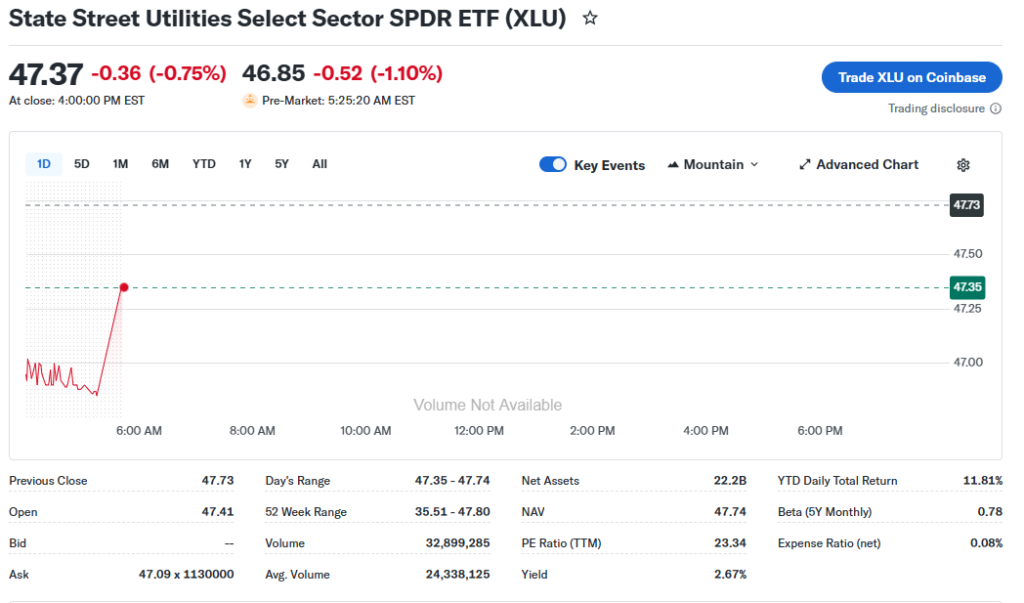
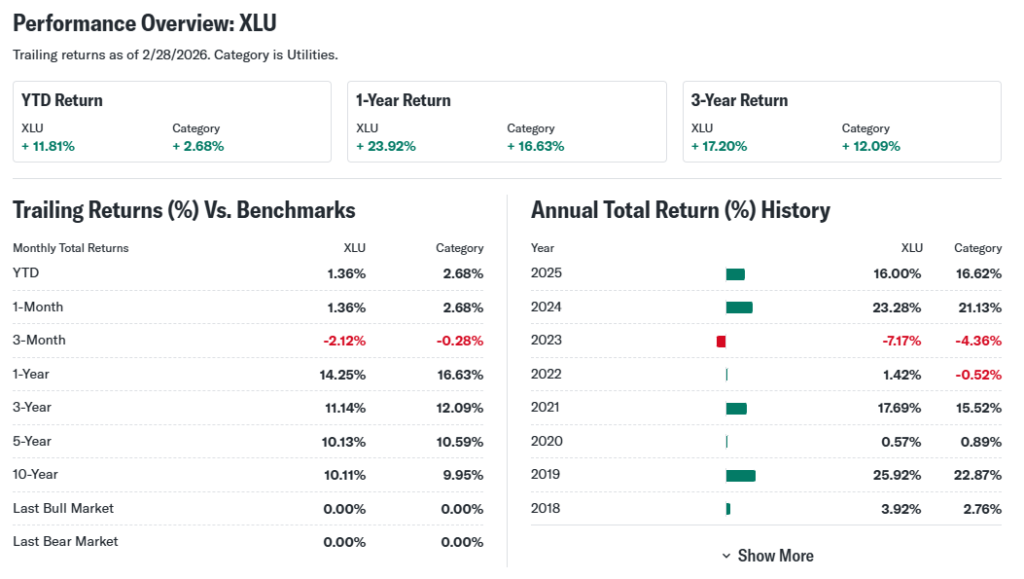
On a 1‑month basis, XLU has gained roughly 11 percent from a low near 42.66 dollars to a recent high around 47.80 dollars, reflecting a strong rebound in utilities. Over 3 months, the fund is up about 13–14 percent from a low near 41.74 dollars, and over 6 months it has climbed roughly 15 percent from around 41.15 dollars. Year-to-date, the XLU etf has returned about 11.8 percent, while the 1‑year return is close to 24 percent, outpacing many other defensive sectors.
The 52‑week low for XLU is around 35.51 dollars, while the 52‑week high is near 47.80 dollars, putting the current XLU etf price close to the upper end of its range. This pattern points to a clearly bullish trend rather than a sideways consolidation. For long‑term investors, the move off the lows with higher highs suggests that utilities are re-rating upward as earnings and yield stability gain renewed attention.
Technical Analysis
Support and resistance levels help investors understand where the XLU etf price may find buying or selling pressure. Based on recent trading, a key support zone sits around 46 dollars, where buyers previously stepped in during pullbacks, while resistance appears near the recent high in the 47.80 dollar area. Support acts like a floor where demand tends to increase, while resistance acts like a ceiling where supply often grows.

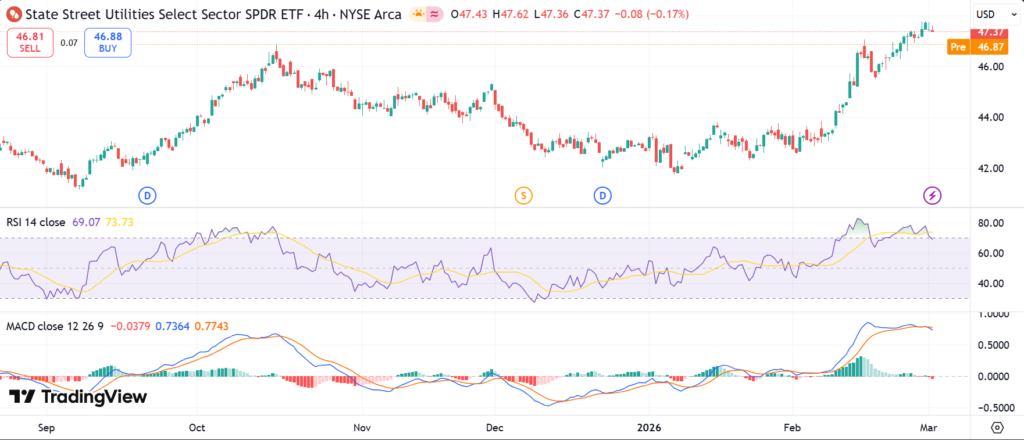
The Relative Strength Index (RSI) measures whether an asset is overbought or oversold on a 0–100 scale. Around current levels, XLU’s RSI has moved into higher territory consistent with a strong rally, which often indicates a mildly overbought but still constructive setup rather than deep oversold conditions. The Moving Average Convergence Divergence (MACD), which tracks trend momentum, has shifted to a bullish configuration as the short-term moving average has crossed above the longer-term line, signaling improving upward momentum.
The 50‑day moving average for XLU now sits below the current price, and the 200‑day moving average is also trending upward underneath the market. When the 50‑day average is above the 200‑day, technicians call this a “golden cross,” which often supports a bullish, medium-term trend. Trading volume has remained healthy, with recent sessions around 30–40 million shares, suggesting that the advance is supported by steady participation rather than thin liquidity. For beginners, these indicators collectively imply that the XLU etf technical analysis currently leans positive, though near-term pullbacks from overbought levels are always possible.
Analyst Ratings & Price Targets
Because XLU is an exchange-traded fund rather than a single company, most formal ratings and price targets from Wall Street are issued on the underlying utilities or on the broader sector rather than directly on the fund. Still, major firms periodically give views on the utilities sector and on the XLU etf as a proxy. Several research notes in late 2025 and early 2026 have described utilities as attractively valued relative to the S&P 500 after underperformance in earlier years.
Sector-oriented strategists at large banks have shifted from underweight to more neutral or modestly overweight on utilities, highlighting improving earnings visibility and stabilizing rate expectations. In this context, the effective “analyst sentiment” for the XLU etf is closer to a cautious buy or overweight on a sector basis rather than a high-conviction growth call. Since the fund tracks an index, price targets are typically expressed as sector fair-value ranges rather than a single fund-specific target, and those ranges currently imply moderate upside from recent levels rather than dramatic appreciation.
Insider Activity
Traditional “insider buying” and “insider selling” refer to company executives and directors trading their own firm’s stock reported through SEC filings. Because XLU is an ETF, it does not have corporate insiders in the usual sense, so there is no direct insider activity on the fund itself. Instead, investors can look at capital allocation and share transactions within the underlying utility companies for signals of management confidence.
Recent sector commentary notes that many regulated utilities continue to invest heavily in grid modernization, renewable generation, and infrastructure, reflecting long-term capital commitments rather than aggressive equity selling by management teams. There have not been broad headlines of large, coordinated insider selling waves in top holdings of the XLU etf, which would otherwise suggest caution. Overall, the absence of worrying insider trends in the sector supports a neutral-to-slightly positive interpretation of management confidence, though it remains an indirect measure for ETF investors.
Valuation Analysis
Valuation for the XLU etf is best assessed through the aggregate fundamentals of its underlying utilities. As of early 2026, utilities trade at a price-to-earnings multiple below the broader S&P 500, reflecting slower growth but more stable cash flows. Trailing P/E ratios for many large utility names cluster in the mid-to-high teens, while forward P/E ratios typically run slightly lower if earnings grow as expected. This places the sector at a discount to the broader market, where many tech giants trade at well above 20 times earnings.

On a price-to-sales basis, utilities often look more expensive than some industrial or financial firms because their margins and capital intensity differ, but their valuation is supported by predictable, regulated revenue streams. Aggregate revenue growth year-over-year for the sector is modest but positive, supported by rate increases, infrastructure spending, and gradual demand growth. Earnings per share growth has also improved as utilities execute cost controls and invest in higher-return projects such as renewable energy and transmission upgrades.
Free cash flow in utilities is often constrained by heavy capital expenditures, but these investments are usually backed by regulatory frameworks that allow cost recovery over time. Many XLU holdings carry meaningful debt loads, common in capital-intensive sectors, yet they also hold adequate cash and enjoy relatively stable credit access due to their regulated nature. Compared with fast-growing technology names like Microsoft or other high-growth peers, the XLU etf valuation looks more conservative, emphasizing income and stability rather than explosive growth. Overall, XLU appears closer to fairly valued to slightly undervalued relative to the broader market, given its discount on earnings and the improving growth profile of the sector.
Recent Earnings & Catalysts
The XLU etf aggregates the earnings of many utilities, so performance reflects sector-wide trends rather than a single quarterly report. Recent quarters have shown that several large utilities have delivered revenue and earnings results in line with or slightly above analyst expectations, helped by rate increases, cost management, and ongoing investments in renewable and transmission infrastructure. Forward guidance from many companies remains cautious but positive, with management teams pointing to multi-year capital spending plans that support regulated asset growth and potential earnings expansion.
These earnings trends have supported the recent rally in the XLU etf price, especially as investors recognize that utilities can provide steady cash flows even if economic growth slows. Major catalysts include the continued build-out of clean energy projects, grid modernization, and potential policy support for infrastructure and decarbonization. While XLU does not benefit from high-growth tech narratives like artificial intelligence directly, the sector’s strategic shift toward modern, more efficient infrastructure provides a structural tailwind that can drive moderate long-term earnings and dividend growth.
Bullish Case
The bullish case for the XLU etf centers on steady revenue and earnings growth combined with attractive yield and lower volatility. Utilities are benefiting from long-term trends such as electrification, renewable energy deployment, and the need for grid upgrades, which support sustained capital spending and regulated asset growth. As these investments enter rate base, they typically translate into higher allowed returns and gradual earnings expansion.
Investors seeking diversification away from growth-heavy technology allocations may view XLU as a defensive anchor with income potential. The sector’s historical resilience in downturns and its improving valuation versus the broader market support a constructive outlook. If interest rates stabilize or decline, utilities can also benefit from lower financing costs and renewed investor demand for income-oriented assets.
Bearish Case
The bearish view on the XLU etf emphasizes interest rate sensitivity, regulatory risk, and relatively slow growth. Utilities often trade like bond proxies; when rates rise, their valuations can compress as income-focused investors shift toward higher-yielding fixed income securities. Persistent or renewed rate pressures could therefore weigh on the XLU etf price.
Competitive and regulatory risks also matter. Some utilities face pressure to accelerate decarbonization, which can increase capital requirements and regulatory scrutiny. Cost overruns on major projects, unfavorable rate decisions, or political shifts could squeeze returns. In addition, utilities typically grow earnings slower than high-growth sectors, so if the market resumes a strong risk-on rally led by technology and cyclicals, XLU could underperform even while delivering positive absolute returns.
Market Sentiment & Investor Psychology
Market sentiment toward the XLU etf has improved as performance has rebounded and valuations look more reasonable. Short interest in large, regulated utilities is typically modest, reflecting the sector’s defensive reputation and limited speculative trading compared with high‑beta industries. Options activity around XLU tends to be more institutional and income-focused, with investors often using covered calls or protective puts rather than aggressive speculative strategies.
Institutional ownership of XLU is substantial, since many asset allocators use the fund as a core utilities holding within sector-rotation or income portfolios. Retail investor interest has also picked up, especially among those seeking diversification and dividend exposure. Overall sentiment appears cautiously optimistic rather than euphoric, with more emphasis on stable income and risk management than on quick capital gains.
Short-Term Outlook
In the near term, the XLU etf technical analysis suggests a constructive but potentially choppy path. The fund trades near 52‑week highs with a bullish MACD and supportive moving averages, yet its RSI is elevated following a strong run. This combination often leads to short-term consolidation, where prices move sideways or pull back modestly before any further advance.
Short-term action will likely depend on interest rate headlines, broader equity volatility, and sector rotation flows. If yields remain contained and market risk appetite stays balanced, XLU could hold above support in the mid‑46 dollar area and attempt to retest or slightly exceed recent highs. However, sharp rate spikes or a rapid shift back into high-beta growth could trigger a quicker correction, so short-term traders should be prepared for volatility around these macro drivers.
Medium to Long-Term Outlook
Over a 6–24 month horizon, the XLU etf outlook ties closely to the underlying business model strength and structural trends in utilities. The sector benefits from regulated revenue frameworks, relatively predictable demand, and multi-year capital plans around renewables and grid upgrades. This supports gradual earnings and dividend growth, making XLU an appealing candidate for long-term income and defensive positioning.
Industry growth is not rapid, but the shift toward cleaner energy, electrification, and infrastructure resilience provides a durable pipeline of investment opportunities for utilities, which can translate into asset and earnings growth. Financial health within the sector is generally solid, though leverage remains above-average due to capital intensity; still, regulated status and stable cash flows help support credit quality.
Given these factors, long-term investors might consider XLU more of a hold or slow accumulation candidate rather than a speculative trade. For investors seeking balanced portfolios, systematically adding on pullbacks within a diversified asset allocation can make sense, especially if they value income, lower volatility, and diversification away from pure growth themes.
FAQ Section
Is XLU etf a buy right now?
The XLU etf looks reasonably valued with an improving trend, making it a potential buy for investors who want defensive income and can tolerate interest rate and regulatory risks.
What is the price target for XLU etf?
Analysts usually set targets on the utilities sector and main holdings rather than on the fund itself, but sector fair-value estimates generally imply moderate upside from current levels over the medium term.
What are the major risks for XLU etf?
Key risks include sensitivity to interest rates, regulatory changes, cost overruns on large projects, and potential underperformance versus high-growth sectors in strong bull markets.
How has XLU etf performed recently?
Over the past year, XLU has delivered a return near 24 percent, with strong gains year-to-date in 2026 and a price near its 52‑week high.
Is XLU etf suitable for long-term investors?
For long-term investors seeking diversification, dividends, and lower volatility exposure to utilities, XLU can be a useful core or satellite holding within a broader portfolio.
Suggestions
You could internally link this article to related pages such as:
Compare with SOXS etf
See our Microsoft etf forecast
Read our tech sector valuation breakdown
Conclusion
The XLU etf offers diversified exposure to U.S. utilities, combining income potential with relatively lower volatility and a recent shift back into favor as investors reconsider defensive sectors. Valuation appears fair to slightly attractive versus the broader market, and technical conditions remain positive even after a strong run. Considering the mix of benefits and risks, XLU looks appropriate as a Hold/Accumulate position for long-term, income-oriented investors rather than a short-term speculative trade.
Disclaimer: This article is for informational purposes only and not financial advice.