
TZA Technical Analysis: Trend, Levels & Outlook March 2026
Direxion Daily Small Cap Bear 3X Shares (TZA) is a leveraged exchange-traded fund designed to deliver three times the inverse daily performance of the Russell 2000 Index. Because it moves opposite to small-cap equities, TZA is often used by traders looking to hedge against declines in the small-cap market or speculate on bearish momentum in the Russell 2000. The ETF belongs to the leveraged inverse equity sector and tends to experience sharp price swings when market sentiment shifts.
In March 2026, traders are paying close attention to TZA as small-cap stocks remain sensitive to macroeconomic developments such as interest-rate expectations, inflation data, and economic growth signals. Since smaller companies are often more affected by economic cycles, movements in the Russell 2000 can produce strong reactions in leveraged inverse ETFs like TZA. This article examines TZA’s current price trend, key support and resistance zones, and momentum indicators including RSI, MACD, and volume.
Current Price Trend in March 2026
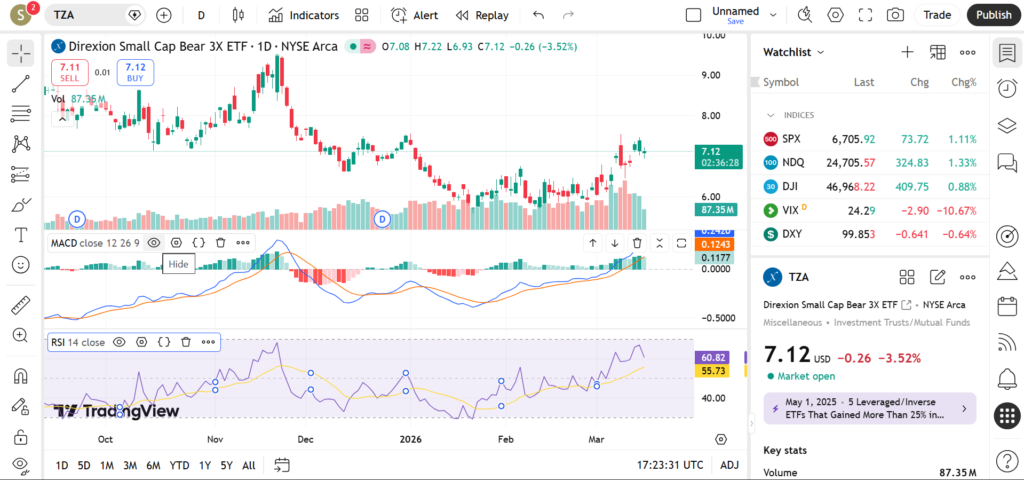
During March 2026, TZA has been moving within a volatile trading range as small-cap stocks fluctuate in response to economic data releases and shifting investor sentiment. Because TZA moves inversely to the Russell 2000, its price tends to rise when small-cap equities decline and fall when the small-cap sector strengthens.
Recent price action suggests that TZA has been interacting closely with its short-term moving averages. The 20-day moving average has acted as a key dynamic level where price frequently pauses or reverses during short-term swings. When price moves above the 20-day average, it may indicate increasing bearish pressure on the small-cap market.
The 50-day moving average serves as an important medium-term reference point. During previous trading sessions, TZA has shown several attempts to push above this level during periods of broader market weakness. Sustained trading above the 50-day average may signal stronger downside pressure on small-cap stocks.
The 200-day moving average represents the broader long-term trend indicator. If TZA approaches or breaks above this level, it could suggest growing market concerns about the economic outlook and risk appetite among investors.
Overall, the current price structure indicates a market environment where traders are reacting quickly to macroeconomic headlines, creating rapid shifts between bullish and bearish sentiment in the small-cap sector.
Key Support and Resistance Levels
Support and resistance zones are particularly important when analyzing leveraged inverse ETFs such as TZA because price movements can accelerate once these levels are breached.
One important support level appears near recent swing lows formed during short-term pullbacks. This zone represents an area where selling pressure previously weakened, allowing the price to stabilize.
Another support level can be observed around the region of the 20-day moving average during certain market phases. When TZA trades above this level, it often signals increasing downward pressure on the underlying Russell 2000 index.
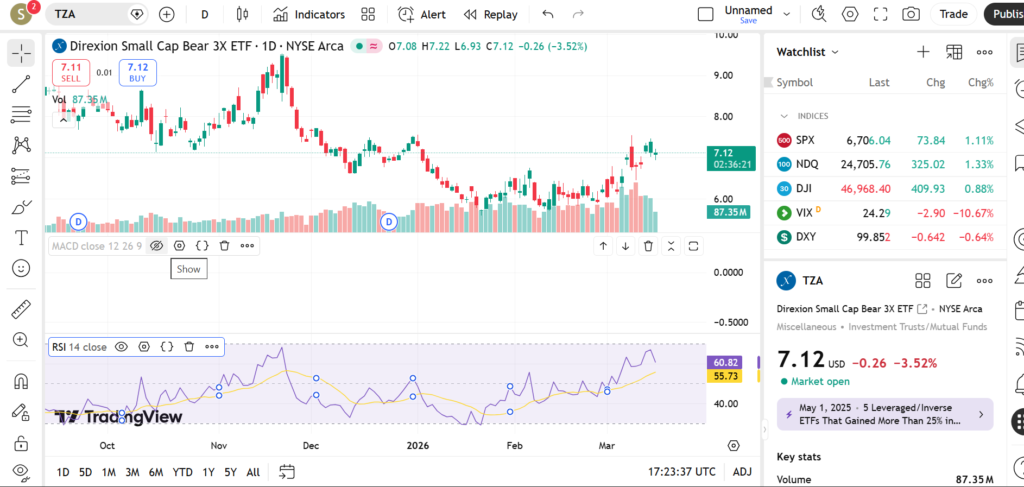
A deeper support zone lies near a previous consolidation range where price spent several sessions moving sideways before attempting a breakout.
On the resistance side, the first key level appears near recent swing highs where rallies temporarily stalled. This region reflects a point where traders previously took profits after rapid upward moves.
The next resistance level lies near the 50-day moving average during certain periods of consolidation. A breakout above this level may suggest stronger bearish sentiment toward small-cap equities.
A higher resistance area can be identified near the ETF’s multi-week highs. If price were to push above this level, it could signal intensified selling pressure across the broader small-cap market.
Indicators – RSI, MACD, Volume
The Relative Strength Index (RSI) for TZA currently fluctuates within a neutral range. This indicates that the ETF is not heavily overbought or oversold and may continue to move depending on broader market conditions.
MACD signals during March 2026 have alternated between bullish and bearish crossovers, reflecting the ongoing uncertainty surrounding small-cap stocks. Traders often watch for sustained momentum when the MACD histogram begins expanding after a crossover.
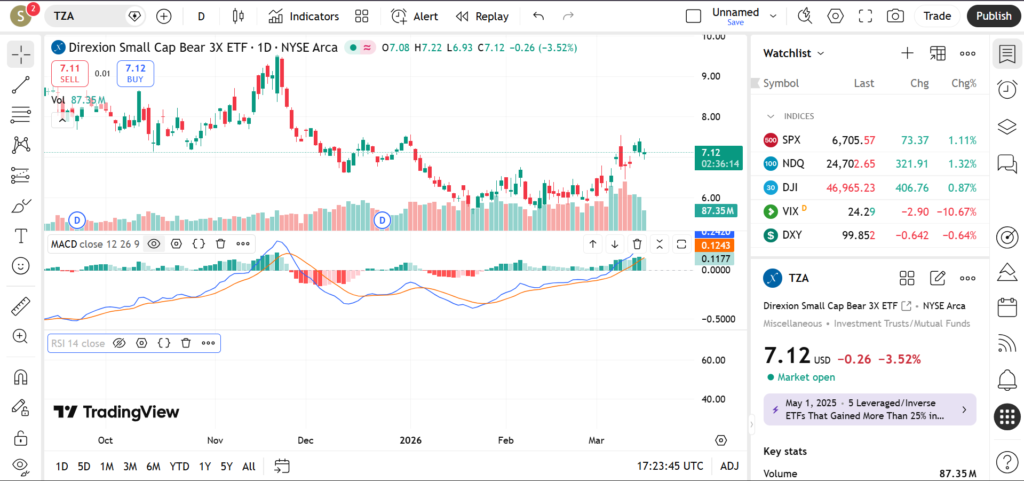
Volume patterns reveal that trading activity tends to increase during strong upward moves in TZA. Because these rallies usually correspond to declines in small-cap stocks, rising volume may indicate increasing defensive positioning among traders.
Short-Term Outlook for TZA in March 2026
The technical outlook for TZA during March 2026 remains closely tied to the direction of the Russell 2000 index. If economic concerns or rising interest rates pressure small-cap stocks, TZA could experience renewed upward momentum.
However, if the broader equity market stabilizes and risk appetite improves, the ETF may struggle to sustain rallies.
What traders are watching
• Movement in the Russell 2000 index
• Reaction near the 50-day moving average
• Breakout attempts above recent highs
• Volume spikes during market sell-offs
• Economic data influencing small-cap sentiment
Risks and Important Notes
Technical levels in leveraged ETFs can change rapidly due to sudden market developments. Economic reports, central-bank decisions, or geopolitical events may cause price movements that override technical patterns.
Leveraged inverse ETFs also experience compounding effects due to daily rebalancing, meaning their long-term performance may differ from the underlying index movement.
This analysis is educational only and should not be interpreted as personalized financial advice.
For additional insights, traders may also explore technical analysis for other leveraged ETFs tracking major U.S. indices or volatility instruments.