

Tesla (TSLA) stock forecast and analysis: latest TSLA stock price, earnings, valuation, technical signals, and analyst targets to help investors decide.
Introduction
Tesla (TSLA) is an electric vehicle and clean energy company that designs, manufactures, and sells EVs, batteries, and energy storage products worldwide. TSLA stock is in focus as the company adjusts pricing, pushes software and autonomous driving, and expands its energy and AI initiatives after a volatile two-year period. Investors are watching how TSLA stock reacts to shifting interest rates, mixed tech earnings, and changing risk appetite in growth names across the broader market.
Latest Stock Price & Trend
As of the last close, TSLA stock traded around 399 dollars per share, with after-hours levels near 399.30 dollars on March 10, 2026. Intraday on March 11, 2026, the stock fluctuated between about 396.55 dollars and 406.58 dollars, with a recent quote near 399.76 dollars and a market cap around 1.5 trillion dollars; these figures are based on recent market data and may differ from live prices. On the day, TSLA stock price has moved within a modest range, reflecting a relatively calm session after recent gains.
Over the last five trading days, TSLA has consolidated near the upper part of its recent range, holding close to 400 dollars after testing above 400 dollars intraday. Over the past month, the TSLA stock price has trended higher, moving from the mid-300s toward the high-300s and low-400s, signaling renewed buying interest after prior weakness. On a three-month basis, TSLA has staged a meaningful recovery from lower levels earlier in the quarter, helped by improved broader tech sentiment and expectations around margins and new products.
Looking at roughly six months and year-to-date performance, TSLA has rebounded from its 52‑week low near 214.25 dollars but remains below its 52‑week high of 498.83 dollars. This places the stock in the upper half of its 12‑month range but still well under prior peaks, suggesting a partial recovery rather than a full return to past highs. Overall, the current TSLA trend can be described as cautiously bullish, with higher lows and improving sentiment, but still subject to volatility and pullbacks. For investors, this pattern points to a stock that has regained momentum but still faces overhead resistance and sensitivity to macro and company news.
Technical Analysis
Support levels are price zones where buyers have recently stepped in; for TSLA stock, short-term support appears in the high-300s, near recent intraday lows around 396 dollars, and stronger support sits further down toward the mid-300s where prior rallies started. Resistance levels are areas where sellers tend to appear; near term, TSLA faces resistance just above 400 dollars and then closer to the mid-400s region, well below the 52‑week high near 499 dollars.

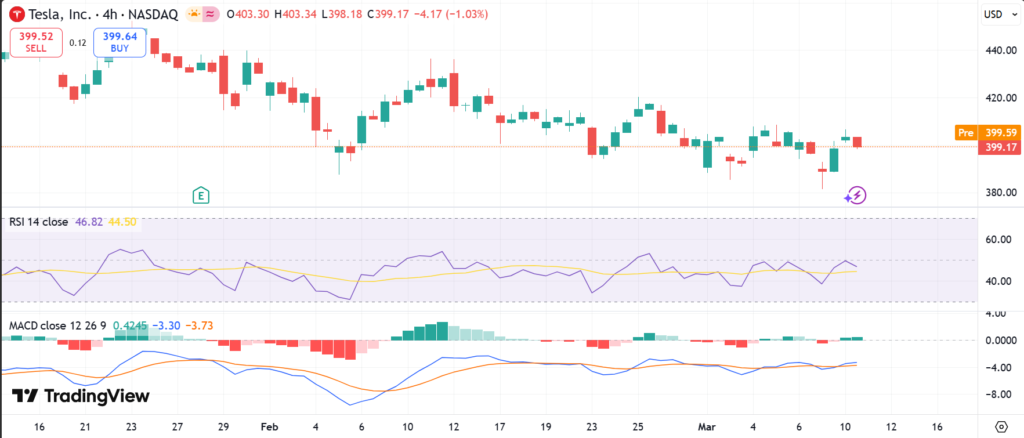
The Relative Strength Index (RSI) measures whether a stock is overbought or oversold, with readings above 70 often viewed as overbought and below 30 as oversold. Recent multi‑day RSI readings for TSLA have been in the low‑40s to low‑50s range, which is considered neutral to slightly weak rather than extreme. This suggests the TSLA stock price is not currently stretched in either direction, leaving room for moves based on new catalysts.
The MACD (Moving Average Convergence Divergence) compares short- and long-term momentum; a rising or positive MACD typically signals a bullish trend, while a falling or negative MACD suggests bearish momentum. Recent MACD readings for TSLA have pointed to improving momentum, with some indicators leaning bullish after earlier weakness. This aligns with the stock’s gradual recovery toward the 400 dollar area.
Moving averages smooth out price noise. The 50‑day moving average tracks intermediate trend, and the 200‑day moving average tracks the longer-term trend. TSLA’s shorter-term averages have been climbing, while longer-term measures are flattening after prior declines, indicating the stock is trying to transition from a corrective phase toward a more stable uptrend. A “golden cross” occurs when the 50‑day average moves above the 200‑day, and a “death cross” is the opposite; TSLA has spent time recovering from prior bearish patterns and is moving closer to a more neutral to positive configuration.
Trading volume has averaged around the high‑50 million range recently, indicating strong liquidity and active interest in the name. Volume spikes around news can confirm breakouts above resistance or breakdowns below support, so investors should watch whether future moves in TSLA stock price are supported by heavy trading. Overall, TSLA technical analysis currently points to a recovering but still volatile stock, with neutral momentum and key support and resistance levels that traders should monitor closely.
Analyst Ratings & Price Targets
Wall Street analyst opinions on TSLA stock are mixed, reflecting both enthusiasm for long-term growth and concern about valuation and competition. Recent data shows a consensus rating around “Hold,” with a blend of Buy, Hold, and Sell views among more than 40 analysts. For example, one source notes a consensus Hold rating based on a mix of approximately 14 Buy, 10 Hold, and 10 Sell opinions, though specific counts can change as new reports are issued.
The average TSLA stock price target over the last few months has been in the mid‑300s to high‑300s, with some services citing an average near 395 dollars. Individual price targets vary widely, with some bullish analysts seeing potential in the mid‑400s or higher, while more cautious or bearish analysts set targets closer to the low‑200s. Recent actions include Buy ratings with targets around 460–550 dollars from certain firms, alongside underweight or neutral calls with targets in the 130–150 dollar range.
This diversity in TSLA forecast targets underscores how polarizing the stock remains. For investors, consensus “Hold” and a wide target range suggest that professional analysts see both meaningful upside if execution is strong and significant downside if growth slows or margins compress. TSLA stock is therefore best viewed as a higher-risk, higher-reward name where analyst sentiment is balanced rather than uniformly bullish.
Insider Activity
Insider activity—buying and selling by executives and directors—can offer signals about management’s confidence, though it is not a guarantee of future performance. Recent filings show several insider sales in early 2026, including stock sales by director James Murdoch at prices around 445 dollars per share. Other insiders, such as members of the board and senior officers, have also reported option-related sales and disposals over the past few months.
In late 2025, TSLA also saw notable transactions, including large director sales and an earlier high-profile purchase by CEO Elon Musk in 2025, though that transaction is now several months in the past. Overall, recent Form 4 filings lean more toward insider selling than buying, which is common in large tech and growth stocks where equity compensation is significant. For investors, heavy or consistent insider selling can warrant caution, but it may also reflect diversification or tax planning rather than a negative view on TSLA stock.
Valuation Analysis
TSLA currently trades at a rich valuation compared with many traditional automakers and even some large-cap tech peers. Recent data shows a price-to-earnings (P/E) ratio above 300 based on trailing earnings, highlighting high expectations embedded in the TSLA stock price. Some earlier datasets have shown TSLA trading at P/E multiples well above 100, far exceeding classic value thresholds.

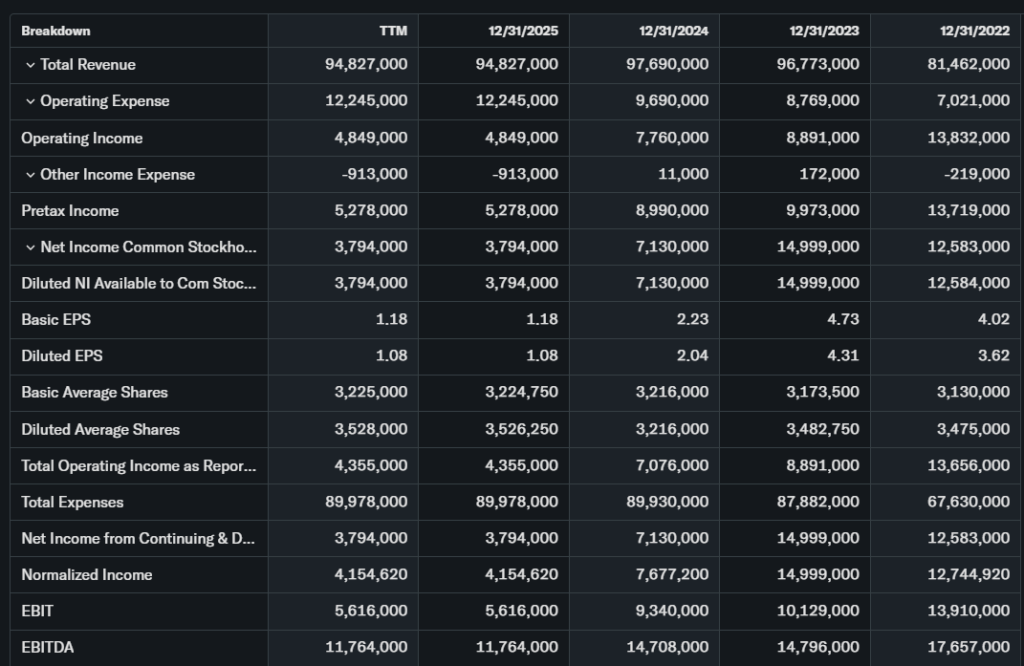

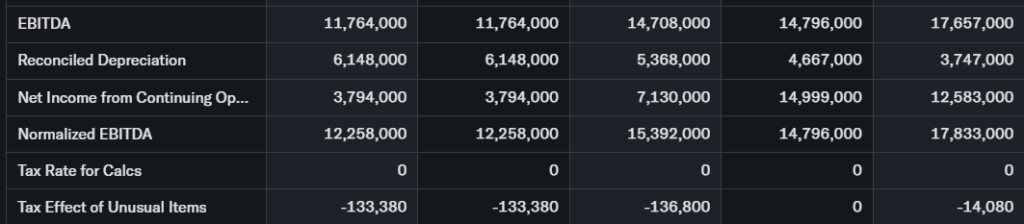
On a full-year basis, Tesla generated roughly 94.8 billion dollars in revenue in 2025, according to financial summaries, with revenue growth slowing versus prior hyper-growth years. That revenue base implies a price-to-sales ratio that remains elevated compared with traditional auto companies but closer to high-growth tech names. Tesla’s GAAP net income in 2025 was about 3.8 billion dollars, with non‑GAAP net income around 5.9 billion dollars and solid free cash flow supported by 44.1 billion dollars in cash, cash equivalents, and investments at year-end.
Revenue growth has decelerated compared with earlier years as EV markets mature and price cuts have weighed on automotive margins. EPS growth has likewise become more uneven, with margin compression offset by scale, software, and energy growth. Compared with megacap software-heavy peers like Microsoft or platform companies with steadier margins, TSLA valuation looks aggressive; compared with early-stage high-growth names, it appears more grounded due to sizeable revenue and cash generation. Overall, TSLA stock appears more likely fairly valued to overvalued on traditional metrics, with the investment case relying heavily on long-term growth in EVs, energy, and software rather than current earnings alone.
Recent Earnings & Catalysts
Tesla’s latest annual update highlighted total revenues of about 94.8 billion dollars in 2025, with Q4 contributing roughly 24 billion dollars and GAAP net income of 0.8 billion dollars in the quarter. Management noted that 2025 was a critical year, with pressures from lower vehicle deliveries and pricing offset by growth in energy and services. While detailed consensus beats or misses versus expectations depend on specific analyst estimates, the company has faced tighter margins and more scrutiny around growth guidance.
Key catalysts include expansion of Tesla’s energy generation and storage segment, growth in services and other revenue, and increased contribution from software features such as Full Self-Driving subscriptions. The company also continues to work on AI and autonomous driving technologies, which investors see as potential long-term margin and valuation drivers. Market reaction to recent earnings has been mixed, with TSLA stock often volatile around reports as investors weigh near-term profit pressures against long-term growth initiatives.
Bullish Case
The bullish case for TSLA stock centers on several realistic growth drivers. First, Tesla remains a leading brand in EVs, with global scale and vertically integrated manufacturing that can support long-term volume growth even in a more competitive market. Second, energy generation and storage is growing, contributing more stable and diversified revenue beyond vehicles.
Third, software and services, including FSD subscriptions and other automotive software, offer higher-margin revenue streams that can improve profitability over time. Tesla’s strong cash position—over 40 billion dollars at year-end 2025—gives it flexibility to invest in new factories, technologies, and AI initiatives. For long-term investors, these factors support a constructive TSLA forecast if the company executes well and maintains its innovation edge.
Bearish Case
On the bearish side, competition in EVs is intensifying from established automakers and new entrants, which could pressure pricing and market share. Margin pressures are already visible, with lower average selling prices and rising costs impacting automotive profitability. Slowing revenue growth compared with earlier years raises questions about whether TSLA’s premium valuation is still justified.
There are also execution risks in scaling new technologies like autonomous driving and robotics, where timelines can slip and regulatory hurdles are significant. Macroeconomic factors such as higher interest rates, consumer affordability, and potential policy changes on EV incentives could weigh on demand. These risks mean that TSLA stock can be volatile and vulnerable to downside if expectations reset.
Market Sentiment & Investor Psychology
Market sentiment around TSLA stock remains polarized, with strong communities of both bulls and bears. While exact short interest percentages fluctuate, Tesla has historically attracted significant short interest due to its valuation and headline risk. Options trading is active, with substantial call and put activity that can amplify moves around major news or earnings events.
Institutional ownership remains high, as large funds maintain positions in TSLA as a core growth holding, but some rotation occurs when risk appetite changes. Retail investors also play a major role, often trading TSLA stock based on momentum and news flow rather than valuation alone. Overall sentiment today appears cautiously optimistic rather than euphoric, with investors balancing long-term growth hopes against near-term fundamentals.
Short-Term Outlook
Over the next several days and weeks, TSLA stock is likely to trade within its established range, with support in the high‑300s and resistance above 400 dollars and into the mid‑400s. Technical indicators such as neutral RSI and improving MACD suggest the potential for continued upward drift if market conditions stay constructive, but not an extreme overbought condition. Volume around key headlines, such as any product updates or macro news, will be critical in confirming breakouts or breakdowns.
Short-term traders should expect volatility, especially around any upcoming news or sector-wide moves in tech and EV names. Without a major new catalyst, the TSLA forecast in the very near term looks like a gradual, choppy uptrend rather than a straight-line move.
Medium to Long-Term Outlook
Over a 6–24 month horizon, the outlook for TSLA stock depends on execution across EV, energy, and software businesses. Tesla’s business model—combining manufacturing, software, and energy—remains differentiated and could support durable growth if demand for EVs and storage continues to expand. The industry backdrop is generally favorable, with long-term trends toward electrification and decarbonization, but competition and pricing will likely remain intense.
Financially, Tesla’s strong balance sheet and free cash flow provide a buffer against downturns and a war chest for investment. However, the current TSLA valuation already discounts significant future growth, leaving less room for error. For long-term investors, TSLA stock may be suitable as a hold or gradual accumulation position, especially on pullbacks, rather than an aggressive buy at any price.
FAQ Section
- Is TSLA stock a buy right now?
TSLA stock may be attractive for investors who believe in Tesla’s long-term growth in EVs, energy, and software but can tolerate volatility and a premium valuation. Others may prefer to wait for better entry points or more evidence of sustained margin improvement before buying. - What is the price target for TSLA stock?
Recent data shows an average analyst TSLA stock price target around the mid‑300s to high‑300s, with some targets above 450 dollars and others closer to 200 dollars. The consensus rating is roughly Hold, reflecting the wide range of views. - What are major risks for TSLA stock?
Key risks include rising competition, margin pressure from price cuts, slower revenue growth, execution challenges in new technologies, and macroeconomic or regulatory headwinds. These factors could lead to volatility and downside if expectations are not met. - How does TSLA valuation compare to other companies?
TSLA trades at a much higher P/E and price-to-sales ratio than traditional automakers and many mature tech companies, reflecting its perceived growth potential. This premium valuation makes the stock more sensitive to changes in growth and profitability. - What is the long-term outlook for TSLA stock?
Over the long term, TSLA’s outlook depends on maintaining EV leadership, growing energy and software businesses, and delivering consistent profits. If Tesla executes well, the stock could justify its valuation; if not, multiple compression is a risk.
Suggestions
You could internally link to related analysis pieces such as:
“Compare with Opendoor stock” for investors considering other growth names.
“See our Microsoft stock forecast” for a look at a more diversified megacap tech.
“Read our tech sector valuation breakdown” for broader context on growth stock pricing.
Conclusion
TSLA stock remains one of the market’s most closely watched names, combining strong brand power, large revenue, and ambitious technology goals with a premium valuation and meaningful risks. Based on current fundamentals, valuation, and sentiment, a balanced stance is to rate TSLA as a Hold with selective accumulation on weakness for investors with a long time horizon and high risk tolerance. Short-term traders should respect volatility and key technical levels, while long-term investors should focus on execution, margins, and the evolution of Tesla’s energy and software businesses.
Disclaimer: This article is for informational purposes only and not financial advice.