

Red Cat (RCAT) stock analysis with price trend, earnings, valuation, and forecast to help investors decide if RCAT stock is a buy or watch.
Introduction
Red Cat Holdings (ticker: RCAT) is a small defense technology company focused on military-grade unmanned aerial systems, primarily through its Teal Drones business. It designs and supplies drones and related technology to U.S. defense and security customers, positioning itself in the fast-growing military drone and reconnaissance market.
RCAT stock has attracted intense attention recently after a sharp move higher followed by volatile swings, as traders react to defense contract headlines and upcoming earnings. This comes against a backdrop of choppy broader markets, where many tech and defense names have been driven by interest rates, geopolitical tensions, and shifting risk appetite.
For everyday investors, understanding RCAT stock now means separating short-term trading excitement from the company’s underlying fundamentals, valuation, and realistic forecast.
Latest Stock Price & Trend
As of the latest available data, Red Cat (RCAT) stock recently traded around the mid‑teens per share, with a closing price of about 15–16 dollars in recent sessions, and after‑hours action a bit higher. One recent trading day saw the stock up roughly 1.8% at the close, with additional gains of about 1.7% after hours, reflecting ongoing speculative interest.
Short-term performance has been very volatile. On one day, RCAT stock was reported up by about 8–9% intraday, while on another session it traded down 7–8% as traders digested prior gains and dilution concerns. Over the last five trading days, the stock has swung sharply both ways, typical of small‑cap defense plays tied to news and sentiment.
On a one‑month basis, RCAT stock has staged a strong rally from lower levels, driven by optimism around defense opportunities and speculation ahead of its next earnings report. Over the last three to six months, the move has been even more dramatic, with shares rising several hundred percent from their 52‑week low as interest in military drones and Red Cat’s Pentagon exposure picked up. Year‑to‑date, the stock is up significantly, though it has recently entered a consolidation phase after the initial surge.
According to recent ranges, Red Cat’s 52‑week low has been under 1 dollar per share, while the 52‑week high has climbed into the mid‑teens. This wide range highlights just how speculative RCAT stock can be. Overall, the current trend is still tilted bullish on a multi‑month view, but sideways to choppy in the near term as the market waits for the next catalyst.
For investors, RCAT stock’s pattern suggests high potential reward but equally high risk; sharp pullbacks can happen quickly after rapid rallies, so position sizing and risk control are crucial.
Technical Analysis
From a technical analysis standpoint, RCAT stock shows classic high‑volatility small‑cap behavior. Support levels are price areas where buyers have recently stepped in; for RCAT, short‑term support appears around prior consolidation zones well below recent highs, closer to earlier breakout levels. If price falls back toward those areas and stabilizes, it may indicate that bulls are still defending the trend.

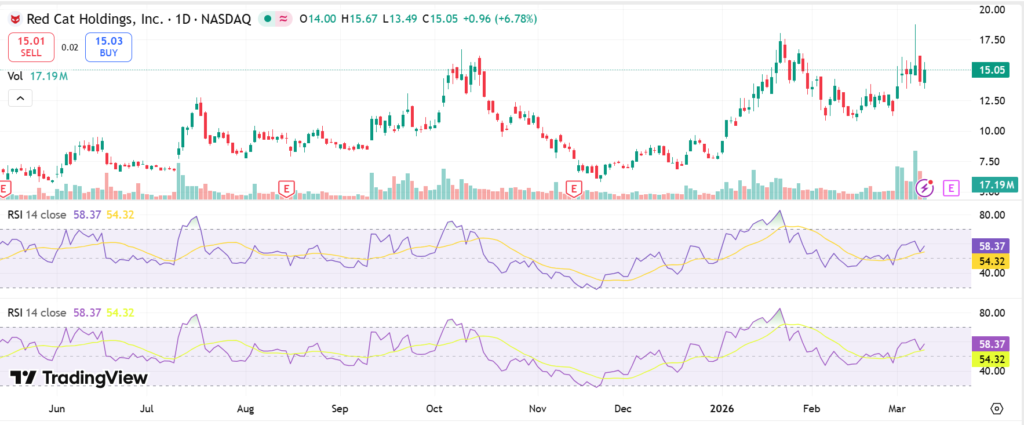
Resistance levels are points where selling pressure has repeatedly capped rallies. For RCAT stock, recent highs in the mid‑teens act as near‑term resistance, with intraday spikes above that range often fading as traders take profits. A strong break and close above these zones, on high volume, would be a constructive signal for momentum‑oriented investors.
The Relative Strength Index (RSI) measures whether a stock is overbought (typically above 70) or oversold (below 30). After RCAT’s powerful run from its lows, RSI readings have likely spent time in overbought territory, reflecting strong buying momentum and raising the risk of pullbacks or sideways consolidation. When RSI cools back toward neutral levels while price holds most gains, it can suggest a healthier, more sustainable trend.
The Moving Average Convergence Divergence (MACD) indicator tracks changes in momentum. During RCAT stock’s recent rally, MACD would normally show a bullish trend, with the MACD line above its signal line, but sharp reversals can cause quick crossovers. Traders often watch for these shifts as early warnings that the current move may be slowing.
Moving averages help smooth noise. The 50‑day moving average typically reacts faster, while the 200‑day moving average reflects the longer‑term direction. After a large rally from low prices, RCAT stock likely trades above both its 50‑day and 200‑day averages, a technically positive setup. If the 50‑day average has crossed above the 200‑day, that would be called a “golden cross,” often seen as a bullish long‑term signal, whereas a “death cross” would be the opposite.
Trading volume in RCAT stock has surged during recent moves, with some sessions showing very heavy turnover relative to average volume. High volume on up days suggests strong participation and interest, but heavy volume on down days can signal distribution as early traders exit.
Analyst Ratings & Price Targets
RCAT stock is a small‑cap defense and drone name, so it tends to have lighter Wall Street coverage than mega‑cap tech companies. Public data and news coverage indicate that only a limited number of analysts actively follow Red Cat Holdings.
Some recent commentary from market sources has discussed whether RCAT is “still a buy” after gapping up and then pulling back on heavy volume. Articles point to both the upside from defense demand and the risks from volatility and potential dilution.
Because of this relatively thin coverage, there is less transparency around a formal consensus of Buy/Hold/Sell ratings and specific average, high, and low price targets compared with larger peers like Microsoft or other major defense contractors. Investors should therefore treat any isolated bullish or bearish target as one opinion, not a broad Wall Street consensus.
In practice, this means RCAT stock is driven more by news, retail sentiment, and institutional trading dynamics than by large banks’ research coverage. For investors, analyst sentiment here plays a smaller role, and due diligence on fundamentals and risk is even more important.
Insider Activity
Insider activity can be a valuable signal, especially in small companies where management has deep insight into prospects. For Red Cat Holdings, SEC Form 4 filings show historical insider transactions, including purchases and sales by executives and major holders.
In smaller growth companies like RCAT, insider selling can occur for many reasons, such as compensation or diversification, while insider buying is more often interpreted as confidence in future performance. Public data indicate that Red Cat has seen various insider transactions over time, but not an overwhelming pattern of sustained heavy buying by leadership in recent months.
Investors should review the most recent SEC filings to see whether insiders have been net buyers or net sellers near current levels and how large those trades are relative to overall holdings. A consistent pattern of meaningful insider buying at prices close to where RCAT stock trades now would be a constructive sign, while persistent large selling into rallies would argue for caution.
Valuation Analysis
Valuing RCAT stock requires accepting that this is an early‑stage, high‑growth, and still unprofitable defense technology company. Recent data from market sources show that Red Cat’s price‑to‑earnings (P/E) ratio is negative, reflecting net losses rather than profits. A traditional trailing P/E therefore does not provide a meaningful valuation anchor.

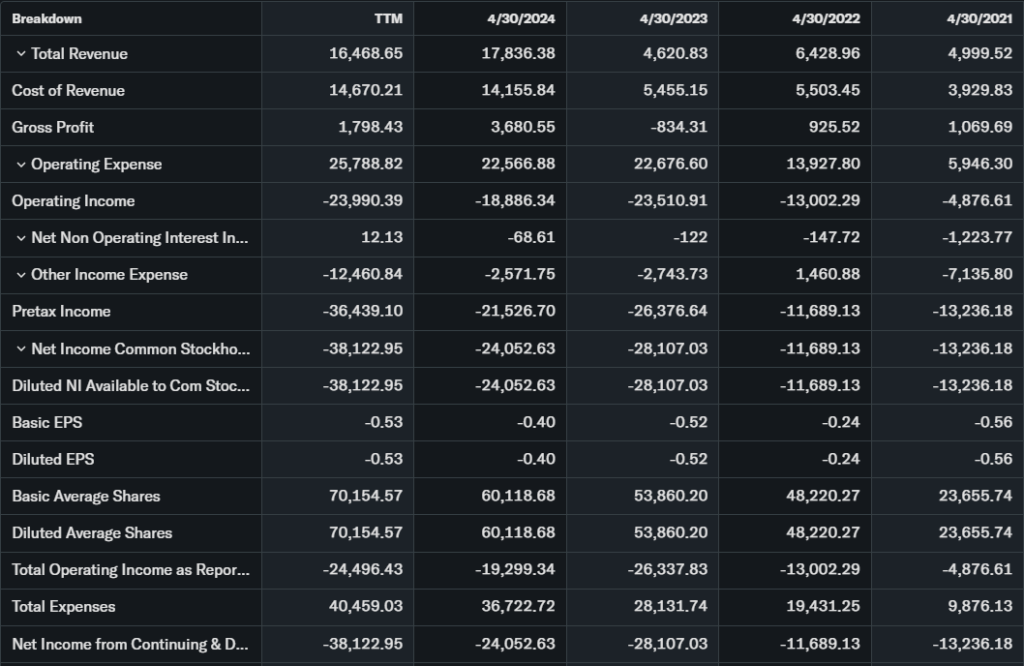


Forward P/E estimates may exist based on expected future earnings, but these projections can be highly uncertain for small defense tech players tied to contract wins and program timing. Price‑to‑sales (P/S) becomes more relevant; given Red Cat’s relatively modest revenue base and sharply higher market capitalization after the rally, the P/S ratio has likely expanded significantly versus its history.
Recent commentary notes that Red Cat’s market cap has moved into the hundreds of millions of dollars, while the business still works toward scaling revenue and profitability. Year‑over‑year revenue growth has been an important story, driven by defense and drone demand, but it remains off a low base and is subject to contract lumpiness. Earnings per share (EPS) have remained negative, though investors are looking for improvement as the company gains operating leverage.
Free cash flow and the balance between debt and cash are also key for RCAT stock. Like many growth‑stage firms, Red Cat has relied on equity issuance and potentially other financing to support operations and investments, which can create dilution risk for existing shareholders. Compared with large, profitable tech names such as Microsoft or diversified defense firms, RCAT trades more on its narrative and future potential than on traditional valuation metrics.
Given the current market cap relative to revenues and continuing losses, RCAT stock screens as aggressive and likely not “cheap” on conventional measures. It looks more fairly to richly valued, depending on how optimistic an investor is about long‑term drone and defense growth and Red Cat’s share of that market.
Recent Earnings & Catalysts
The market’s focus now is on Red Cat’s upcoming quarterly results, with investors watching to see whether the company can justify its recent move with solid numbers. Recent commentary highlights that traders are eyeing a scheduled earnings date in mid‑March, with speculation around revenue growth and future guidance.
Previous quarters have shown the importance of contract wins, defense demand, and operational performance to Red Cat’s revenue line. Investors will be looking closely at whether revenue beats or misses expectations, and whether EPS shows progress toward breakeven or profitability.
On the catalyst side, several developments have influenced RCAT stock. News that Red Cat’s Teal Drones unit was among 11 finalists for Pentagon drone contracts significantly boosted optimism about potential future orders and validation of its technology. The stock has also moved on talk of new partnerships, expansion into maritime drone applications, and strategic moves to broaden its customer base.
Each earnings release and related commentary on forward guidance can quickly shift sentiment. Strong numbers and constructive guidance may support the current valuation, while disappointments or cautious outlooks could trigger sharp pullbacks.
Bullish Case
A constructive case for RCAT stock rests on several factors. First, global demand for military and security drones is growing, driven by rising geopolitical tensions and the military’s need for advanced reconnaissance and tactical capabilities. Red Cat’s positioning as a U.S. defense‑aligned drone supplier gives it exposure to this structural trend.
Second, the company’s presence among finalists for Pentagon drone programs and its partnerships with various defense and security actors provide potential for large multi‑year contracts. If Red Cat can convert these opportunities into firm orders, revenue growth could accelerate, improving scale and margins.
Third, operational improvements, such as better manufacturing efficiency, cost control, and product innovation, can gradually push RCAT toward profitability. If management executes well, the market could reward the stock with a premium multiple for its unique niche in defense technology.
Bearish Case
On the downside, RCAT stock faces intense competition from larger, better‑capitalized drone and defense companies, both in the U.S. and globally. Winning and retaining major contracts is not guaranteed, and even being a finalist does not ensure significant revenue.
Growth may also be uneven. Revenue can be lumpy due to contract timing, procurement cycles, and budget shifts, which may lead to volatile quarterly results and disappointments versus investor expectations. Persistent losses and negative free cash flow could require additional capital raises, introducing dilution risk for existing shareholders.
Regulatory and political factors present additional uncertainty, as defense budgets and procurement priorities can change. For a small‑cap like Red Cat, any execution missteps, delays, or technical issues may have an outsized impact on sentiment and valuation.
Market Sentiment & Investor Psychology
Market sentiment around RCAT stock is currently a mix of excitement and caution. The sharp rally from its lows, followed by swings in both directions, suggests a strong presence of active traders and momentum‑focused investors.
Short interest and options activity can further influence price action. While specific short interest percentages and put‑call ratios require up‑to‑date data, commentary around profit‑taking and “run‑up” digestion indicates that some traders are betting against the stock after its big move. At the same time, bullish call buying or speculative options activity can amplify moves when news breaks.
Institutional ownership appears more limited than in larger, mature companies, which means RCAT stock can be more susceptible to retail flows and headline‑driven momentum. Overall sentiment seems cautiously optimistic but highly sensitive; good news can drive fast spikes, whereas negative surprises may trigger sharp drops.
Short-Term Outlook
In the short term, RCAT stock is likely to remain volatile. Technical indicators such as elevated but cooling RSI, active MACD signals, and price trading above major moving averages point to a stock that has had a strong run but is now consolidating.
Upcoming earnings and any fresh defense or contract headlines are the key near‑term catalysts. If results exceed expectations and management delivers constructive commentary, RCAT stock could attempt to retest or break above recent resistance levels. Conversely, any disappointment in numbers or guidance could send shares quickly toward prior support zones.
For short‑term traders, RCAT stock may offer opportunities on both sides, but risk management is essential, as daily swings can be large.
Medium to Long-Term Outlook
Over a 6–24 month horizon, the outlook for RCAT stock depends heavily on execution and contract wins. If Red Cat can translate its Pentagon finalist status and other partnerships into substantial, recurring revenue streams, the business model could strengthen significantly.
The broader defense and drone industry is expected to grow, supported by ongoing modernization and the strategic importance of unmanned systems. Red Cat’s competitive position will be defined by its technology, performance in trials, reliability, and ability to scale production and support.
Financial health is another key factor. Progress toward positive EPS, improving free cash flow, and a manageable balance sheet would greatly improve the medium‑term investment case. If these elements move in the right direction, long‑term investors could consider gradually accumulating RCAT stock on pullbacks, rather than chasing spikes.
At this stage, RCAT stock may best fit investors who are comfortable with small‑cap risk and can tolerate volatility, rather than those seeking stable, income‑oriented holdings.
FAQ Section
1. Is RCAT stock a buy right now?
RCAT stock may be attractive for aggressive investors who believe in long‑term defense drone growth, but its valuation, volatility, and ongoing losses mean it is high risk and more suitable as a speculative position rather than a core holding.
2. What is the price target for RCAT stock?
Because RCAT is a small‑cap company with limited Wall Street coverage, there is no widely cited, stable consensus price target; investors should focus on their own assumptions about revenue growth and contract wins rather than a single target figure.
3. What are the major risks for RCAT stock?
Key risks include competition from larger defense firms, lumpy and uncertain revenue tied to contract timing, potential dilution if more capital is raised, and sensitivity to defense spending and regulatory changes.
4. How important are RCAT earnings reports?
Earnings reports are critical for RCAT stock because they show revenue progress, margin trends, and updated guidance, which can sharply move the share price in either direction.
5. What is the long‑term outlook for RCAT stock?
The long‑term outlook depends on Red Cat’s ability to secure and execute major defense contracts, improve profitability, and maintain a solid balance sheet; success on these fronts could support a constructive long‑term case, but failure would put significant pressure on the stock.
Suggestions
You could internally link this RCAT stock analysis to other pages such as:
- “Compare with Opendoor stock analysis”
- “See our Microsoft stock forecast” for those balancing speculative and blue‑chip exposure.
- “Read our tech sector valuation breakdown” to place RCAT’s valuation in a broader context.
Conclusion
RCAT stock offers a compelling but speculative way to gain exposure to the growing military drone and defense technology space. Its recent rally, Pentagon finalist status, and upcoming earnings create both opportunity and risk for investors.
Given the current mix of high volatility, negative earnings, and meaningful upside potential if contracts materialize, RCAT stock looks more appropriate as a watchlist or small speculative position rather than a full‑confidence Buy for conservative investors. Those considering the stock should size positions carefully, monitor earnings and contract news closely, and be prepared for sharp swings in either direction.
Disclaimer: This article is for informational purposes only and not financial advice.