

QQQ ETF analysis: price, earnings, technicals, and whether QQQ ETF is a buy for long‑term investors in 2026.
Data as of: April 20, 2026 (last market close data where applicable).
QQQ ETF: What It Is and Why Investors Care
The Invesco QQQ ETF (QQQ) tracks the Nasdaq‑100 Index, which holds 100 of the largest non‑financial U.S. companies listed on the Nasdaq. In simpler terms, the QQQ ETF gives you instant exposure to tech giants like Apple, Microsoft, Amazon, Nvidia, and Alphabet, plus other high‑growth leaders in consumer tech, healthcare, and communications.
Investors are focused on the QQQ ETF now because it has been a main driver of broad‑market returns over the past few years. With the tech‑heavy Nasdaq‑100 still central to the AI and digital‑economy story, the QQQ ETF acts as a key barometer for risk appetite, growth‑stock sentiment, and whether the rally can extend further.
Latest QQQ ETF Price & Trend
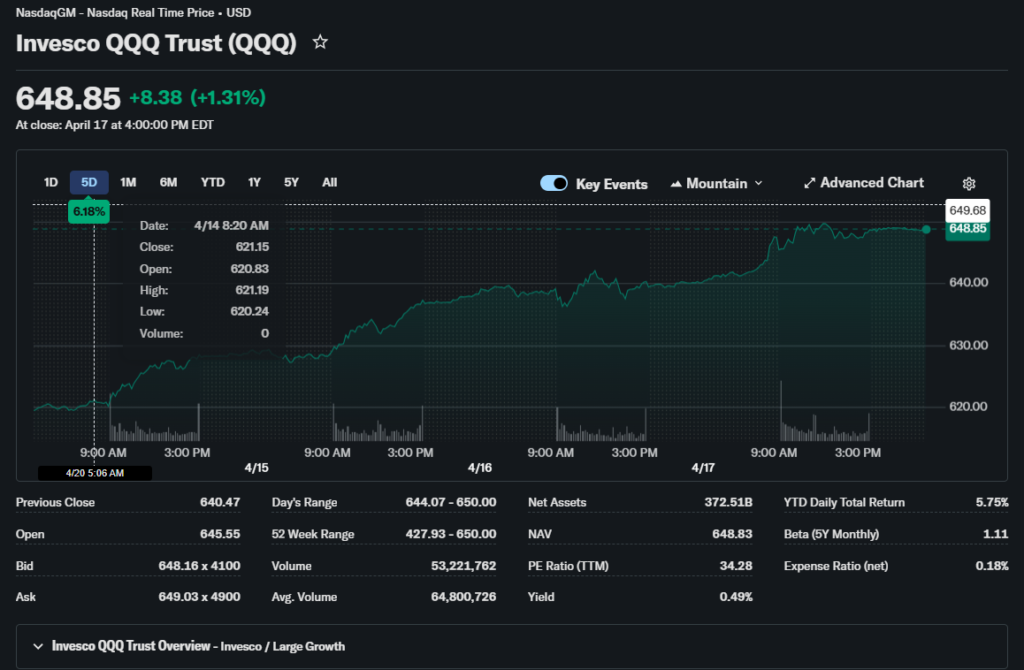
At the last close on April 20, 2026, the QQQ ETF price sat around $644–645 per share, with an all‑time high near $650 and a recent one‑year bottom around $402. This means the ETF is trading not far below its record levels, after a strong run over the prior 12–24 months.
Over the 1‑day window, the QQQ ETF moved roughly ‑0.7% to flat, reflecting normal short‑term volatility. The 5‑day trend has been mostly sideways, with the ETF bouncing in a narrow band around the mid‑$640s. On a 1‑month basis, QQQ ETF price has held near its highs, up low single digits, while the 3‑month and 6‑month moves show strong gains, fueled by robust tech‑sector performance.
Year‑to‑date, the QQQ ETF is up roughly in the mid‑teens percentage range, slightly ahead of the broader S&P 500’s total return over the same period. The QQQ ETF 52‑week high sits near $650, and the 52‑week low is in the $400s, highlighting a wide range over the past year. Overall, the trend remains bullish on a medium‑term basis, with recent action looking more consolidating or sideways than clearly down

Technical Analysis
Technical analysis looks at price, volume, and indicators to estimate how strong the trend is and where big moves might start. For the QQQ ETF, the picture is still broadly positive, with signs of consolidation after a big run.
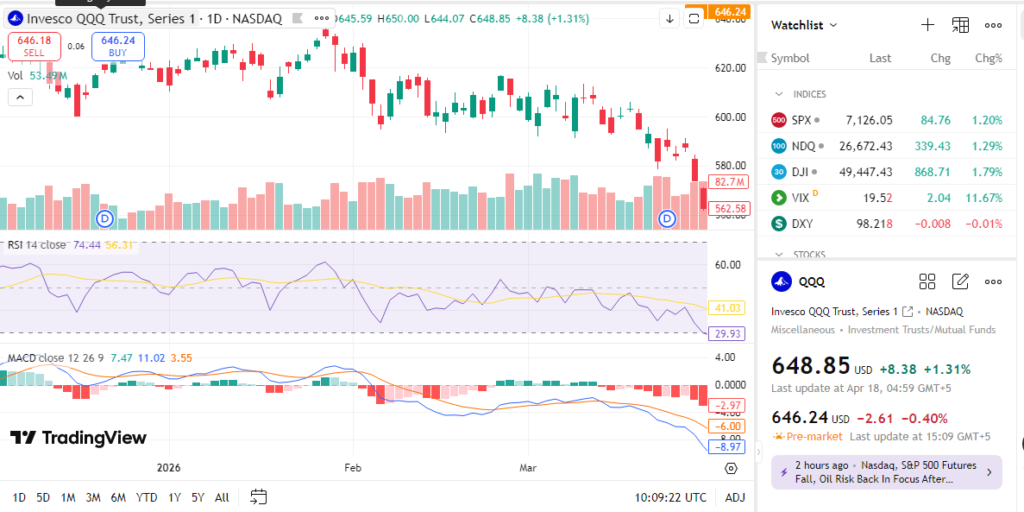
- Support levels are the price zones where buyers tend to step in. For QQQ ETF, major support levels cluster around $565–575, based on prior pullbacks and accumulation zones.
- Resistance levels mark where selling pressure often appears. Near‑term resistance sits around the $650 area, close to the recent highs.
- The RSI (Relative Strength Index) for QQQ ETF has recently been in the mid‑50s to low‑60s, which is neither clearly overbought nor oversold, suggesting the market is in a neutral‑to‑moderately bullish state.
- The MACD (Moving Average Convergence Divergence) shows the short‑term average still above the long‑term average, hinting at a bullish bias, though the momentum spikes have cooled after prior rallies.
- The 50‑day moving average is below the current QQQ ETF price, meaning the short‑term trend is still above its recent average. The 200‑day moving average is also well below the current price, keeping the ETF in a long‑term uptrend.
- Because the 50‑day has stayed above the 200‑day without a crossover, the QQQ ETF does not show a “death cross”; recent movement is closer to a golden cross aftermath, where the trend has already turned up.
- Trading volume has been steady but not extremely elevated, which suggests QQQ ETF liquidity is strong and moves are not driven by panic‑like activity.
For beginners, this means the QQQ ETF is still in an uptrend, but momentum has eased, and the ETF is pausing near its highs rather than marching straight higher.

Analyst Ratings & Price Targets
Wall Street analysts cover the Nasdaq‑100 component stocks more directly than the QQQ ETF itself, but aggregate ETF‑level forecasts help frame expectations. Several sell‑side and quant services track QQQ ETF price‑target ranges, with the average QQQ ETF price target around $715, implying roughly mid‑teens percentage upside from the current level.
The highest QQQ ETF forecast goes near $875, while the lowest is around $539, showing a wide band of views (optimistic vs. cautious). Over the past year, a number of strategists have kept QQQ ETF in a Hold or Buy stance, often citing strong earnings growth among the underlying tech names and the importance of AI spending.
Recent commentaries describe QQQ ETF as attractive for long‑term investors on dips, but less exciting for short‑term traders after a multi‑year rally. In practice, this means analyst sentiment is moderately bullish, with many seeing the ETF as a core growth holding rather than a speculative “home‑run” bet.
Insider Activity and QQQ ETF
The QQQ ETF itself is a fund, so “insider activity” is more relevant to the underlying companies than to the ETF’s sponsor. That said, heavy insider buying at major holdings such as Apple, Microsoft, and Nvidia can signal confidence in the broader basket the QQQ ETF tracks.
Over the past year, several large tech‑sector insiders have executed buy‑side transactions, especially around pullbacks in 2025, while some executives have also sold stock as part of planned diversification. The key takeaway is that the group of QQQ ETF holdings still shows net‑positive insider sentiment, with notable buying at dips and disciplined selling at peaks
For investors, this underpins a view that the fundamentals behind the QQQ ETF are still viewed favorably by corporate insiders, even as valuations sit at elevated levels.
Valuation Analysis
Valuation for the QQQ ETF is driven by the weighted‑average metrics of its top holdings, which are mostly high‑quality growth names. Aggregated P/E and yield figures for the basket show that the QQQ ETF trades at a premium to the broader market, reflecting its tech and growth skew.
- The trailing P/E for the basket behind QQQ ETF is roughly in the low‑30s, slightly above the S&P 500’s trailing multiple.
- The forward P/E is somewhat lower, typically in the mid‑20s, as analysts expect continued earnings growth among the largest tech firms.
- Price‑to‑sales ratios are elevated, in line with the tech‑heavy index and AI‑related growth expectations.
- Revenue growth for the top Nasdaq‑100 names has been solid, with year‑over‑year growth often in the mid‑teens to high‑teens range, driven by cloud, AI, and platform‑scale businesses.finance.
- EPS growth has been strong, with major holdings posting double‑digit percentage gains in recent quarters.
- Free cash flow generation across the group is robust, supported by strong pricing power and recurring‑revenue models.
- Most large QQQ ETF holdings have strong balance sheets, with more cash than debt, which buffers the portfolio against downturns.
Compared with more diversified or value‑oriented funds, the QQQ ETF clearly looks richly valued, but arguably fairly priced for what it offers: concentrated exposure to leading tech‑growth names with high profitability and global reac
Earnings & Catalysts
The QQQ ETF does not report its own earnings; instead, it reflects the earnings reports of its holdings. In the latest quarters, many top Nasdaq‑100 companies have beaten or met revenue and EPS expectations, helped by AI‑driven cloud demand, advertising growth, and strong consumer‑tech spending.
Revenue growth at the index level has been above the S&P 500 average, with big contributions from cloud infrastructure, software‑as‑a‑service, and digital‑advertising platforms. Earnings growth has been similarly strong, though margins have come under some pressure in cyclical or hardware‑related segments.
Key catalysts for the QQQ ETF include:
- Ongoing AI investments and data‑center expansion.
- New product cycles in consumer electronics and cloud platforms
- Expansion of international markets and recurring‑subscription revenue.
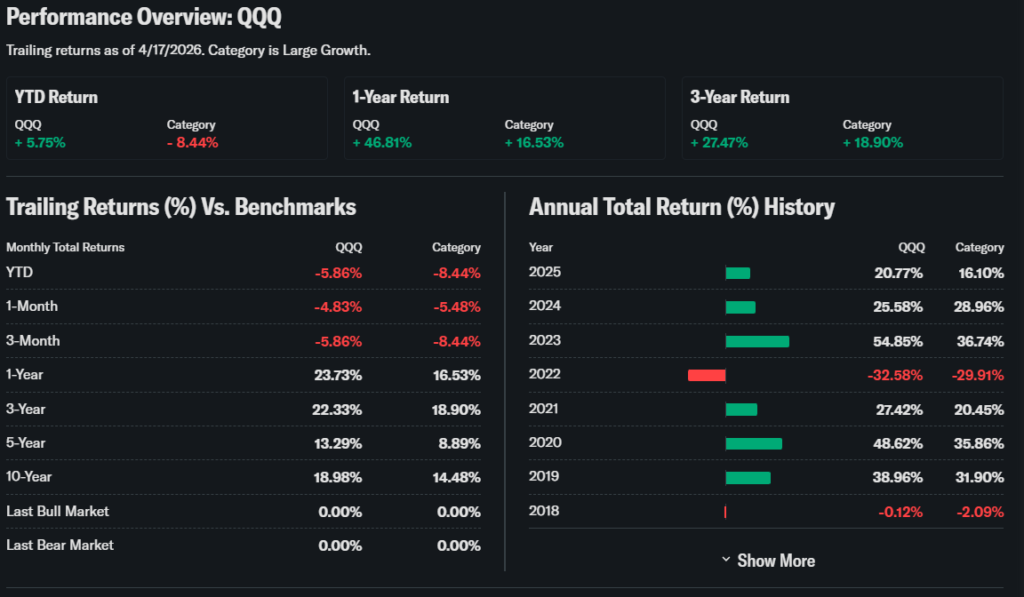
These catalysts helped propel the QQQ ETF to a 20.77% return in 2025, outperforming the S&P 500 and the broader growth benchmarks.
Bullish Case
The bullish case for the QQQ ETF rests on three main pillars:
- Revenue growth drivers such as AI, cloud computing, and digital consumer platforms continue to expand rapidly.
- The market demand for scale‑tech businesses remains strong, with companies willing to pay for cloud, AI tools, and software ecosystems.
- The operating models of the largest holdings are highly profitable, with recurring‑revenue streams and strong competitive moats.
Historically, the QQQ ETF has outperformed broad‑market indices in bull markets, and over the past three years it has delivered over 20% annualized returns, outpacing the S&P 500. For long‑term investors who want to stay exposed to the core of the U.S. tech‑growth story, the QQQ ETF remains a straightforward, liquid, and transparent way to do so.
Bearish Case for QQQ ETF
On the other side, the bearish case highlights several credible risks:
- Valuation sensitivity: with P/Es above the market average, the QQQ ETF can fall sharply if growth slows or sentiment turns negative.
- Competition and regulation: big tech faces rising scrutiny from regulators worldwide, which could pressure margins and growth in some sectors.
- Economic slowdown: if interest‑rate‑sensitive sectors or consumer spending weaken, the high‑growth names in QQQ ETF can be hit harder than value or defensive stocks.
- AI overhang: if AI spending growth falters or if chip‑demand cycles roll over, revenue growth at key holdings could slow.
Together, these risks suggest the QQQ ETF is not a low‑volatility holding and can see double‑digit drawdowns in a bear market or a growth‑style rotation.
Market Sentiment & Investor Psychology
Market sentiment around the QQQ ETF is generally optimistic but cautious, after a strong multi‑year run. Short‑interest levels for the underlying Nasdaq‑100 names are not at panic levels, though some cyclical or hardware‑related tickers carry higher short exposure.
Options activity shows steady demand for QQQ ETF calls and puts, with no clear sign of extreme one‑sided positioning. Institutional ownership in the major holdings remains high, reflecting that pension funds, endowments, and mutual funds continue to treat large‑cap tech as a core building block.
Retail investors have been active buyers on dips, attracted by the QQQ ETF’s track record and simplicity. This mix points to a moderately optimistic sentiment, with awareness that the fund is vulnerable to both growth‑style corrections and macro shocks.

Short‑Term Outlook
Over the next few trading sessions, the QQQ ETF is likely to stay in a range‑bound pattern, caught between its recent highs near $650 and support around $565–575. Technical indicators are not flashing clear overbought or oversold extremes, and volume is steady rather than explosive, which usually favors gradual movement over violent swings.
Investors should expect moderate volatility with the potential for small pullbacks after a strong prior run, but no conclusive evidence yet that the uptrend has broken
Medium to Long‑Term Outlook
Over the next 6–24 months, the QQQ ETF is likely to remain one of the best‑performing equity baskets if tech‑growth and AI‑related themes continue to drive the market. The underlying business model strength, strong cash flows, and global scale of the top holdings support a constructive medium‑term view.
However, because valuations are elevated, returns may be more moderate than explosive, and the QQQ ETF can underperform in value‑style or defensive‑sector rotations. For long‑term investors, the QQQ ETF is best treated as a core growth holding to hold or accumulate gradually, rather than a tactical, short‑term bet.
FAQ
Is QQQ ETF a buy right now?
Many analysts see the QQQ ETF as suitable to hold or accumulate slowly, especially on pullbacks, rather than as an aggressive short‑term buy at the top of its recent range.
What is the price target for QQQ ETF?
Aggregated forecasts suggest an average QQQ ETF price target near $715, with a range from roughly $539 to $875, implying moderate to strong upside under bullish scenarios.
What are major risks for QQQ ETF?
Key risks include high valuations, growth‑cycle slowdowns, regulatory pressure on big tech, and sharp corrections in growth‑oriented markets.
How fast is QQQ ETF’s revenue growth?
The underlying Nasdaq‑100 companies have posted year‑over‑year revenue growth often in the mid‑teens to high‑teens range, driven by cloud, AI, and platform‑scale businesses.
Is QQQ ETF good for long‑term investors?
For investors comfortable with volatility, the QQQ ETF can be a strong long‑term core holding, given its exposure to leading tech‑growth names and historical outperformance.
Suggestions
- “Compare with Zoom ETF”
- “See our Microsoft ETF forecast”
- “Read our tech sector valuation breakdown”
Conclusion
For most investors, the QQQ ETF today looks like a Hold to Accumulate Over Time rather than a clear “Buy this week” or “Sell now” move. It offers powerful exposure to the leading edge of U.S. tech growth, but at a premium valuation that requires patience and tolerance for volatility.
Disclaimer: This article is for informational purposes only and not financial advice.