QID ETF analysis, price trends, forecast, risks, and outlook. Is QID ETF a buy? Full breakdown of inverse Nasdaq exposure.
Data as of April 21, 2026, 16:00 UTC — using last market close data from publicly available ETF trackers and market data platforms.
Introduction
The QID ETF, known as the ProShares UltraShort QQQ ETF, is a leveraged inverse ETF designed to deliver -2x the daily performance of the Nasdaq-100 index.
This means QID ETF rises when the Nasdaq falls, making it popular among traders looking to hedge or bet against tech stocks.
Investors are watching QID ETF closely due to volatility in the tech sector, interest rate uncertainty, and shifting AI-driven valuations.
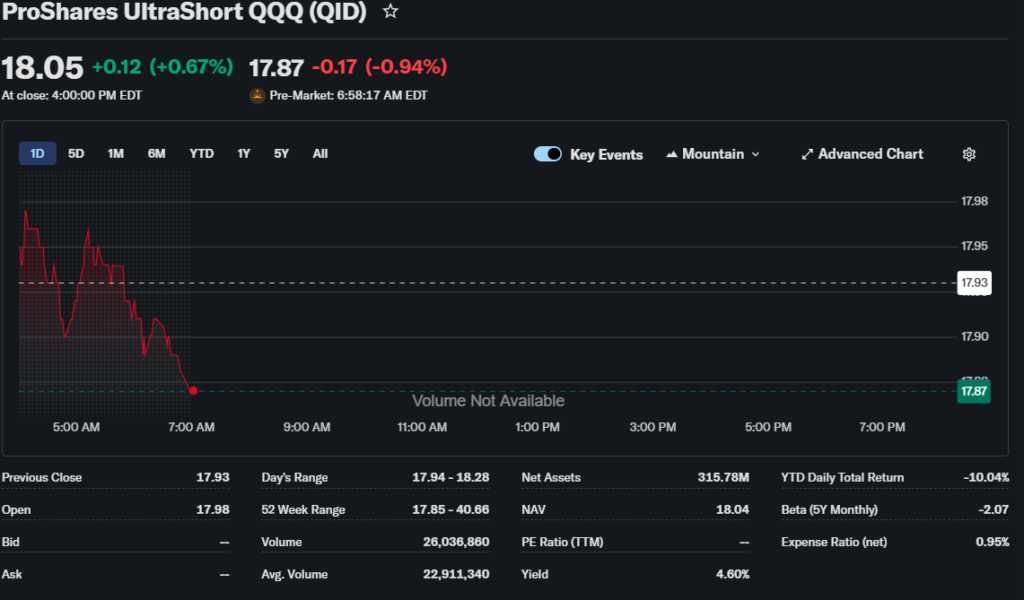
Latest QID ETF Price & Trend
As of the latest market close, QID ETF price is approximately $10.80–$11.20 range (varies slightly across platforms intraday).
The ETF showed a small daily gain as tech stocks faced mild selling pressure.
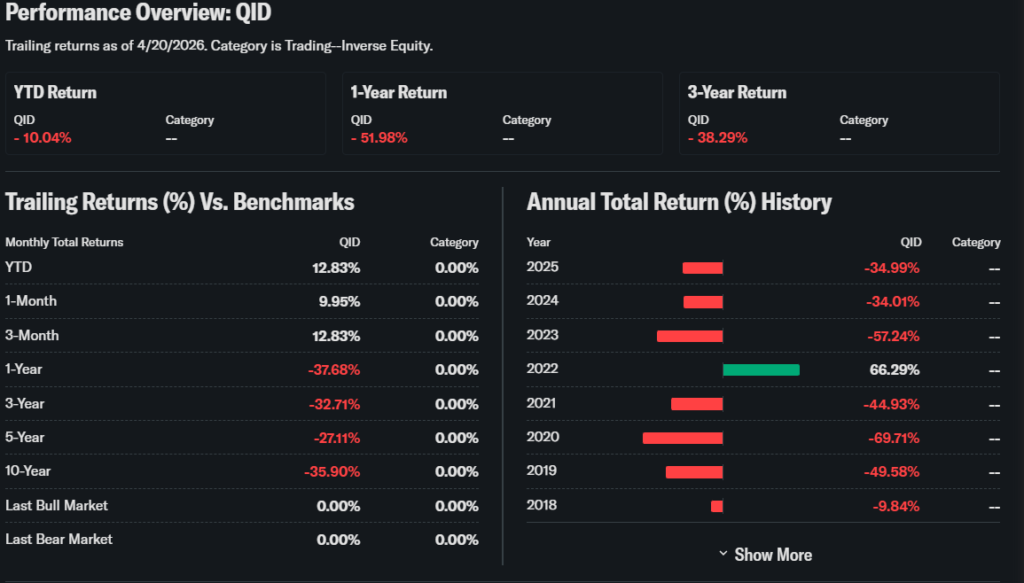
Over the past 5 days, QID ETF has traded sideways, reflecting mixed Nasdaq performance.
The 1-month trend is slightly negative, as tech stocks have generally remained strong.
The 3-month trend is bearish for QID ETF, meaning bullish for Nasdaq.
Over the last 6 months, QID ETF has declined significantly due to strong performance in tech.
Year-to-date, QID ETF remains down, reflecting continued Nasdaq strength.
The 52-week high is near $18+, while the 52-week low is around $9.
Overall trend is bearish for QID ETF, indicating a bullish environment for tech stocks.
Technical Analysis
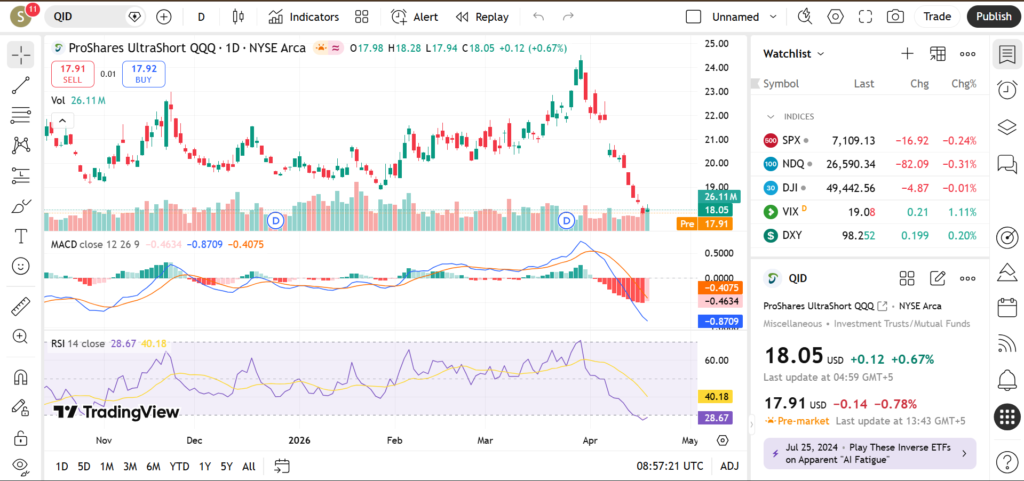
QID ETF technical analysis shows support near $10.00.
Resistance is around $12.20.
The RSI is near 40–45, indicating weak momentum but not oversold.
The MACD is slightly bearish, showing continued downside pressure.
The 50-day moving average is above the current price, acting as resistance.
The 200-day moving average is also above current levels, confirming a downtrend.
No golden cross is present; trend structure remains weak.
Volume has been moderate, suggesting limited strong conviction.
Analyst Ratings & Price Targets
QID ETF does not have traditional analyst ratings.
It is a trading tool rather than a long-term investment.
Price expectations depend entirely on Nasdaq movement.
If tech stocks decline sharply, QID ETF can move higher quickly.
Insider Activity
No insider activity applies.
Investor flows suggest short-term trading interest rather than long-term holding.
Valuation Analysis
QID ETF does not have valuation metrics like P/E or revenue.
It tracks daily inverse performance using derivatives.
Its value depends on Nasdaq movement and volatility.
Recent Earnings & Catalysts
QID ETF does not report earnings.
Key catalysts include Federal Reserve policy, tech earnings reports, AI sector momentum, and market corrections.
Bullish Case
QID ETF benefits when tech stocks fall.
Market corrections or economic slowdown can push it higher.
Rising interest rates can pressure tech valuations.
Bearish Case
If Nasdaq continues to rise, QID ETF loses value.
Leverage decay reduces returns over time.
Not suitable for long-term holding.
Market Sentiment & Investor Psychology
Sentiment around QID ETF is cautious.
Most investors remain bullish on tech, limiting demand.
Used mainly as a hedge or short-term trading tool.
Short-Term Outlook
QID ETF may rise if Nasdaq shows weakness.
Break above $12.20 could signal short-term upside.
Below $10 may indicate continued downside.
Medium to Long-Term Outlook
QID ETF is not designed for long-term holding.
Compounding effects reduce returns over time.
Best used for short-term hedging strategies.
FAQ Section
Is QID ETF a buy right now?
Only for short-term bearish trades on Nasdaq.
What is the QID ETF price target?
Depends on Nasdaq movement.
What are major risks for QID ETF?
Leverage decay and rising tech stocks.
Suggestions
Compare with leveraged inverse ETF analysis
See Nasdaq forecast
Read tech sector outlook
Conclusion
QID ETF is a high-risk inverse ETF designed for short-term trading or hedging.
It is not suitable for long-term investors due to leverage decay.
Best used tactically during market downturns.
Disclaimer: This article is for informational purposes only and not financial advice.