
NSA stock forecast and analysis: National Storage Affiliates Trust stock price, earnings, valuation, insider activity, and long term outlook for income-focused investors.
Introduction
National Storage Affiliates Trust is a self-storage real estate investment trust that owns and operates storage properties across the United States. The business earns rent from individuals and small businesses storing goods, which makes cash flows relatively steady compared with more cyclical industries.
NSA stock is on the radar of income investors because of its high dividend yield and recent earnings guidance that reshaped expectations for future growth. At the same time, higher interest rates and slower storage demand have pressured many real estate names, so NSA stock now trades in a market that is cautious on property-related cash flows. In this backdrop, understanding NSA stock price trends, NSA earnings, NSA valuation, and both upside and downside drivers is essential before deciding whether NSA stock is a buy.
Latest stock Price & Trend
As of the last market close, NSA stock price was about 34.29 dollars per share on the New York Stock Exchange. On that day, the stock slipped roughly 0.32 dollars, reflecting a modest decline versus the prior close and showing that sentiment remains somewhat cautious in the near term. Over the past five trading days, NSA stock has moved around the mid‑30s range, with no decisive breakout, indicating a sideways short-term pattern.
On a one‑month view, NSA stock price has generally stabilized after previous weakness, with investors digesting the latest NSA earnings guidance and dividend announcement. Across the last three months, the share price has traded in a broad band around the low‑ to mid‑30s, reflecting a balance between income buyers attracted to the yield and sellers worried about slower growth. Over six months and year‑to‑date, performance has been mixed, with NSA lagging high‑growth tech names but holding up better than more leveraged property names thanks to its recurring revenue.
The 52‑week high for NSA stock is in the low‑40s, while the 52‑week low sits in the mid‑20s, showing that the stock has already recovered significantly from its worst levels. With the price currently closer to the middle of that range, NSA stock forecast signals a market that sees neither extreme distress nor strong growth optimism. Overall, the trend looks neutral to slightly bullish for income‑oriented holders, but not yet convincing for aggressive momentum traders.
Technical Analysis
From a simple NSA stock technical analysis perspective, the shares appear to have nearby support in the low‑30s, where buyers previously stepped in when yields became more attractive. If NSA stock price falls back toward that zone, income investors may again view it as a reasonable entry point, assuming fundamentals hold steady. On the upside, recent trading around the mid‑30s creates a resistance area near the upper‑30s, where prior rallies stalled as concerns around growth and interest rates resurfaced.
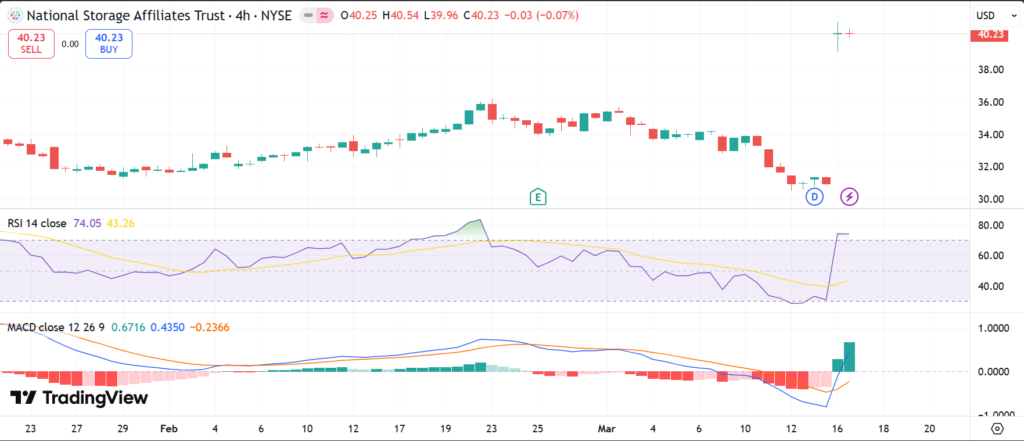
Support levels represent price zones where demand historically outweighed supply, while resistance levels show where selling pressure often emerges. NSA support and resistance therefore help investors frame short‑term risk versus reward. On momentum measures, an NSA RSI analysis would likely show a reading in the neutral band, suggesting the stock is neither overbought nor deeply oversold after its recent consolidation.
The MACD, which tracks the relationship between shorter and longer moving averages, appears close to flat, consistent with a sideways trend and no decisive bullish or bearish signal yet. NSA stock price has been oscillating around its 50‑day moving average, while the 200‑day moving average sits not far below, indicating that the long‑term trend is stabilizing after prior declines. The absence of a clear golden cross or death cross suggests that the market is still waiting for more fundamental news before re‑rating the shares.
Trading volume for NSA stock has been roughly in line with its recent average, with occasional spikes around earnings and dividend news. This indicates that large long‑term holders have not dramatically changed positions, though short‑term traders continue to react to data releases. For beginners, these indicators mean NSA stock forecast in the near term is driven more by news flow and rates sentiment than by pure technical momentum.
Analyst Ratings & Price Targets
Sell‑side coverage of NSA stock currently leans cautious. According to recent data, analysts as a group have assigned an average rating closer to “Reduce” or “Hold” rather than a clear “Buy.” For example, one source notes that around eight analysts rate NSA stock, with most classifying it as a Hold and a minority recommending Sell, while the consensus NSA price target sits roughly around 32 to 33 dollars per share.
That consensus NSA price target is slightly below the latest NSA stock price, implying limited expected upside in the near term. The highest price targets reach into the mid‑30s, while the lowest fall into the high‑20s, reflecting genuine disagreement about NSA valuation as interest rates and storage demand evolve. Some research desks have trimmed targets or ratings in recent quarters as growth slowed and payout ratios rose, while others maintain neutral stances, pointing to resilient occupancy and income potential.
For investors, this analyst split means NSA stock forecast on Wall Street is modest and risk‑aware. The lack of strong Buy conviction suggests that many professionals see NSA stock as suitable for income and defensive positioning, but not as a high‑growth story. When investors ask, “Is NSA stock a buy?”, the Street’s message is closer to “selective Hold” than “strong accumulation” at current levels.
Insider Activity
Recent NSA insider activity has not shown an aggressive wave of insider buying that would clearly signal strong confidence, nor a mass exit that would flag severe concern. Public filings point to routine equity grants and occasional sales by executives and trustees, which are common in REIT structures where compensation includes stock. Large one‑off transactions have been limited, and no recent insider move has fundamentally changed the ownership picture.
Moderate insider selling can reflect portfolio diversification or tax planning rather than a direct view on NSA forecast. In contrast, sustained open market buying by top management would typically be interpreted as a stronger vote of confidence in NSA long term outlook. With NSA insider activity currently mixed and relatively modest, investors should weigh it as a secondary input behind fundamentals, rather than a primary trading signal.
Valuation Analysis
On valuation, NSA stock trades like a mature income‑oriented REIT rather than a high‑growth technology name. Recent data indicate a high trailing P/E ratio, influenced by non‑cash items and REIT accounting, while the forward P/E based on funds from operations and normalized EPS looks more reasonable but still not cheap relative to lower‑risk bonds. Price‑to‑sales metrics show NSA valued at a multiple that reflects its recurring rent base, but below premium software or AI names such as Microsoft, which command much richer ratios due to stronger growth prospects.
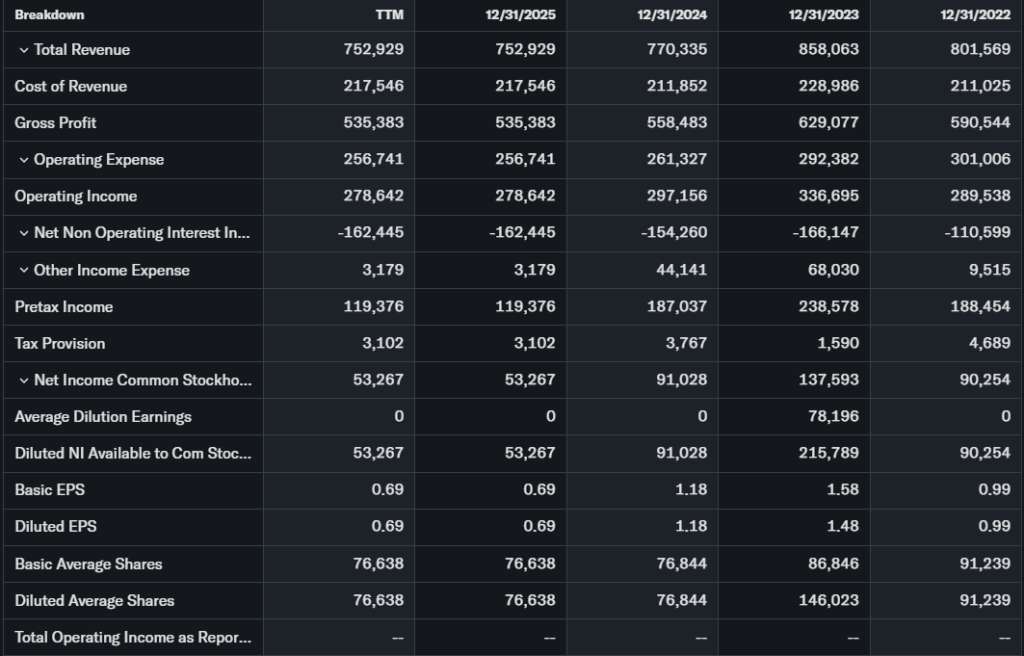
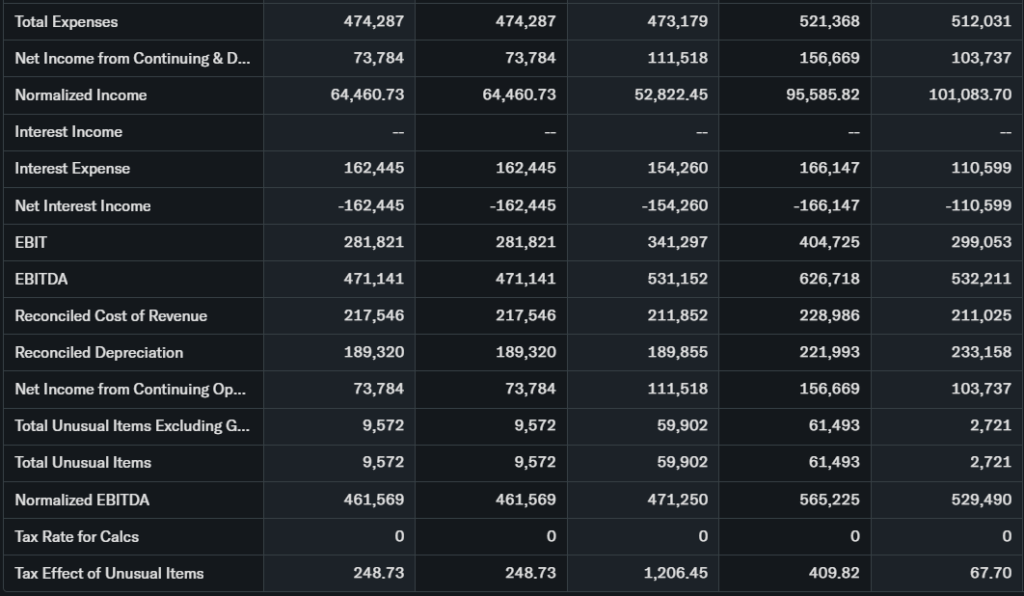
Revenue growth year over year has slowed to low single digits, with recent guidance signaling same‑store total revenue growth between roughly negative 0.3 percent and positive 2.1 percent. This modest NSA revenue growth outlook, combined with pressure from higher operating costs and refinancing expenses, limits the case for a high growth multiple. EPS growth has also been constrained as interest costs and property taxes weigh on margins, even as occupancy and pricing remain relatively stable.
Free cash flow and funds from operations are still solid enough to support the dividend, but the payout ratio is elevated, with one report citing a ratio above 300 percent on traditional earnings measures. NSA carries meaningful debt, as is common for REITs, but also maintains access to capital markets and a diversified portfolio of properties. Compared with higher‑growth platforms like Zoom or software giants like Microsoft, NSA valuation looks income‑driven and fairly valued to slightly rich given its slower growth, though still attractive for investors who prioritize yield over capital appreciation.
When investors search for “NSA stock valuation,” they should view the shares as primarily a yield vehicle with moderate growth optionality. At current levels, NSA stock appears closer to fairly valued than deeply undervalued, leaving a margin of safety that depends heavily on stable cash flows and disciplined capital allocation.
Recent Earnings & Catalysts
In its most recent quarter, National Storage Affiliates Trust reported revenue of about 187 million dollars, roughly in line with market expectations. However, NSA earnings per share missed consensus estimates, with one report noting EPS of 0.23 dollars versus expectations of around 0.55 dollars. For the full year, NSA generated total revenue of about 753 million dollars and net income close to 74 million dollars, underscoring the scale of its storage platform.
The company also provided guidance that shapes NSA forecast for the coming periods. One source highlighted 2026 diluted EPS guidance of roughly 0.93 to 1.03 dollars and same‑store revenue growth close to flat to low single digits. Another source mentioned broader full‑year EPS guidance around the low‑to‑mid 2 dollar range, reflecting different definitions and adjustments used by analysts. NSA declared a quarterly dividend of 0.57 dollars per share, or 2.28 dollars annualized, which implies a yield in the high‑single‑digit range at the current NSA stock price.
These NSA quarterly results and the steady dividend reinforce the income case but also highlight that growth is slowing. Earnings misses and cautious revenue guidance limited post‑report upside in NSA stock, though the robust dividend has continued to attract income seekers. Future catalysts include further guidance updates, any portfolio optimization moves, and changes in interest rate expectations that could alter the relative appeal of REIT yields.
Bullish Case
The bullish case for NSA stock centers on resilient demand for self‑storage, attractive income, and operational discipline. Self‑storage has proven relatively defensive, as individuals and small firms often continue renting space even in slower economic periods. NSA’s portfolio of geographically diversified properties creates recurring cash flows that support a generous dividend, which can be compelling versus fixed‑income yields if rates stabilize or decline.
Potential revenue growth catalysts include modest rent increases, improved occupancy, and selective acquisitions if valuations in the sector remain attractive. Technology and process improvements across marketing, pricing, and property management can also support margins, even if top‑line growth is slow. For long‑term holders, NSA long term outlook could benefit if the company uses its scale to optimize the portfolio and refinance debt on better terms when the rate environment improves.
Bearish Case
The bearish case focuses on slower growth, cost pressures, and rate sensitivity. Guidance for only flat to low‑single‑digit same‑store revenue growth suggests that NSA revenue growth may struggle to outpace rising costs, especially property taxes, marketing spend, and interest expenses. If occupancy softens or competition intensifies from other storage operators, pricing power could weaken, further squeezing margins.
High payout ratios increase risk, because maintaining the current dividend requires stable or growing cash flows. If NSA earnings disappoint again or free cash flow tightens, management could face a hard choice between funding growth, preserving the balance sheet, and supporting the current dividend level. Rising or persistently high interest rates would also put pressure on NSA valuation, as investors demand more yield to hold REIT risk over safer bonds.
Market Sentiment & Investor Psychology
Market sentiment toward NSA stock is best described as cautious but not deeply pessimistic. Short interest appears moderate rather than extreme, indicating that while some traders bet against further upside, NSA is not a heavily targeted short opportunity. Options activity around NSA tends to pick up near earnings and dividend dates, with a mix of calls from yield‑oriented buyers and puts from hedgers who fear rate or earnings surprises.
Institutional ownership remains significant, as many income and REIT funds hold NSA as part of diversified portfolios. Some institutions have recently added or trimmed positions, reflecting standard portfolio rebalancing rather than a wholesale shift in conviction. Retail investors are drawn by the yield but may be less familiar with REIT‑specific risks, leading to bouts of volatility when headlines around NSA stock price, NSA earnings, or dividends hit feeds.
Overall, sentiment is closer to neutral than either fearful or euphoric. NSA stock technical analysis suggests consolidation, while valuation and dividend appeal support a base of long‑term holders. Investors currently show a blend of income bias and moderate risk aversion rather than aggressive momentum buying.
Short-Term Outlook
Over the next several days and weeks, NSA stock forecast is likely to depend more on macro factors and interest‑rate expectations than on company‑specific news. With technical indicators neutral and NSA support and resistance levels well‑defined, the stock may continue trading in a range around the low‑ to mid‑30s unless a major catalyst emerges. Volume spikes around any new guidance, macro data, or REIT‑sector moves could briefly push NSA stock price above resistance or below support.
Given these conditions, short‑term traders should expect modest swings rather than a sustained trend without fresh news. NSA RSI analysis and MACD readings reinforce the idea of consolidation rather than a strong breakout signal at this stage. A realistic short‑term expectation is continued range‑bound action with a bias toward stability as long as the dividend remains credible and broader markets avoid sharp risk‑off episodes.
Medium to Long-Term Outlook
Over 6 to 24 months, NSA long term outlook hinges on business model resilience, industry growth, and financial discipline. The self‑storage model remains structurally attractive, offering recurring rental income that can compound over time, especially if NSA continues to optimize pricing and occupancy. Industry growth is slower than high‑growth tech, but it can still be solid if population shifts and small‑business demand support storage usage.
Competitive position matters: NSA operates in a fragmented market with many local and regional players, which creates both risk and opportunity. Effective integration of acquired properties, technology‑enabled management, and brand recognition can help NSA stand out. Financial health will remain under scrutiny, as investors watch leverage levels, refinancing terms, and the balance between dividends, capital expenditures, and potential acquisitions.
If execution is steady and the interest‑rate backdrop becomes more supportive, NSA stock could offer attractive total returns for patient income investors through dividends plus modest capital appreciation. In that scenario, long‑term investors may consider accumulating on dips rather than chasing rallies, treating NSA stock as a core income holding rather than a high‑beta growth trade.
FAQ Section
Is NSA stock a buy right now?
NSA stock is closer to a Hold than a clear Buy based on current analyst views, modest growth, and fair valuation. Income‑focused investors comfortable with REIT risks may still find NSA appealing for its dividend, while growth‑oriented investors might look elsewhere.
What is the price target for NSA stock?
Recent consensus figures show an average NSA price target around 32 to 33 dollars per share, slightly below the current NSA stock price. Individual targets range from the high‑20s to the mid‑30s, reflecting differing views on earnings and rates.
What are major risks for NSA stock?
Key risks include slow NSA revenue growth, high payout ratios, refinancing at higher interest rates, and competitive pressure in self‑storage. A weaker economy or prolonged high rates could weigh on NSA earnings and NSA valuation.
How did the latest NSA quarterly results look?
Recent NSA quarterly results showed revenue in line with expectations but an EPS miss, along with cautious guidance for future earnings. The company maintained a sizable dividend, reinforcing its income profile.
What is NSA stock long term outlook?
NSA long term outlook is moderate: the business model is resilient, but growth is likely to be gradual, not rapid. For long‑term investors seeking income, NSA stock may fit as a patient Hold or selective Accumulate rather than a speculative play.
Suggestion
For readers interested in similar income and tech‑adjacent names, consider internal links such as:
“Compare with Opendoor stock” for contrasting income REITs with growth software.
“See our Microsoft stock forecast” to understand how large‑cap tech valuations differ from REITs.
“Read our tech sector valuation breakdown” for context on how NSA stock valuation fits into broader market pricing.
Conclusion
Overall, NSA stock offers a compelling dividend and a stable self‑storage platform, but faces headwinds from slower growth and higher financing costs. Recent NSA earnings and guidance suggest that investors should not expect rapid expansion, yet the income profile remains attractive for those prioritizing yield over capital gains.
Given the current balance of risks and rewards, a balanced view is that NSA stock is a Hold for existing income investors and a Watchlist or selective Accumulate on pullbacks for those building a diversified income portfolio. NSA stock technical analysis and valuation point to moderate upside potential if execution remains solid and the rate backdrop improves, but not to a high‑conviction growth story.
Disclaimer: This article is for informational purposes only and not financial advice.