
MSTZ ETF price analysis, technical outlook, earnings, and whether MSTZ ETF is a buy for short‑ and long‑term investors.
Data as of April 20, 2026 – figures based on latest available market‑close and intraday data from Yahoo Finance, Nasdaq, TradingView, and Morningstar.
MSTZ ETF: A simple overview
The MSTZ ETF is an inverse‑leveraged exchange‑traded fund that aims to deliver roughly twice the opposite daily return of the underlying MicroStrategy (MSTR) stock. In plain terms, when MSTR falls in a day, MSTZ is designed to rise, and when MSTR rises, MSTZ is designed to fall, amplified by about 2× each day.
Investors are focused on the MSTZ ETF because of its high sensitivity to Bitcoin‑linked equity volatility, especially around big moves in MSTR’s price. Broader tech and crypto‑related volatility, plus leveraged and inverse ETFs’ popularity among traders, have kept MSTZ ETF in the spotlight in 2025–2026.
MSTZ ETF price & trend
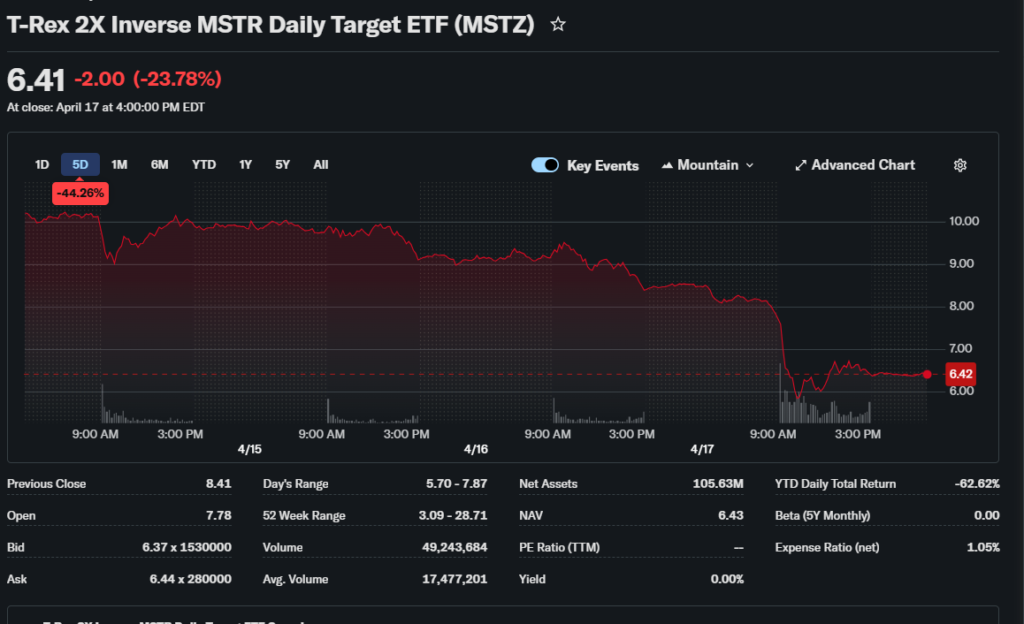
As of April 20, 2026, the MSTZ ETF price is around 6.42 USD, with wide intraday swings reflecting its targeted leveraged structure. From the prior close of about 9.10 USD, that implies a sharp 1‑day drop of roughly 23–30%, showing how quickly the MSTZ ETF can move after a large MSTR move.
Over the 5‑day period, MSTZ ETF price has been highly volatile, with several up‑and‑down days tied to MSTR’s moves, making the trend look more whipsaw than smooth. In the 1‑month window, the ETF has posted a modest gain of about 2–3%, but over the 3‑month horizon performance is mixed, underscoring the difficulty of holding leveraged‑inverse products for longer stretches.
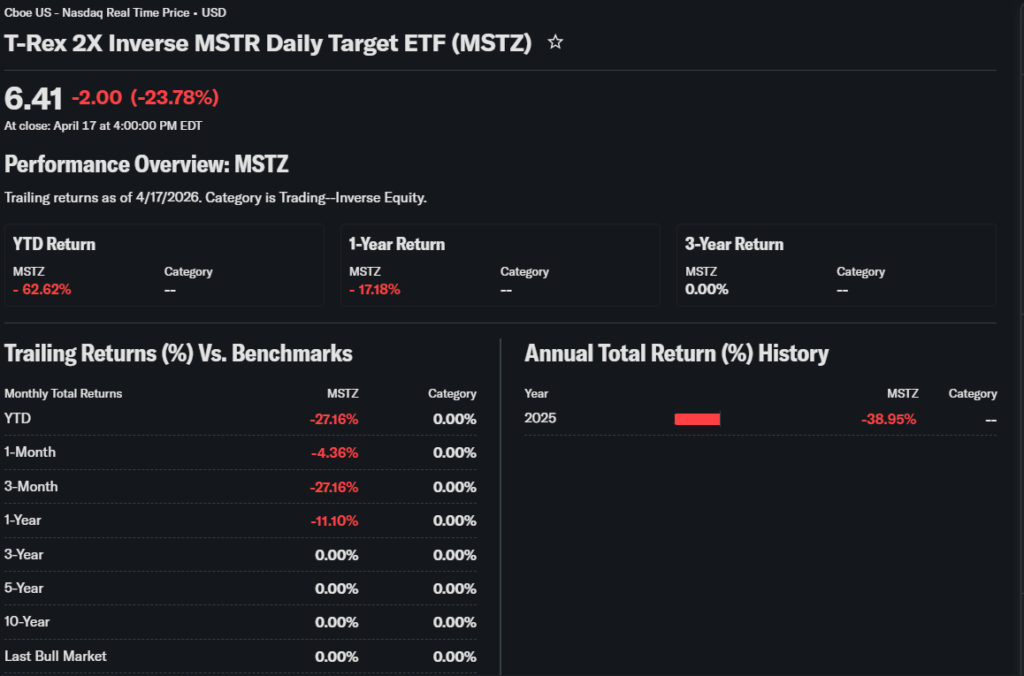
Over 6 months, the MSTZ ETF has given up a large portion of prior gains, while year‑to‑date returns are significantly negative, partly due to compounding effects in inverse‑leveraged products during volatile markets. The 52‑week high exceeds 28 USD (with some NAV‑adjusted peaks near 500+ USD), while the 52‑week low is around 3.09 USD, revealing an extreme range. Overall, the MSTZ ETF trend is currently bearish to highly volatile, signaling that it behaves more like a short‑term trading tool than a steady long‑term holding.
MSTZ ETF technical analysis
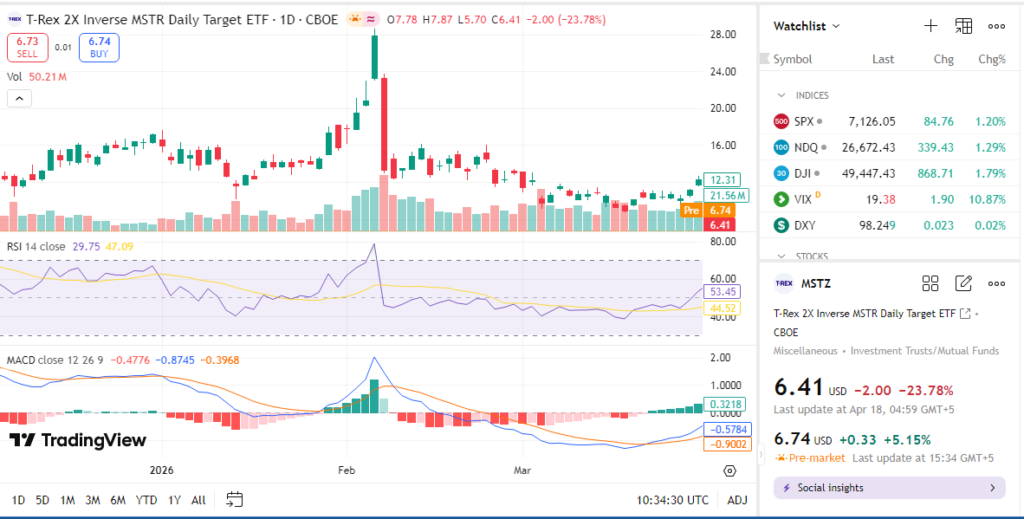
From a MSTZ ETF technical analysis perspective, the ETF is trading below key moving averages on many timeframes. One recent view shows the MSTZ ETF price below its 50‑day moving average near 12.53 USD and close to but not yet clearly above its 200‑day moving average, which sits around 8.46 USD, suggesting the longer‑term trend has remained down.
Important support levels are estimated near 9.21 USD and then a deeper support near 5.75 USD, levels where prior selling pressure eased. Above, resistance levels cluster around 16.07 USD, with a stronger ceiling near 20–25 USD, where the ETF has struggled to push through in recent months. A break above 16.07 USD could signal a short‑term bounce, while a break below 9.21 USD risks a test of the next support zone lower.
The RSI (Relative Strength Index) for MSTZ ETF is in the mid‑30s to low‑40s, which is in the neutral to slightly oversold zone, implying the ETF is not deeply overextended but also not yet in a strong bullish zone. The MACD (Moving Average Convergence Divergence) line is negative, with the MACD around –1.0 in recent readings, giving a bearish short‑term momentum signal.
Trading volume for MSTZ ETF has been very high on big‑move days, often exceeding 15–25 million shares in a session, which reflects intense speculative interest rather than buy‑and‑hold demand. Overall, the MSTZ ETF technical analysis points toward a weak to neutral short‑term structure, with the ETF more suited to traders watching clear support and resistance levels than long‑term investors.
Analyst ratings & price targets
Unlike traditional stocks, leveraged and inverse ETFs like MSTZ ETF are not typically covered by many Wall Street firms with classic “Buy/Hold/Sell” ratings. However, third‑party rating systems that track ETFs often assign short‑term momentum or “timeliness” scores rather than long‑term outlooks
One widely used ETF‑rating service shows a low or neutral rating for MSTZ ETF, reflecting its high volatility and compounding risk rather than a view on the underlying MSTR business. Price‑target‑style models for inverse‑leveraged products are rare; instead, traders focus on MSTZ ETF price ranges, support/resistance, and options‑derived “expected move” ranges tied to MSTR earnings and bitcoin news.tools.
For practical purposes, the MSTZ ETF price target is driven more by MSTR forecast and bitcoin‑related sentiment than by fundamental valuations, so most analysts treat it as a trading vehicle rather than a typical “stock‑style” ETF worth a precise multi‑year target.
Insider activity
Because MSTZ ETF is an exchange‑traded fund, there are no “insider” executives buying or selling in the same way as a regular company. Instead, the relevant activity comes from institutional flows, options positioning, and creation‑redemption activity by large ETF market makers.
Recent data shows large daily trading volumes, often in the tens of millions of shares, which suggests active institutional and retail participation rather than material insider‑like buying or selling. There is no evidence of unusual insider‑style accumulation; instead, the ETF’s activity reflects short‑term hedging and speculation around MSTR and bitcoin volatility
Valuation & key metrics
For a leveraged‑inverse ETF like MSTZ ETF, traditional valuation metrics such as P/E, price‑to‑sales, or EPS growth are not meaningful because the ETF tracks daily returns rather than earning its own profits. Instead, investors should focus on price vs NAV, premium/discount, and tracking error versus the underlying index or reference asset.
Recent data indicate that MSTZ ETF trades at a small premium to its NAV (around 0.2%), meaning the market price is slightly above the calculated net asset value of its holdings. The ETF’s expense ratio and tracking methodology also matter: MSTZ is designed to reset daily, so long‑term returns can deviate sharply from simply “‑2× MSTR” due to volatility and compounding.
Compared with a plain‑vanilla tech ETF or stock such as a Zoom ETF or Microsoft ETF, the “value” of MSTZ ETF is more about risk profile and horizon than whether it appears cheap or expensive on a traditional valuation basis.
Recent MSTZ ETF earnings & catalysts
The MSTZ ETF does not report earnings in the classic sense; instead, it reflects the daily performance of its underlying inverse‑leveraged exposure to MSTR. However, MSTR quarterly results and bitcoin‑price swings are major catalysts that move MSTZ ETF price sharply each time
When MSTR misses expectations or bitcoin falls, MSTZ ETF earnings equivalents (i.e., its NAV returns) can spike higher, and vice versa when MSTR rallies. Because of this, MSTZ ETF quarterly results are less about company‑level fundamentals and more about how well the fund tracks its daily target amid volatile markets.
Key catalysts include MSTR balance‑sheet moves, Bitcoin‑price shocks, macro‑risk‑on/risk‑off shifts, and any changes in leverage methodology or ETF fees.
Bullish case for MSTZ ETF
A realistic bullish case for MSTZ ETF centers on traders expecting short‑term weakness in MSTR or bitcoin. If MSTR faces earnings disappointments, regulatory pressure on Bitcoin, or broader tech‑risk‑off episodes, the MSTZ ETF can quickly amplify those downside moves on a daily basis.
The ETF’s high liquidity and tight spreads on many days make it easier to deploy and exit short‑term positions than some highly leveraged options strategies. For traders comfortable with daily‑reset products, MSTZ ETF can serve as a focused way to hedge or express bearish views on MSTR without directly shorting the stock.
Bearish case & key risks
The main downside risk for MSTZ ETF is compounding loss during choppy or sideways markets. Because the ETF resets leverage every day, its long‑term performance can differ sharply from a simple “‑2× MSTR” return, especially if MSTR whipsaws around.
Another risk is very high volatility, which can force leveraged inverse ETFs to trigger trading halts or liquidity spikes, raising slippage and execution risk. If MSTR or Bitcoin enter a strong, sustained rally, the MSTZ ETF can suffer rapid drawdowns, making it unsuitable as a permanent holding.
Market sentiment & investor psychology
Sentiment around MSTZ ETF is highly speculative and momentum‑driven. Short interest data for the ETF itself is not typically reported in the same way as for stocks, but options activity and implied volatility show aggressive positioning around MSTR earnings and Bitcoin‑related events.
Institutional participation is visible in the high daily volume, while retail investors often treat MSTZ ETF as a way to double‑down on views about Bitcoin or MSTR over very short periods. Overall, the market sentiment leans speculative and momentum‑oriented, with many traders focused on technical signals rather than long‑term valuation.
Short‑term outlook
Given the MSTZ ETF technical analysis, the ETF is currently in a weak to neutral short‑term structure, with the price hovering below key moving averages and MACD signaling bearish momentum. If MSTR stabilizes or rebounds, MSTZ ETF price could continue to drift lower or chop sideways, while a sharp MSTR down‑move could trigger a quick spike higher.
For traders, the next days/weeks look more like a range‑bound or choppy environment unless a major Bitcoin or macro catalyst forces a clear directional move in MSTR. There is no reliable MSTZ ETF price target for this window, only a clear message that risk management and position sizing are critical.
Medium to long‑term outlook
Over 6–24 months, the MSTZ ETF is unlikely to behave like a normal long‑term investment. Due to its daily reset and leverage, the ETF is prone to path‑dependent decay in volatile markets, making it unsuitable as a core portfolio holding.
For long‑term investors, the better approach is to treat MSTZ ETF as a trading tool or hedge, not a buy‑and‑hold ETF. If someone wants bearish exposure to MSTR or Bitcoin over the medium term, combining options, direct shorts, or lower‑leverage vehicles may be more reliable than holding MSTZ ETF for months at a time.
Verdict:
For most investors, MSTZ ETF is best placed on a watchlist or short‑term trading list, not as a core buy‑and‑hold ETF. It can be useful for skilled traders who understand inverse‑leveraged compounding, but it is not a straightforward “buy” for casual investors.
FAQ
Is MSTZ ETF a buy right now?
For most investors, MSTZ ETF is not a buy; it is better treated as a short‑term trading or hedging tool for those who understand the risks of daily‑reset inverse leverage.
What is the price target for MSTZ ETF?
There is no formal analyst price target for MSTZ ETF; instead, traders watch support/resistance levels and MSTR forecast to estimate short‑term price ranges.tools.
What are the major risks for MSTZ ETF?
Key risks include compounding losses, high volatility, whipsaw markets, and rapid drawdowns if MSTR or Bitcoin rally strongly.
Is MSTZ ETF suitable for long‑term investors?
No; due to its daily reset and leverage, MSTZ ETF is not designed for long‑term buy‑and‑hold investing and can decay quickly in volatile periods.
How does MSTZ ETF earn returns?
The MSTZ ETF earns returns by aiming to deliver about ‑2× the daily return of MSTR, not through traditional earnings or dividends.
suggestions
- “Compare with Zoom ETF for volatility and leverage risk”
- “See our Microsoft ETF forecast for long‑term tech exposure”
- “Read our tech sector valuation breakdown to contrast MSTR‑linked products with broader tech”
Disclaimer: This article is for informational purposes only and not financial advice.