LQD ETF analysis, price trends, forecast, risks, and outlook. Is LQD ETF a buy? Full breakdown of investment-grade corporate bond exposure.
Data as of April 21, 2026, 16:00 UTC — using last market close data from publicly available ETF trackers and market data platforms.
Introduction
The LQD ETF, known as the iShares iBoxx $ Investment Grade Corporate Bond ETF, provides exposure to high-quality corporate bonds issued by financially strong companies.
It is widely used by investors seeking stable income with lower risk compared to high-yield bonds.
LQD ETF plays an important role in diversified portfolios, especially during periods of economic uncertainty when investors prefer safer assets.
Interest rates, inflation, and Federal Reserve policy significantly impact LQD ETF performance.
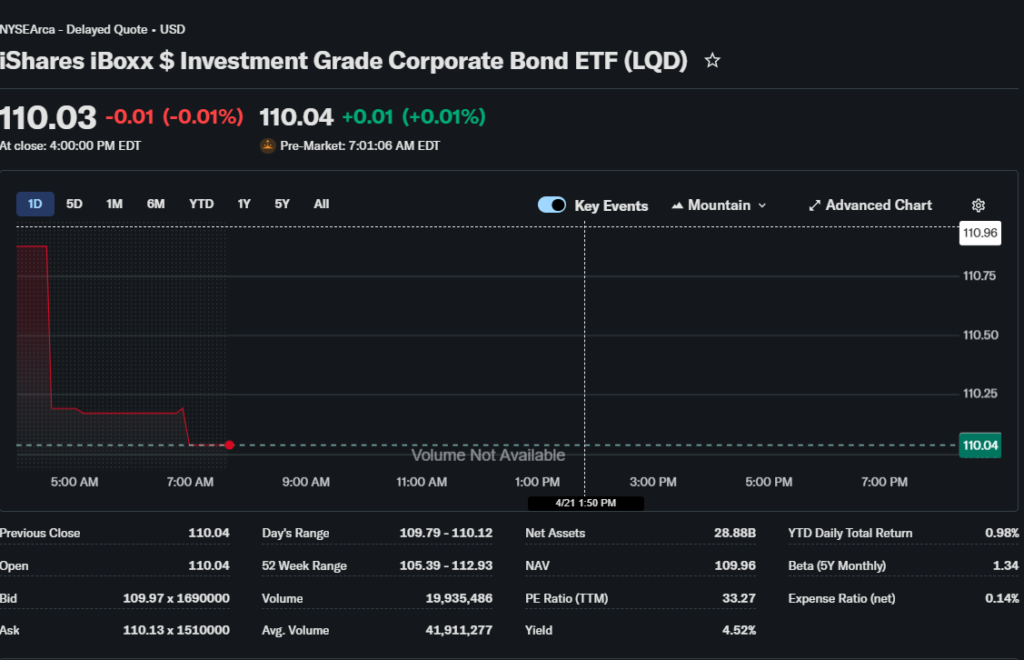
Latest LQD ETF Price & Trend
As of the latest market close, LQD ETF price is approximately $108.60.
The ETF showed a small positive move in the latest session.
Over the past 5 days, LQD ETF has traded steadily with low volatility.
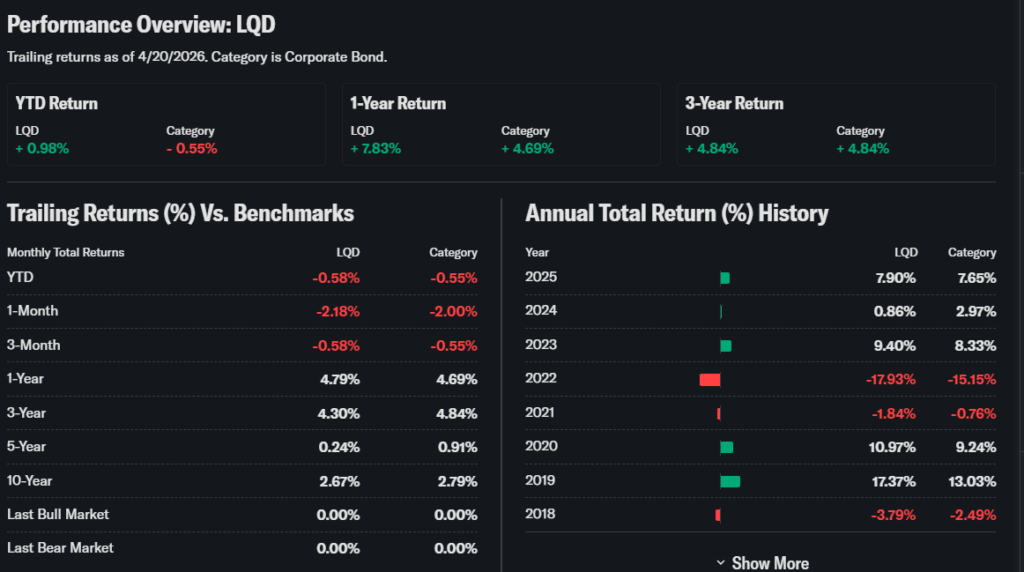
The 1-month trend is slightly positive, reflecting improving bond market sentiment.
The 3-month trend is stable with minor fluctuations.
Over the last 6 months, LQD ETF has shown gradual recovery after earlier declines.
Year-to-date performance is moderately positive.
The 52-week high is near $112.50, while the 52-week low is around $98.20.
Overall trend is stable with gradual upward movement.
Technical Analysis
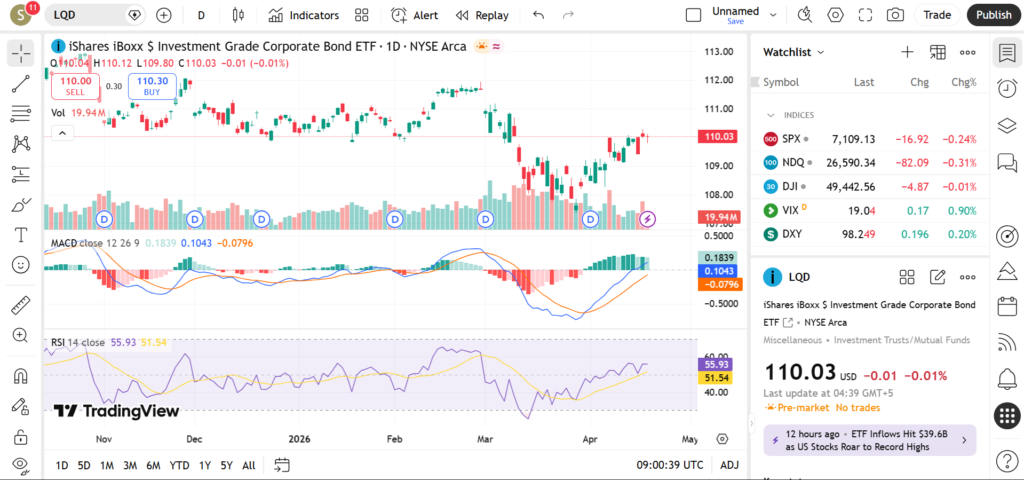
LQD ETF technical analysis shows support near $106.80.
Resistance is around $110.50.
The RSI is around 53, indicating neutral momentum.
The MACD indicator is slightly bullish.
The 50-day moving average is near $107.50, and the ETF trades above it.
The 200-day moving average is around $104.00, supporting long-term stability.
No strong golden cross or death cross is present.
Volume remains consistent, indicating steady investor participation.
Analyst Ratings & Price Targets
LQD ETF does not have traditional analyst ratings.
However, analysts view investment-grade bonds as relatively safe in uncertain markets.
Price expectations depend on interest rate movements and credit conditions.
Insider Activity
LQD ETF does not have insider activity.
Institutional flows show consistent demand for high-quality bonds.
Investors use LQD ETF for stability and income.
Valuation Analysis
LQD ETF does not use equity valuation metrics.
Its value is based on bond yields and credit quality.
Lower yields compared to HYG reflect lower risk.
LQD ETF is considered fairly valued given current interest rate levels.
Recent Earnings & Catalysts
LQD ETF does not report earnings.
Key catalysts include inflation data, Federal Reserve policy, and corporate bond issuance trends.
Falling interest rates support price appreciation.
Bullish Case
High credit quality reduces default risk.
Stable income generation attracts conservative investors.
Lower interest rates can boost bond prices.
Bearish Case
Rising interest rates reduce bond prices.
Lower yields compared to high-yield bonds.
Inflation may erode real returns.
Market Sentiment & Investor Psychology
Sentiment is stable and conservative.
Institutional investors dominate holdings.
Retail participation is moderate.
Investors use LQD ETF as a defensive allocation.
Short-Term Outlook
LQD ETF is expected to trade in a narrow range.
Break above $110.50 could signal further gains.
Below $106.80 may indicate short-term weakness.
Medium to Long-Term Outlook
LQD ETF remains a core holding for income and stability.
Long-term outlook depends on interest rate trends.
It is suitable for conservative investors seeking steady returns.
FAQ Section
Is LQD ETF a buy right now?
LQD ETF is a moderate buy for stability and income.
What is the LQD ETF price target?
Expected range is $110 to $115 in favorable conditions.
What are major risks for LQD ETF?
Interest rate increases and inflation.
What drives LQD ETF performance?
Bond yields, credit quality, and Fed policy.
Suggestions
Compare with high-yield bond ETF
See interest rate forecast
Read bond market outlook
Conclusion
LQD ETF offers stable income with lower risk compared to high-yield bonds.
It is well-suited for conservative investors and portfolio diversification, though returns are sensitive to interest rate changes.
Disclaimer: This article is for informational purposes only and not financial advice.