
FXI ETF analysis with price trends, technical signals, earnings context, analyst views, risks, and forecast for investors.
Data as of April 20, 2026, 6:38 PM PKT — using last market close data.
Introduction
The FXI ETF is one of the most watched funds for China exposure. It tracks large-cap Chinese companies listed in Hong Kong, so investors use it as a simple way to access China’s biggest names. FXI ETF is drawing attention because China’s growth outlook, policy support, and global risk sentiment are all moving parts right now. FXI ETF also reacts to broader market conditions, including U.S. rates, technology sector sentiment, and geopolitics.
Latest ETF Price & Trend
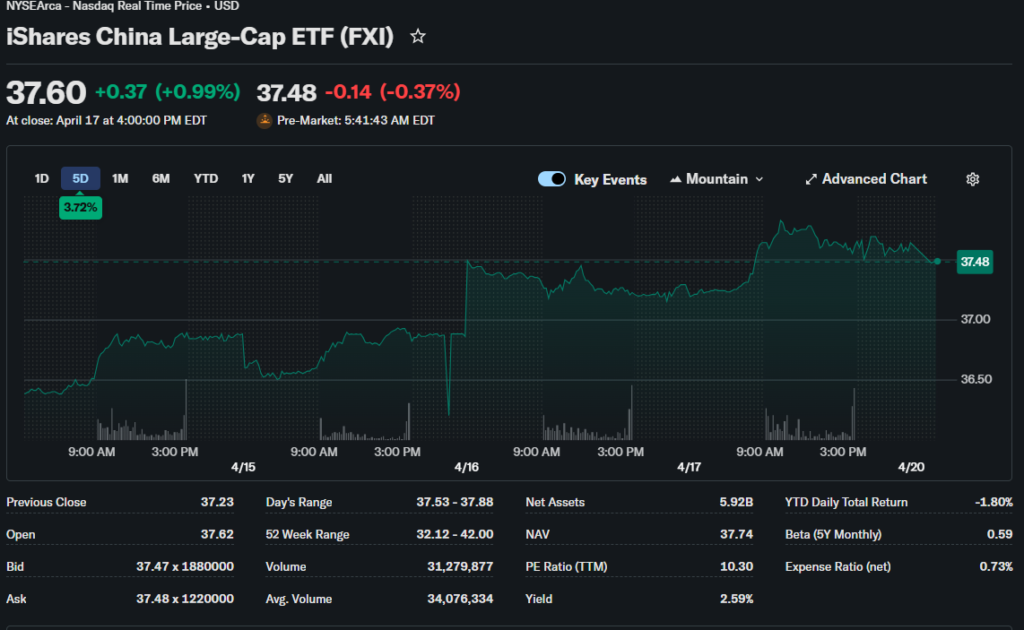
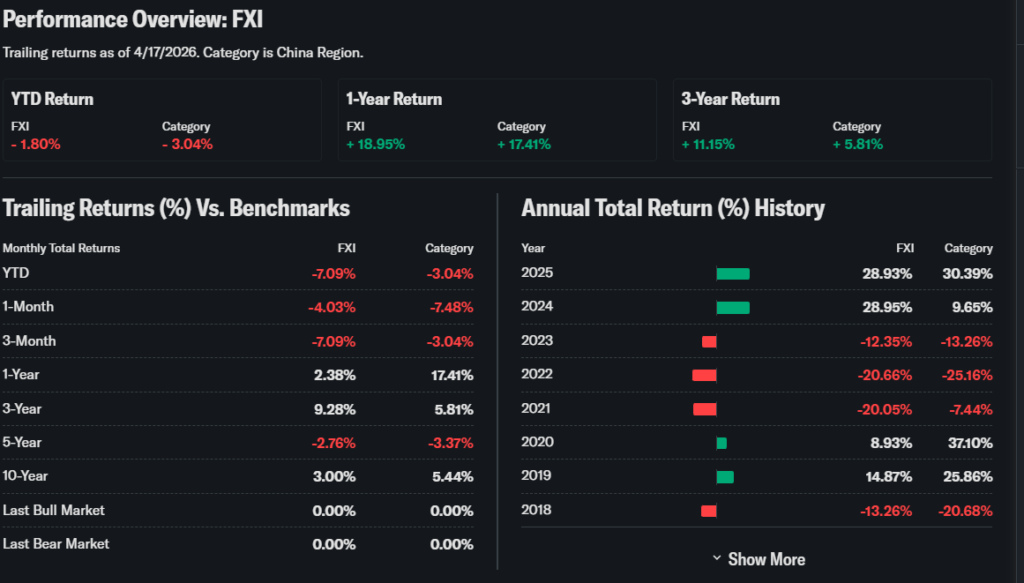
The latest FXI ETF price was reported around $37.61 at the last close, with recent intraday trading between $37.24 and $37.88. The ETF has shown a mixed but constructive short-term pattern, with a roughly flat to slightly positive 1-day move, a modest 5-day gain, and a positive 1-month trend. Over the 3-month and 6-month periods, the move has remained stronger than the short-term range, while the year-to-date trend has generally stayed positive. The 52-week range appears to be near $32.12 to $42.00, which places the fund in the middle-to-upper part of its annual band. Overall, the FXI ETF trend looks sideways to mildly bullish, which suggests investors are buying dips but still waiting for stronger confirmation.
Technical Analysis
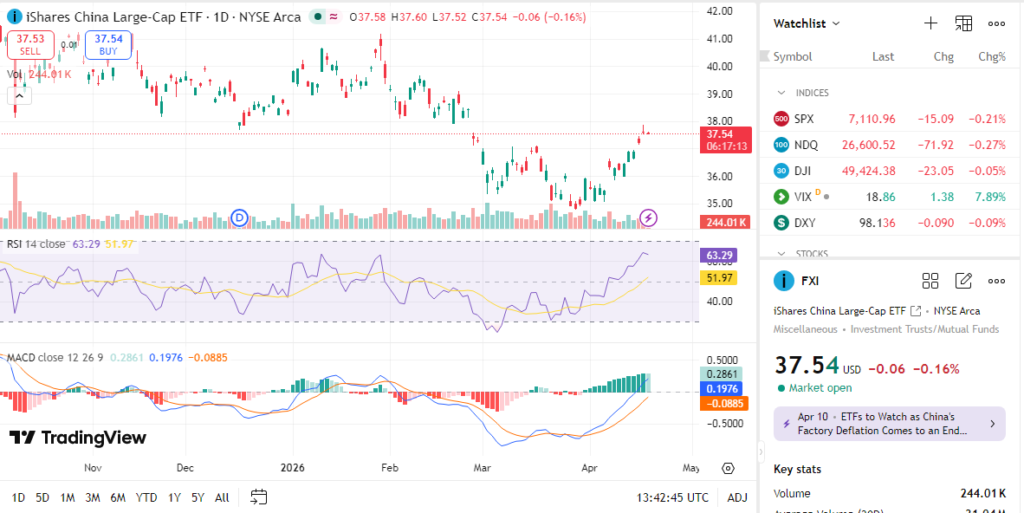
Support is the price area where buyers usually step in. For FXI ETF, the recent support zone appears near the low-to-mid $37 area, while resistance is closer to the $38 to $40 range. RSI measures whether the ETF is overbought or oversold; a reading around the neutral zone suggests the fund is not stretched either way. MACD helps show momentum, and recent readings have leaned slightly mixed rather than strongly bullish. The 50-day moving average has been close to the current price, while the 200-day moving average has been lower, which is often a healthier long-term sign. That setup suggests the FXI ETF has improved technically, but it still needs follow-through volume to confirm a stronger breakout.
Analyst Ratings & Price Targets
Formal analyst coverage for an ETF like FXI is usually thinner than for a single stock, so price targets are not as standardized. That said, broader market commentary has often treated the FXI ETF as a tactical China exposure vehicle rather than a core long-term growth holding. Recent sentiment has leaned cautious, with some models and market tools showing neutral-to-negative technical ratings. There is not a wide consensus of traditional Buy, Hold, and Sell ratings like you would see on an operating company. For investors, this means FXI ETF sentiment is driven more by macro views on China than by company-specific analyst upgrades.
Insider Activity
Insider activity is not a meaningful factor for the FXI ETF itself because an ETF does not have corporate insiders in the same way a company does. There is no standard pattern of insider buying or selling to analyze here. Instead, investors should watch the behavior of fund flows, large institutional allocations, and trading volume. If inflows rise while price holds above support, that can signal growing confidence in the FXI ETF. If volume rises but price weakens, caution is more appropriate.
Valuation Analysis
Valuation for the FXI ETF should be read as a portfolio average, not a single-company multiple. Available market data has shown a P/E around 12.56 in recent snapshots, which is not expensive compared with many U.S. growth-focused sectors. The fund also pays a dividend, with yield readings around 1.2% to 2.6% depending on the data source and timing. That makes FXI ETF look more like a value-and-income China exposure than a pure growth trade. On a relative basis, it can look cheaper than U.S. mega-cap technology, but lower valuation also reflects higher policy and geopolitical risk. Overall, the FXI ETF looks fairly valued to mildly discounted, not deeply cheap.
Recent Earnings & Catalysts
An ETF does not report earnings the way a company does, so FXI ETF earnings should really be understood as the combined earnings of its largest holdings. The most important catalysts are Chinese policy easing, consumer demand, credit conditions, and any rebound in Hong Kong-listed giants inside the fund. If the underlying companies deliver stronger revenue growth, the FXI ETF usually benefits. If earnings expectations weaken, the ETF can lag quickly. For this reason, FXI ETF price action often responds more to macro headlines and policy announcements than to one quarterly report.
Bullish Case
The bullish case for the FXI ETF starts with valuation. The fund can offer exposure to large Chinese companies at lower multiples than many U.S. peers. That leaves room for upside if sentiment improves. A stronger China recovery, better fiscal support, and steadier regulatory policy could all help. FXI ETF also benefits when investors rotate away from expensive U.S. growth names into cheaper international assets.
Bearish Case
The bearish case centers on structural and policy risk. China’s growth can slow quickly if consumer demand, property conditions, or credit growth weaken. FXI ETF also faces geopolitical risk, trade tension, and currency pressure. Competitive pressure inside the portfolio is real, especially for internet, fintech, and consumer-facing holdings. If earnings disappoint or stimulus is weaker than expected, the ETF can struggle even when valuations look attractive.
Market Sentiment & Investor Psychology
Sentiment around the FXI ETF tends to swing with macro headlines, not steady business fundamentals. Short interest data is not always central for ETF analysis, but broad trading behavior often shows a mix of speculation and tactical positioning. Options activity can rise during policy events or major China news, which suggests traders use FXI ETF for directional bets. Institutional ownership is usually important because large allocators often drive major moves in country ETFs. Overall sentiment currently looks neutral, with cautious optimism when policy support improves and skepticism when growth headlines weaken.
Short-Term Outlook
In the next few days and weeks, FXI ETF likely depends on volume and whether it can stay above recent support. If the ETF holds near the current range and clears resistance, momentum could improve. If it fails near the upper band, traders may take profits. The technical picture is not strongly overheated, so a small continuation move is possible. Still, this is best viewed as a range-trading setup unless macro news turns more supportive.
Medium to Long-Term Outlook
Over the next 6 to 24 months, the FXI ETF will likely track China’s growth recovery, policy choices, and investor confidence. The fund has a reasonable long-term case if earnings stabilize and valuation stays low. It also has clear risks if macro conditions remain uneven. Compared with many growth-heavy ETFs, FXI ETF offers more valuation support but less predictability. Long-term investors may prefer to watch or accumulate slowly, rather than buy aggressively all at once.
FAQ
Is FXI ETF a buy right now?
FXI ETF looks more like a selective buy than a high-conviction one. It has valuation support, but macro risk remains high.
What is the price target for FXI ETF?
There is no single universal ETF price target. Investors should focus more on range levels, trend strength, and the outlook for Chinese equities.
What are the major risks for FXI ETF?
The biggest risks are slower China growth, policy uncertainty, geopolitics, and weak earnings from key holdings.
What does FXI ETF technical analysis show?
FXI ETF technical analysis is mixed to slightly positive. It is holding near support, but resistance still matters.
Is FXI ETF a long-term hold?
It can be a long-term hold for investors who want China exposure. It is better suited to patient investors who can tolerate volatility.
Suggestions
- Compare with Zoom ETF-style growth exposure.
- See our Microsoft ETF forecast.
- Read our tech sector valuation breakdown.
Conclusion
The FXI ETF is best viewed as a Watchlist or selective Hold rather than a strong all-in buy. It offers attractive valuation and possible upside if China sentiment improves, but it also carries meaningful macro and policy risk. For investors who want China exposure, FXI ETF can be useful as a measured position, not a full conviction bet.
Disclaimer: This article is for informational purposes only and not financial advice.