CRMU ETF analysis covers price trend, technicals, analyst sentiment, earnings, valuation, risks, and forecast for everyday investors.
Introduction
Data as of April 19, 2026, 11:05 AM PKT — using last market close data where noted.
The CRMU ETF is the Leverage Shares 2x Long CRML Daily ETF. It aims to deliver 2x the daily move of Critical Metals Corp. stock, minus fees and expenses. This makes the CRMU ETF a short-term trading tool, not a long-term buy-and-hold fund.
Investors are focused on the CRMU ETF because leveraged funds can move sharply when the underlying stock is volatile. That matters more now because small-cap and commodity-linked names can react strongly to headlines, liquidity, and risk appetite. Broader market caution also matters, since leveraged ETFs tend to amplify both gains and losses.
Latest etf Price & Trend
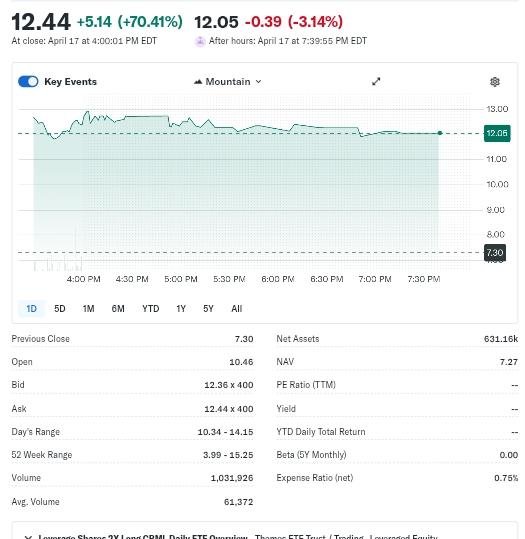
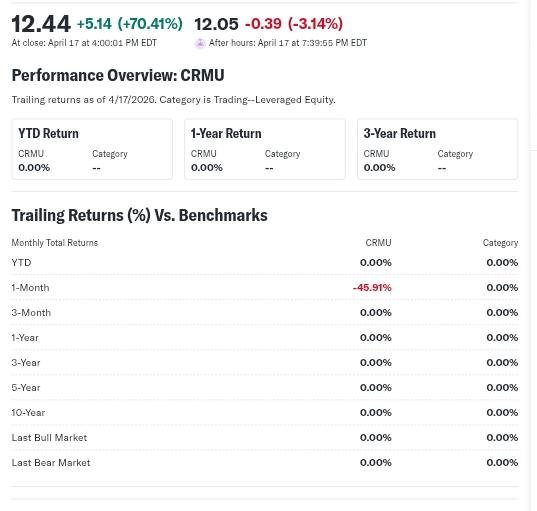
The latest reported market price for the CRMU ETF was $7.33 as of April 16, 2026, while NAV was $7.27. On that date, the ETF traded above NAV by about 0.8%, showing a small premium. The fund also reported a 1-month return of -5.78% for market price and -6.31% for NAV, which points to a weak short-term trend.
The ETF’s inception was 10, 2026, so longer performance windows are limited. The fund says it is designed for daily exposure, and performance over periods longer than one day can differ sharply from 2x the underlying move because of daily rebalancing and compounding. Based on the recent price action and the fund’s structure, the overall trend looks bearish to volatile, which is important for investors who expect clean, linear price moves.
Technical Analysis
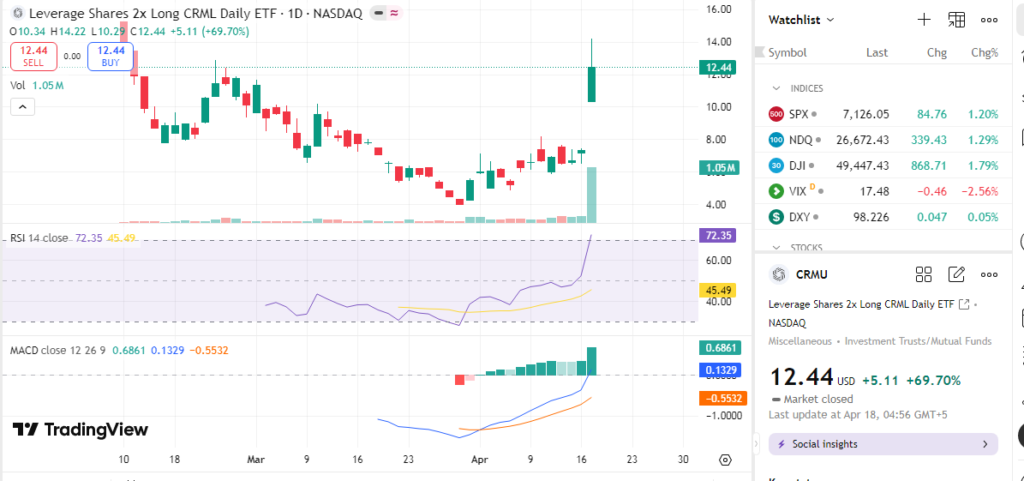
Support is the price zone where buyers may step in and slow a drop. Resistance is the level where selling pressure may appear and block upside. For the CRMU ETF, recent public chart data showed trading between $8.02 and $14.15 on April 18, 2026, with a wider 52-week range of $3.99 to $15.25. That range suggests the ETF can swing fast, so support and resistance levels matter more than usual.
RSI, or Relative Strength Index, measures whether a security may be overbought or oversold. A reading above 70 often signals overbought conditions, while a reading below 30 can suggest oversold conditions. Public chart sources for CRMU ETF technical analysis highlight RSI as a tracked indicator, but a verified RSI reading was not available from the cited fund pages, so any exact number would be speculation. The same caution applies to MACD, 50-day and 200-day moving averages, and golden cross or death cross signals, because the fund’s official source does not publish those values.
Volume trend is still useful. Robinhood data showed volume of 1.05 million shares versus a daily average of 175.03K, which indicates elevated trading interest. High volume in a leveraged ETF can confirm strong conviction, but it can also reflect panic, speculation, or fast hedging.
Analyst Ratings & Price Targets
Traditional Wall Street coverage is limited for the ETF itself, because most research focuses on the underlying company, Critical Metals Corp. Public analyst data for CRML showed a Strong Buy consensus from 2 analysts and an average price target of $13.50. Another analyst summary showed a $14.00 average target from 1 analyst, with 2 Buy, 0 Hold, and 0 Sell ratings.
For the CRMU ETF, this sentiment matters only indirectly because the fund tracks daily CRML exposure. In plain terms, bullish analyst views on CRML can support CRMU ETF upside in the short run, but the ETF still depends on daily price movement, leverage effects, and timing. Because leveraged ETFs reset every day, analyst price targets are less useful than they are for a normal stock.
Insider Activity
Insider activity is not reported for the ETF itself in the same way it is for a company. For the underlying issuer, SEC filing data showed a Form 144 filed on January 14, 2026, which is linked to intended sale of restricted stock by insiders. SEC filing activity also showed additional insider-related filings in March 2026.
That does not automatically mean management is bearish, but it does show that share activity has occurred around the underlying company. For the CRMU ETF, insider buying or selling is not a direct fund signal because the ETF holds swaps, not company shares. So insider activity should be read as a proxy for the underlying stock, not as a direct ETF factor.
Valuation Analysis
Valuation is difficult here because the CRMU ETF is not a normal operating business. The fund itself does not have trailing P/E, forward P/E, sales, revenue growth, EPS growth, cash flow, or debt metrics in the way a company does. Instead, its value depends on the market price of CRML exposure and the costs of running a leveraged product.
For context, the underlying company is still early-stage and loss-making, so standard valuation screens are harder to apply cleanly. Third-party earnings data showed CRML reported -0.06 EPS for Q1 2026, matching expectations. Because of that, the CRMU ETF valuation is best viewed through structure and risk, not traditional multiples. On that basis, the fund looks neither clearly undervalued nor overvalued; it is simply a high-risk trading vehicle tied to a volatile underlying
Recent Earnings & Catalysts
The latest reported underlying earnings event showed CRML delivered -0.06 EPS, which matched estimates. That means there was no big surprise in that quarter, but the company still remains unprofitable. For leveraged holders of the CRMU ETF, earnings matter because any large surprise can quickly move the underlying stock and then magnify the ETF’s daily
The main catalyst is the company’s operating and financing progress, not a stable dividend or mature cash flow model. The ETF also depends on broader catalysts such as lithium and critical metals sentiment, mining-sector headlines, and financing updates. In practical terms, CRMU earnings news can create fast bursts of momentum, but those moves can fade just as quickly.
Bullish Case
The bullish case for the CRMU ETF starts with leverage. If CRML rises sharply in a short period, CRMU can magnify that move on a daily basis. That can make the fund attractive for experienced traders who expect a near-term breakout and can monitor the position closely.
Another positive factor is liquidity and accessibility. The fund trades on NASDAQ and offers 2x exposure without a margin account. The underlying company also has analyst support in public forecasts, which can help sentiment when the market wants a speculative growth
Bearish Case
The bearish case is stronger for long holding periods. The fund warns that returns over periods longer than one day can diverge materially from 2x the stock’s return, and investors can lose money even if the underlying rises over time. That is the core risk in any leveraged ETF, and it is especially important here.
The underlying business also faces execution risk, financing risk, and sector volatility. If CRML weakens, the ETF can fall faster than a plain equity position because of leverage. Thin structure, small asset size, and a wide trading range also raise the risk of slippage and timing mistakes.
Market Sentiment
Market sentiment appears mixed to cautious, with a speculative bias. Volume has been elevated, which suggests active trader interest, but elevated volume does not always mean confidence. The fund’s small size and short history also make sentiment harder to read from institutional flows alone.
Short interest, options positioning, and institutional ownership data were not clearly verified in the available fund sources, so exact figures would be unreliable to quote. Public analyst sentiment on the underlying CRML remains supportive, which adds a constructive tone to the CRMU ETF forecast. Still, leveraged ETF sentiment usually tracks momentum more than long-term fundamentals.
Short-Term Outlook
Over the next few days or weeks, the CRMU ETF likely remains highly sensitive to CRML price moves, trading volume, and commodity-related headlines. The recent premium above NAV and heavy volume suggest active interest, but not necessarily stable demand. That usually points to choppy trading with fast reversals.
In simple terms, the short-term CRMU ETF technical analysis picture is better suited to traders than investors. If CRML gains momentum, CRMU can react fast. If momentum fades, the downside can also arrive quickly.
Medium to Long-Term Outlook
Over 6 to 24 months, the outlook is less attractive for patient investors. Leveraged daily ETFs are built for short windows, and compounding can erode returns over time when volatility is high. That makes long-term holding risky even when the underlying story is positive.
For that reason, the CRMU ETF long-term outlook is best framed as a tactical tool, not a core portfolio holding. Investors who want exposure to Critical Metals should compare the leverage structure carefully against owning the underlying stock or using a different risk approach. The most sensible stance is watch or trade selectively, not accumulate for the long run.
FAQ
Is CRMU ETF a buy right now?
It can work for short-term traders, but it is not ideal for passive investors because of daily leverage and decay risk.
What is the price target for CRMU ETF?
There is no standard ETF price target. Analyst targets apply mainly to CRML, the underlying stock.
What are the major risks for CRMU ETF?
The biggest risks are leverage, volatility, compounding loss over time, and sudden moves in CRML.
What is CRMU ETF earnings impact?
Earnings for CRML can move the ETF quickly, especially when results surprise or guidance changes.
How should investors read CRMU technical analysis?
Use it as a short-term timing tool only. Support, resistance, volume, and momentum matter more than long-term valuation here.
Internal Links
- Compare with Zoom ETF.
- See our Microsoft ETF forecast.
- Read our tech sector valuation breakdown.
Conclusion
The CRMU ETF is best rated Watchlist for most investors, with a trading-only case for active users. It offers strong upside potential in short bursts, but the leverage structure makes it unsuitable for most long-term portfolios. Balance, not excitement, is the right way to view this fund.
Disclaimer: This article is for informational purposes only and not financial advice.