

BigBear.ai (BBAI) stock forecast and analysis, including price trend, valuation, earnings, and technical signals to help investors decide if BBAI stock is a buy.
Introduction
BigBear.ai Holdings, Inc. is an artificial intelligence company that helps government and commercial clients make data‑driven decisions using analytics, machine learning, and mission‑critical software. The BBAI stock has drawn strong attention as investors look for smaller AI names that could benefit from rising adoption across defense, logistics, and enterprise applications. Recent volatility in BBAI stock, combined with fresh earnings and a busy news flow around AI infrastructure, has pushed many traders to reassess the BigBear.ai stock outlook.
Broader market conditions remain mixed, with technology and AI‑related stocks experiencing large swings as interest rates, growth expectations, and risk appetite shift week to week. In this context, understanding BigBear.ai stock price action, technical analysis, and valuation is essential before making decisions.
Latest Stock Price & Trend
As of the latest available data, BigBear.ai (BBAI) stock is trading around 4.24 dollars, giving the company a market capitalization near 2.02 billion dollars. These figures are based on the last regular session close and may differ from real‑time trading quotes. During the most recent trading day, BBAI stock moved between an intraday low of 3.93 dollars and a high of 4.42 dollars, finishing modestly below the daily peak.
Over the past five trading days, BBAI stock has generally trended higher, supported by strong volume and anticipation around recent earnings and AI‑related announcements. On a one‑month view, the BBAI stock price shows a sharp rebound from prior lows, with multiple sessions of double‑digit percentage gains indicating speculative interest. The three‑month and six‑month trends remain volatile, with the stock swinging between roughly the mid‑2 dollar area and highs approaching 9.39 dollars over the last year. BigBear.ai’s 52‑week range spans from about 2.36 dollars to 9.39 dollars, highlighting its high‑beta profile and strong sensitivity to news and sentiment.
Year‑to‑date, BBAI stock has delivered substantial gains from its early‑year levels, though it remains well below its 52‑week high, suggesting a recovery phase rather than a full breakout. Overall, the trend appears cautiously bullish but highly volatile, which means investors should be prepared for sharp price moves in either direction.
Technical Analysis
From a simple technical analysis perspective, BigBear.ai stock trades in the lower half of its 52‑week range but above recent swing lows, which forms an initial support zone around the mid‑3 dollar region. Support levels are price areas where buyers previously stepped in, and for BBAI stock, the 3.50–3.80 dollar band looks like near‑term support based on recent lows and rebounds. Resistance levels are zones where selling pressure often appears; for BBAI, recent peaks between 5 and 6 dollars, and then around 9 dollars, serve as important resistance overhead.

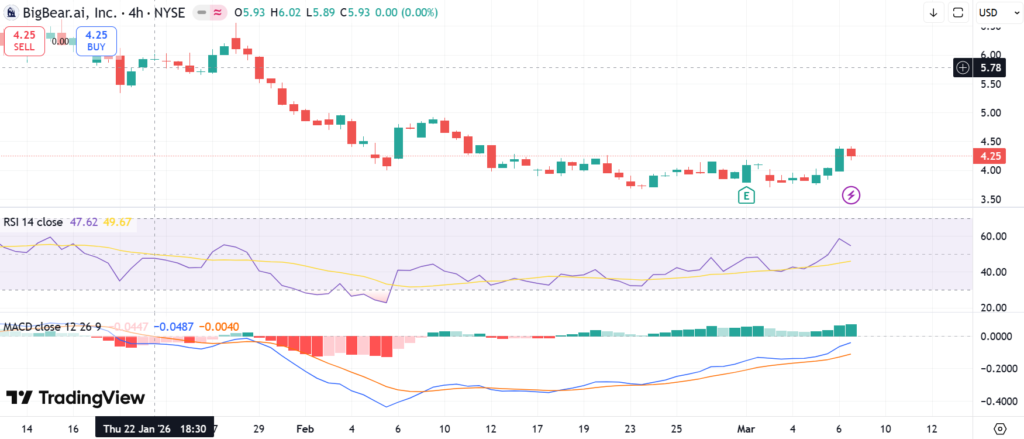
The 50‑day moving average tracks the average closing BBAI stock price over about two months, while the 200‑day moving average captures a longer‑term trend. When the 50‑day line trades above the 200‑day, technicians call it a golden cross, which can signal a strengthening long‑term uptrend; the opposite (50‑day below 200‑day) is a death cross, often linked with bearish momentum. Recent data show BBAI hovering close to key moving averages, reflecting an attempt to transition from a downtrend to a more constructive pattern, but confirmation is still needed.
Relative Strength Index (RSI) usually measures whether a stock is overbought (typically above 70) or oversold (typically below 30). While specific intraday RSI figures vary, the recent surge after prior weakness suggests BBAI moved from oversold or neutral conditions toward a more balanced or slightly overbought zone as traders chased the rally. The Moving Average Convergence Divergence (MACD) indicator, which compares short‑ and long‑term momentum, has recently turned more positive, signaling a bullish bias in the short term. Trading volume for BigBear.ai has been significantly above its average on big up days, which confirms strong participation behind the recent move and is a key factor in short‑term technical analysis.
Analyst Ratings & Price Targets
According to recent data, Wall Street coverage on BigBear.ai remains limited but generally positive, with an average analyst rating of “Buy.” On one widely followed platform, two analysts covering BBAI stock assign it a Buy recommendation and see upside potential from current levels. Consensus 12‑month price targets cluster around 5.33–5.50 dollars, implying roughly 40–45 percent upside from the latest BBAI stock price.
MarketWatch data show a high price target of about 6 dollars, a median around 5 dollars, and a low target also near 5 dollars, indicating analysts broadly expect moderate appreciation rather than extreme moves. Recent commentary highlights BigBear.ai’s positioning within AI and government analytics as a positive, while also noting execution risks and competitive pressures. For everyday investors, this means analyst sentiment leans constructive but not euphoric, framing BigBear.ai stock as a higher‑risk AI name with measured upside expectations.
Insider Activity
Insider activity can signal how confident management and major shareholders are about the company’s future. Public filings show that BigBear.ai insiders have at times sold shares, often related to stock‑based compensation or liquidity needs, alongside periods of smaller purchases. No recent, very large insider buying spree has been reported that would dramatically shift sentiment, but insider selling has also not reached levels that typically alarm long‑term investors.
Institutional investors, such as funds and asset managers, hold a meaningful portion of BBAI stock, and shifts in these positions can matter as much as insider trades. Over recent quarters, institutional interest has fluctuated with the stock’s volatility, with some funds adding exposure around lower prices while others trimmed positions during sharp rallies. Overall, insider and institutional activity appears mixed, suggesting neither strong insider conviction nor clear insider pessimism at this stage.
Valuation Analysis
On a trailing basis, BigBear.ai is not yet consistently profitable, which makes its trailing price‑to‑earnings (P/E) ratio not meaningful or negative. Instead, investors often focus on price‑to‑sales (P/S) and growth metrics when evaluating BBAI stock valuation. BigBear.ai generated approximately 127.7 million dollars in trailing twelve‑month revenue, while still reporting a net loss of roughly 293.9 million dollars, leading to negative earnings per share of about 0.82 dollars.

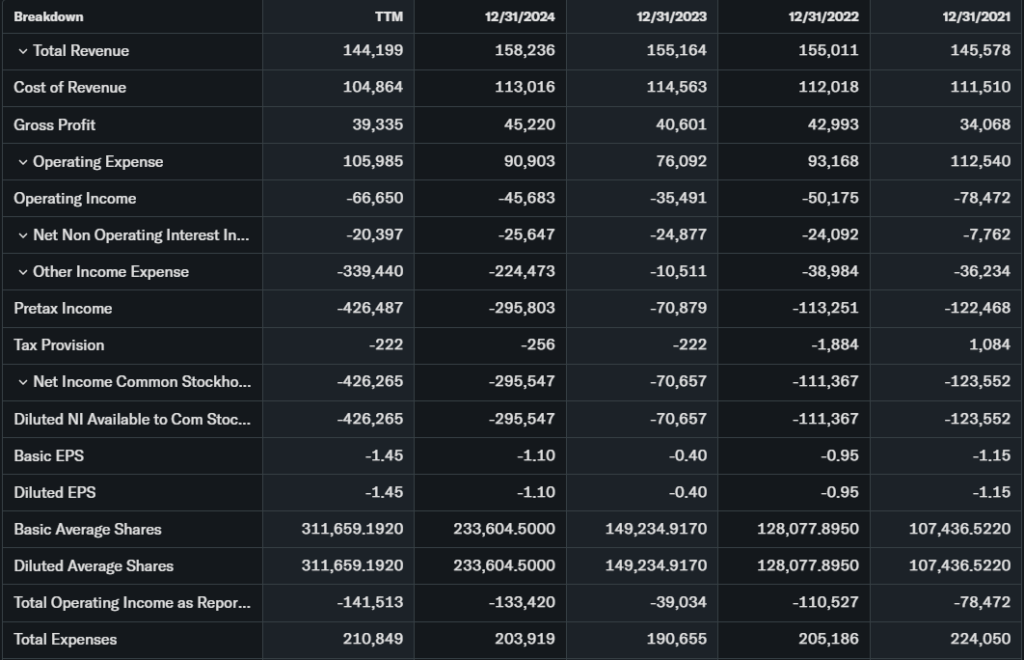

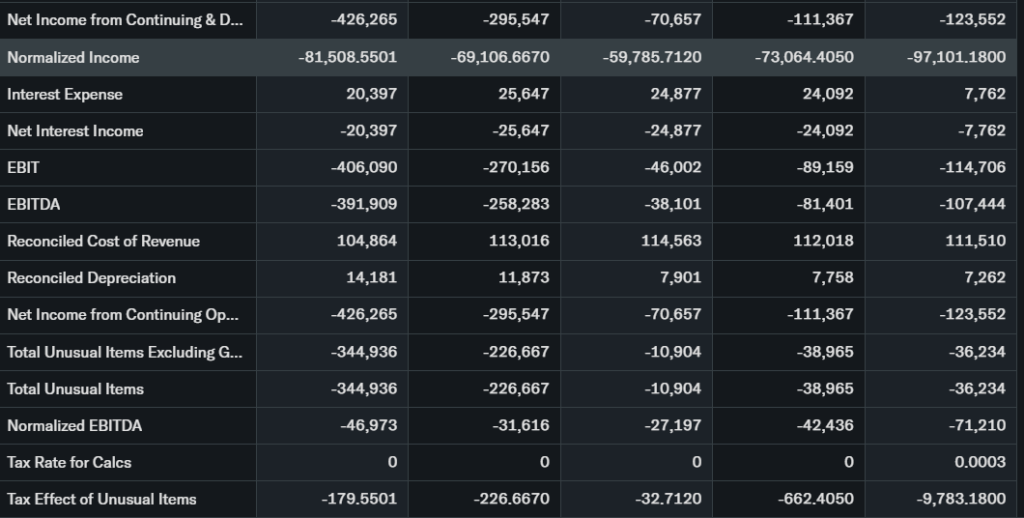
The company’s market capitalization near 1.8–2.0 billion dollars implies a P/S ratio in the mid‑teens, which is elevated compared with mature software firms but more common among smaller, high‑growth AI names. Revenue has recently declined year over year, even as the firm works to narrow losses and stabilize its business. Free cash flow remains pressured as BigBear.ai invests in platforms, acquisitions, and customer delivery, and the company has used equity offerings to strengthen its balance sheet, including raising around 337 million dollars in capital.
When compared with large players like Microsoft or established collaboration names such as Zoom, BBAI stock trades at a much smaller absolute valuation but with higher risk, negative earnings, and greater dependence on future contract wins. Based on current fundamentals, BigBear.ai stock looks more speculative than undervalued, and it may be best described as a high‑risk growth story rather than a classic value opportunity.
Recent Earnings & Catalysts
In a recent quarter, BigBear.ai reported financial results that modestly beat expectations, with earnings per share of approximately minus 0.03 dollars versus consensus forecasts of minus 0.05 dollars. Revenue for that period came in around 33.1 million dollars, ahead of expectations near 31.8 million dollars, representing a small but meaningful positive surprise for investors. Despite this beat, management acknowledged that revenue declined year over year, though the company improved its bottom line and moved closer to breakeven.
Following these earnings, BBAI stock reacted positively, with after‑hours gains and subsequent sessions showing strong upside momentum. BigBear.ai also provided full‑year revenue guidance in a range of roughly 125–140 million dollars and highlighted opportunities in government AI adoption, particularly in the United States, United Kingdom, and Middle East. A key catalyst is the planned acquisition of AskSage, which management expects to enhance BigBear.ai’s generative AI capabilities and position the firm to benefit from rising government and defense AI spending in 2026 and 2027.
Bullish Case
The bullish case for BigBear.ai stock centers on its niche in AI‑enabled decision intelligence for defense, logistics, and critical infrastructure. Governments and large enterprises increasingly need tools that can analyze complex data in real time, and BigBear.ai’s platforms are built specifically for these demanding use cases. Revenue growth could accelerate if the company wins additional multi‑year government contracts, successfully integrates acquisitions like AskSage, and scales commercial deployments.
Another positive factor is the broader AI “super‑cycle,” as many organizations modernize their IT and analytics stacks, creating a larger addressable market for BBAI. If management continues to improve margins and move toward positive free cash flow while maintaining top‑line growth, the market could reward the stock with a higher valuation multiple over time. For investors who can tolerate volatility, these growth drivers support a constructive BigBear.ai stock forecast over the long run.
Bearish Case
On the bearish side, BigBear.ai faces intense competition from both large cloud providers and specialized analytics firms that offer overlapping AI solutions. Revenue has recently declined year over year, which raises questions about the pace of new contract wins and the stability of existing customer relationships. Continued losses and negative free cash flow may require future capital raises, potentially diluting existing shareholders if the stock trades at lower levels.
Execution risk is another major concern, as integrating acquisitions, scaling complex implementations, and meeting strict government requirements can strain resources. Macroeconomic and budget pressures could slow government spending or delay large contracts, which would weigh on BBAI stock price performance. These risks mean that BigBear.ai stock is not suitable for conservative investors seeking stable earnings or dividends.
Market Sentiment & Investor Psychology
Market sentiment around BigBear.ai stock is highly sensitive to news and earnings, leading to big short‑term swings in price. BBAI has a relatively high beta, around 3.25, which signals that it tends to move more than the overall market in both directions. Short interest data from major platforms indicate that a notable portion of the float is sold short, reflecting a mix of skepticism and active trading interest.
Options activity often features elevated volume in near‑dated calls when momentum picks up, as traders look to leverage upside moves around catalysts like earnings or AI announcements. Institutional ownership remains meaningful but not dominant, leaving room for retail investors and short‑term traders to influence daily price action. Overall, sentiment appears cautiously optimistic but speculative, with many participants treating BBAI stock as a trading vehicle rather than a core long‑term holding.
Short-Term Outlook
In the short term, the BigBear.ai stock forecast depends heavily on technical indicators and news flow rather than long‑term fundamentals. BBAI is trading above recent lows and attempting to build a base, with support in the mid‑3 dollar region and resistance around 5–6 dollars. As long as the BBAI stock price holds above key support levels and volume remains healthy on up days, the bias may remain slightly bullish over the coming weeks.
However, any disappointment in follow‑up news, macro risk‑off episodes, or profit‑taking after big rallies could trigger sharp pullbacks. For active traders, BBAI stock may present opportunities within a wide trading range, but position sizing and risk management are crucial given the volatility.
Medium to Long-Term Outlook
Over a 6–24 month horizon, the BigBear.ai stock outlook hinges on the company’s ability to grow revenue, manage costs, and convert its AI pipeline into profitable contracts. If BigBear.ai executes well on its strategy, successfully integrates AskSage, and capitalizes on global government AI demand, earnings and cash flow could improve meaningfully. In that scenario, today’s valuation, while high on a sales basis, might prove reasonable for a high‑growth AI specialist.
On the other hand, if revenue growth remains weak, contract wins fall short, or competition erodes pricing power, BBAI stock could struggle to support its current market cap. Given these cross‑currents, BigBear.ai stock may best fit investors who understand speculative AI plays and can handle multi‑year volatility. For long‑term investors, a “watch or accumulate on weakness” stance seems more appropriate than an aggressive all‑in approach.
FAQ Section
Is BigBear.ai (BBAI) stock a buy right now?
BigBear.ai stock carries a Buy consensus rating from a small group of analysts, but it remains a high‑risk, speculative AI play. Whether BBAI stock is a buy depends on your risk tolerance and time horizon.
What is the price target for BigBear.ai stock?
Recent data show an average 12‑month BBAI stock price target around 5.3–5.5 dollars, with estimates generally ranging from 5 to 6 dollars. This implies moderate upside from current levels, not a guaranteed result.
What are the major risks for BigBear.ai stock?
Key risks include ongoing losses, revenue volatility, potential dilution from capital raises, and heavy competition in AI analytics. Government and macroeconomic uncertainties can also impact contract timing and overall demand.
How does BigBear.ai valuation compare to larger tech names?
Unlike profitable large‑cap tech such as Microsoft or established platforms like Zoom, BigBear.ai trades on revenue rather than earnings and shows negative net income. This makes BBAI stock valuation more speculative and sensitive to growth expectations.
What is the long‑term outlook for BigBear.ai stock?
The long‑term BBAI stock forecast is tied to execution in government AI, successful integration of acquisitions, and a path toward profitability. If these elements come together, upside is possible, but the journey is likely to be volatile.
Suggestions
You can internally link this article to related coverage such as:
“Compare with Opendoor stock”.
“See our Microsoft stock forecast” to contrast a mega‑cap AI leader with a smaller AI specialist.
“Read our tech sector valuation breakdown” for broader context on how AI and software stocks are priced today.
Conclusion
BigBear.ai (BBAI) stock offers significant upside potential tied to AI adoption in government and enterprise, but it also comes with notable execution, competitive, and financial risks. Given the current mix of positive analyst sentiment, improving but still negative earnings, and elevated valuation on sales, a balanced view would categorize BBAI stock as a speculative Watch/Hold for most investors, with accumulation on weakness only for those comfortable with high volatility.
Disclaimer: This article is for informational purposes only and not financial advice.