
SPY ETF overview including price, technicals, valuation, and whether SPY is a buy for long‑term investors.
Introduction
The SPY ETF (SPDR S&P 500 ETF Trust) is one of the most widely traded exchange‑traded funds in the world. It tracks the S&P 500 index, which holds about 500 large‑cap U.S. stocks across sectors like technology, healthcare, finance, and consumer goods. Instead of buying hundreds of individual companies, investors can get broad market exposure by owning a single SPY ETF share.
Interest in the SPY ETF has risen as markets have shifted between expectations for rate cuts, strong earnings from tech giants, and ongoing concern about inflation and economic growth. Because the SPY ETF price broadly mirrors the U.S. stock market, it has become a benchmark for gauging whether U.S. equities look expensive, cheap, or fairly valued.
Latest SPY ETF price & trend
As of the close on March 2, 2026, the SPY ETF price was about 684.17 USD per share. That compares with a previous‑day close around 685.99 USD, implying a roughly ‑0.3% one‑day move.
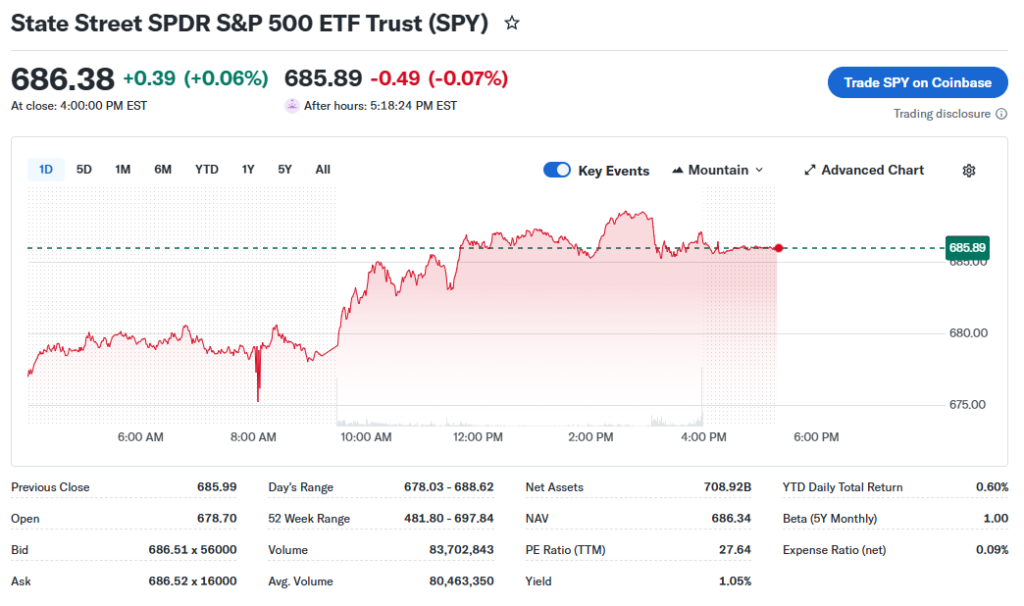
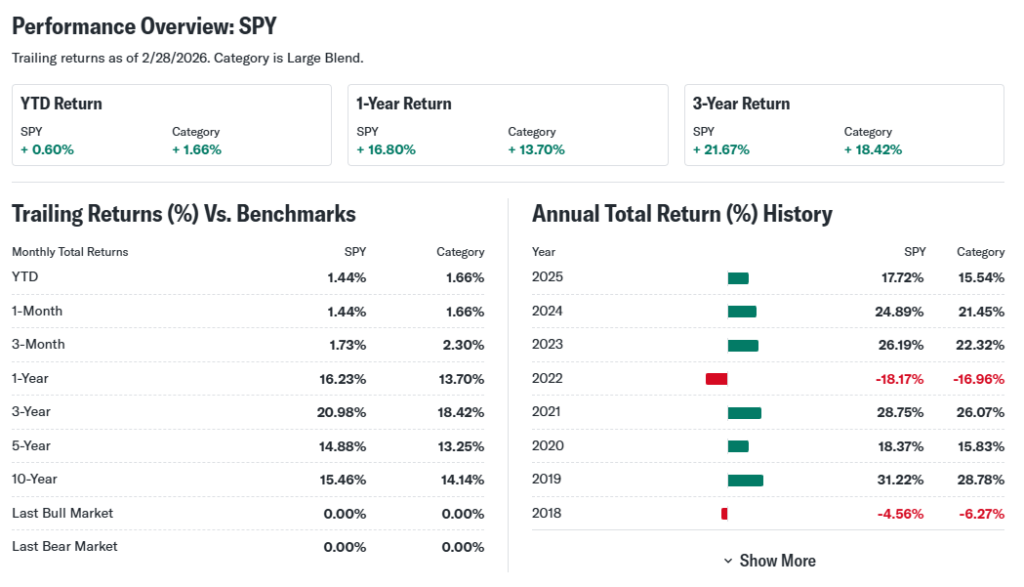
Over the short term, the SPY ETF price has been slightly volatile but mostly stable. In the last five trading days, SPY is up about 0.8%, according to moving‑average data. Over the past one month, it has gained roughly 1–2%, while the three‑month return is about 4–5% higher than the level seen late November 2025. On a six‑month basis, SPY is up around 17% including dividends, reflecting strong S&P 500 performance.
Year‑to‑date through early March 2026, SPY is up about 0.8–1%, depending on the index calculation method. On a 12‑month view, total return (price plus dividends) is near 17%, which is solid for a broad U.S. market fund. The 52‑week high for the SPY ETF is about 697.84 USD, while the 52‑week low is roughly 481.80 USD.
Overall the trend is moderately bullish, with the SPY ETF price trading above its major moving averages and well above its 52‑week low. This suggests that, despite short‑term swings, the broader market rally is still intact, but investors should expect normal volatility around any major news or Fed‑policy updates.
Technical analysis
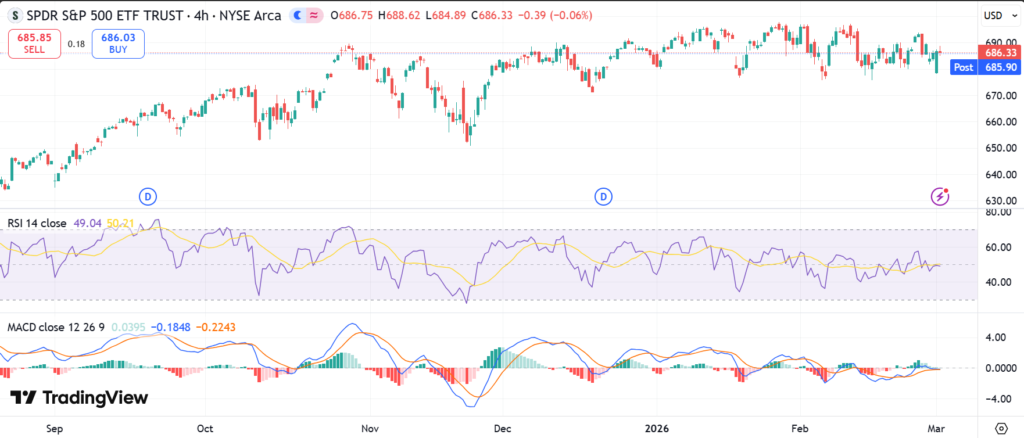
Technical analysis looks at price patterns, moving averages, momentum, and volume to judge whether an asset is more likely to rise, stall, or fall in the short term. Here is how SPY ETF technical analysis currently stacks up.
Support and resistance
For the SPY ETF, key support levels are roughly around 670–675 USD and, below that, the 650–660 USD zone, which corresponds with prior swing lows and the 200‑day moving average. Clear resistance is just above the current price, near 685–690 USD, and then at the recent 52‑week high near 697–700 USD. If price holds above support, the SPY ETF price can stay in an uptrend; if it breaks below, the trend may weaken.
RSI and MACD
The SPY ETF RSI (Relative Strength Index) is in the mid‑50s on typical 14‑day charts, which is neutral to slightly bullish rather than overbought or oversold. This suggests that momentum is positive but not stretched to extremes, reducing the risk of a sudden sharp pullback.
On the SPY ETF MACD (Moving Average Convergence Divergence), the fast‑line sits slightly below the signal line in many recent summaries, pointing to mildly bearish short‑term momentum even though the longer‑term trend remains upward. That means short‑term traders may see some selling pressure, but the core trend is still intact.
Moving averages and volume
The SPY ETF 50‑day moving average is around 687–688 USD, while the 200‑day moving average is near 654–655 USD. Because the current SPY ETF price is above both averages, this is generally read as a bullish trend.
There is no clear “golden cross” (when the 50‑day crosses above the 200‑day) or “death cross” at the moment, as the 50‑day sits just below the current price and the 200‑day is well below. Trading volume is above average, which tells us that many investors are actively transacting SPY, reinforcing the idea that the market is paying attention.
Analyst ratings & price targets
Because the SPY ETF holds multiple companies, analyst ratings are usually shown as an aggregate for the underlying S&P 500 components rather than a single “SPY” rating. One major rating aggregator shows that the SPY ETF‑held stocks have an aggregate rating around “Moderate Buy”, based on hundreds of Wall Street analyst reviews.
The same source lists an average aggregate price target for those holdings near 678 USD, which is slightly below the current SPY ETF price of about 684 USD. The highest and lowest projections also cluster near this range, indicating that analysts, on balance, expect only modest upside or even a small correction rather than a big rally.
Recent months have seen a few upgrades and downgrades among big‑cap tech names inside SPY, but no major, coordinated shift in the overall analyst stance. This means that the SPY ETF forecast from Wall Street is cautiously optimistic, with expectations of steady but not explosive growth.
Insider activity
The SPY ETF is a passively managed index fund, so there is no CEO or management team buying and selling its shares like a single stock. Insider‑trading data for SPY therefore mainly reflects trades by fund‑sponsor officers or large institutional investors rather than individual company executives.
Recent data shows no large unplanned open‑market purchases by known insiders of the SPY ETF itself, and only routine institutional activity. That contrasts with some individual tech stocks, where heavy insider buying can signal strong confidence. In practice, insider‑trading signals are much less useful for SPY than for single‑name stocks, because the SPY ETF price depends on the whole index, not one company’s prospects.
Valuation analysis
Valuation for the SPY ETF is usually measured by the price‑to‑earnings (P/E) ratio and related metrics of the S&P 500 index. As of late February 2026, the SPY ETF P/E is about 27–28 times trailing earnings, depending on the source. That is higher than the long‑term average of around 15–17, suggesting that U.S. large‑caps are relatively expensive by historical standards.
The forward P/E (based on expected next‑year earnings) is lower, around 22–23, which indicates that analysts expect earnings to grow enough to justify today’s prices if the economy remains stable. The price‑to‑sales ratio for the S&P 500 is also elevated, reflecting the heavy weight of high‑margin tech and AI‑related businesses in the index.
In terms of revenue and earnings growth, the companies inside the SPY ETF have delivered solid year‑over‑year growth, driven largely by tech, cloud, and AI‑related revenue. Free cash flow across the index is strong, and net debt levels for the index as a whole are manageable, though some individual sectors (like financials) carry more leverage.
Compared with a more concentrated tech‑sector ETF such as one focused only on Zoom‑like names or a single‑name tech stock, the SPY ETF looks fairly valued but on the rich side. It is not clearly cheap, but it is also not wildly overpriced if earnings growth continues and interest rates stay supportive.
Recent earnings & catalysts
Because the SPY ETF is an index fund, it does not report its own quarterly SPY earnings like a company would. Instead, its performance is driven by the quarterly results of the S&P 500 companies inside it, especially the largest tech and consumer names.
In the most recent S&P 500 earnings season, revenue and EPS across the index beat expectations by a modest margin, led by strong cloud, AI, and advertising‑related revenue. Many large tech firms inside the SPY ETF reported above‑street EPS and raised full‑year guidance, which helped support the SPY ETF price.
Key catalysts for the SPY ETF going forward include:
Continued adoption of AI tools and cloud infrastructure by enterprises.
Evolution of monetary policy, including potential Fed rate cuts if inflation cools.
Mergers and capital‑return programs (buybacks and dividends) at major S&P 500 companies.
These factors help explain why the SPY ETF has delivered strong returns over the past 12 months, even as valuation multiples have expanded.
Bullish case
There are several realistic reasons investors might view the SPY ETF positively over time.
First, the SPY ETF offers broad diversification across hundreds of large‑cap companies, which reduces single‑stock risk. Second, the leading tech and software firms in the index have high margins and recurring revenue, which can support long‑term revenue growth and cash flow.
The SPY ETF also benefits from the scale and global reach of U.S. mega‑caps, which are leaders in AI, cloud computing, e‑commerce, and digital advertising. Over time, the compounding effect of reinvested dividends and buybacks can significantly boost total return, even if the SPY ETF price moves sideways for periods.
Finally, for many investors, the SPY ETF represents a low‑cost, liquid core holding rather than a speculative bet, making it attractive as a long‑term base for a portfolio.
Bearish case
Despite the positives, there are credible risks to owning the SPY ETF.
Valuation is one concern: the SPY ETF trades at a P/E near 27–28, which is higher than historical averages and leaves less margin of safety if earnings disappoint. If growth slows or if inflation forces the Fed to keep rates higher for longer, the SPY ETF could re‑rate lower as multiples compress.
Another risk is concentration in a few large‑cap tech names such as Nvidia, Apple, and Microsoft, which together account for a sizable share of the index. A sharp pullback in any of these names can move the whole SPY ETF price.
Broader macro worries—such as a deeper‑than‑expected economic slowdown, geopolitical shocks, or tighter regulatory scrutiny on big tech—could also pressure the SPY ETF from both the growth and valuation angles.
Market sentiment & investor psychology
Market sentiment toward the SPY ETF is currently moderately optimistic but cautious. The SPY ETF is trading near its 52‑week high, and the RSI is neutral, suggesting that fear is low but euphoria is not extreme.
Short‑interest data for the S&P 500 index is relatively low, which means that most pessimistic bets are not heavily concentrated in a single leveraged vehicle. Options activity shows a mix of calls and puts, indicating that investors are hedging but not expecting a crash.
Institutional ownership in large‑cap U.S. stocks remains high, and retail investors continue to flow into broad‑based index funds like the SPY ETF instead of picking individual names. This supports a momentum‑leaning bias in the market, but also raises the risk of a sharp, broad correction if sentiment turns.
Short‑term outlook
Over the next days and weeks, the SPY ETF is likely to trade in a range between support near 670–675 USD and resistance around 685–690 USD, with occasional breakouts triggered by major economic data or Fed‑related news. With the SPY ETF price slightly below its 50‑day moving average but well above its 200‑day average, the short‑term bias is neutral to mildly positive, assuming no sudden negative shock.
Technical indicators such as the RSI and MACD do not show strong overbought or oversold conditions, so investors should expect moderate volatility rather than a smooth, one‑way move. For traders, that environment favors cautious positioning rather than aggressive all‑in bets.
Medium to long‑term outlook
Over the 6–24‑month horizon, the SPY ETF is likely to reflect the underlying health of the U.S. economy and the earnings power of large‑cap companies. If growth remains positive, inflation stays under control, and corporate profits grow at a mid‑ to high‑single‑digit pace, the SPY ETF could continue to deliver solid total returns, even if valuation multiples expand only modestly.
The SPY ETF is well‑positioned to benefit from ongoing trends in AI, cloud, and digital infrastructure, but it is also exposed to any slowdown in consumer spending or corporate IT budgets. For long‑term investors, the SPY ETF is best viewed as a core holding—worth holding or accumulating gradually—rather than a tactical bet on a short‑term SPY forecast spike.
FAQ:
Is the SPY ETF a buy right now?
For long‑term investors who want broad U.S. market exposure, the SPY ETF can be a reasonable buy at current levels, especially when bought gradually. It is not obviously cheap, but it offers diversification and liquidity.
What is the price target for the SPY ETF?
Aggregate price targets for the S&P 500 holdings inside SPY cluster around 678 USD, which is slightly below the current price, implying modest upside or even a small correction rather than a big rally.
What are major risks for the SPY ETF?
Key risks include high valuation, concentration in a few tech giants, potential slowing earnings growth, and sensitivity to interest‑rate moves and macro shocks.
Suggestions
Compare with SOXS ETF
See our Microsoft ETF forecast
Read our tech sector valuation breakdown
Conclusion
For most investors, the SPY ETF is best treated as a hold or gradual accumulation rather than an aggressive short‑term trade. It offers strong diversification, solid long‑term performance, and relatively low costs, but it trades at a premium valuation that leaves less room for error if the macro or earnings backdrop weakens. A balanced conclusion is to **hold as a core
Disclaimer: This article is for informational purposes only and not financial advice.