
BMNU Technical Analysis March 2026: Leveraged Crypto-Mining Exposure with Key Support and Resistance Levels
BMNU (T‑REX 2X Long BMNR Daily Target ETF) is a leveraged ETF that seeks 200% of the daily performance of Bitmine Immersion Technologies (BMNR), giving traders amplified exposure to a highly volatile crypto‑mining related stock. It sits in the leveraged equity / thematic tech–crypto space, where price swings are often much larger than in broad market index ETFs.
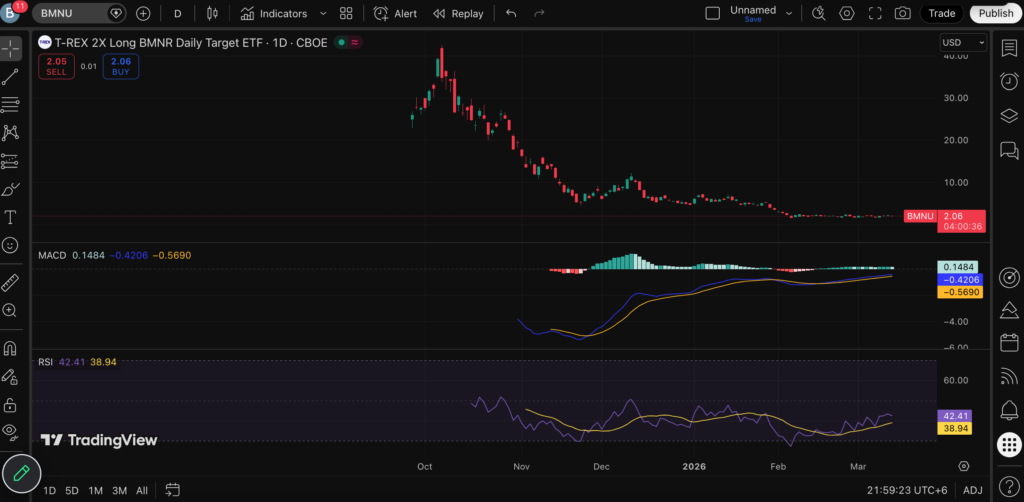
In March 2026, BMNU is trading at a low absolute price (around the low single digits) after a prolonged drawdown, with daily candles showing sharp intraday moves and gaps that reflect both BMNR’s volatility and the compounding effect of 2x daily leverage. This article will walk through the current short‑term trend, key support and resistance levels, and what RSI, MACD, and volume are suggesting for traders monitoring BMNU in March 2026.
Current Price Trend in March 2026
Price history into late February and early March 2026 shows BMNU grinding lower from above 2.30 down toward the high‑1s, with several sessions closing significantly below their intraday highs. That pattern points to a short‑term downtrend or at best a weak consolidation, where sellers have been able to fade intraday strength and push closes lower.
Given recent closes around the high‑1s to low‑2s, the short‑term 20‑day moving average is likely sloping down and sitting not far above the current price, acting as dynamic resistance during bounces. The 50‑day moving average is reported well above the market (around the mid‑4 area), underscoring how much BMNU has declined from prior levels, while the 200‑day moving average is even higher, consistent with a longer‑term bearish structure.
The ETF has experienced large percentage drops from its earlier highs in 2025, with one‑year performance deeply negative, which is typical for single‑stock leveraged products when the underlying has a sustained downtrend. Traders should remember that daily compounding in a 2x ETF can magnify path‑dependence, so sideways‑to‑choppy conditions in BMNR can still lead to erosion in BMNU over time.
Key Support and Resistance Levels
Because BMNU is trading around the high‑1s to low‑2s, the nearest short‑term support sits just below recent lows from late February and early March, roughly in the mid‑1s area where several sessions found intraday buyers after sharp sell‑offs. This zone matters because it marks where dip‑buyers previously stepped in; a decisive break below it could signal that the downtrend is accelerating and that traders expect further weakness in BMNR.
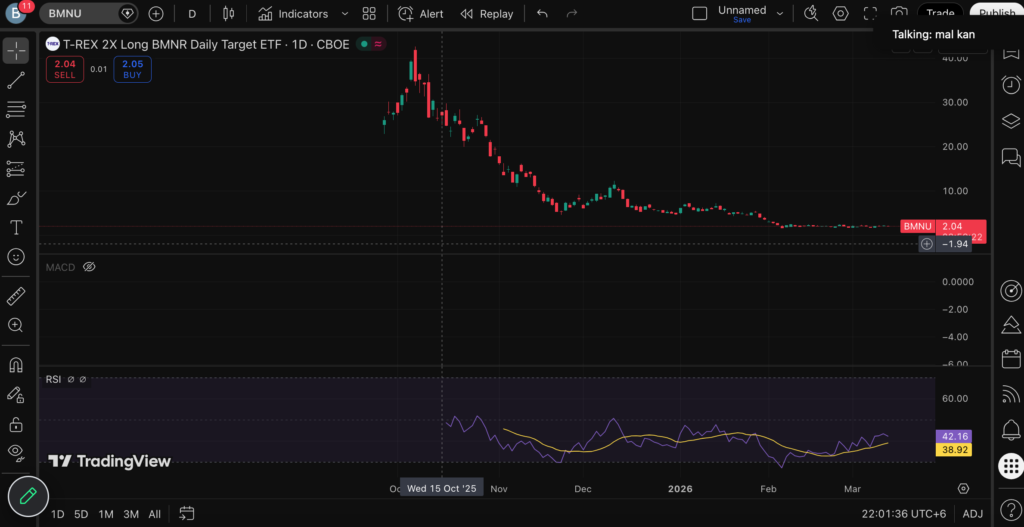
A second, deeper support region can be thought of as the “capitulation” area, moderately below the recent trading range, where any large gap‑down or spike in fear could drive BMNU into new lows. If price reaches this area on a volume spike but then quickly reverses, it might indicate an exhaustion move and potential short‑term mean reversion.
On the upside, the nearest resistance is around recent swing highs in early March, roughly in the low‑2s, where rallies have repeatedly stalled and intraday gains have failed to hold into the close. A daily close above that band, especially if it coincides with reclaiming the 20‑day moving average, could signal that buyers are regaining short‑term control.
Further up, the 50‑day moving average, which sits noticeably above current prices, represents a more medium‑term resistance zone and a reference to the prior trading range around the 4 area. If BMNU were able to sustain a move back toward that region, it would indicate a significant shift in momentum from the current depressed levels, but traders would still need to watch for profit‑taking as price approaches such a well‑watched moving average.
Indicators – RSI, MACD, Volume
RSI on BMNU’s daily chart has spent much of recent weeks in a low‑to‑mid range, reflecting persistent selling pressure without a prolonged oversold bounce. This kind of neutral‑to‑weak RSI profile can suggest that the market is in a grinding downtrend rather than a sharp capitulation, meaning traders may look for either a drop into oversold territory or a break above the midline to signal a more meaningful shift.
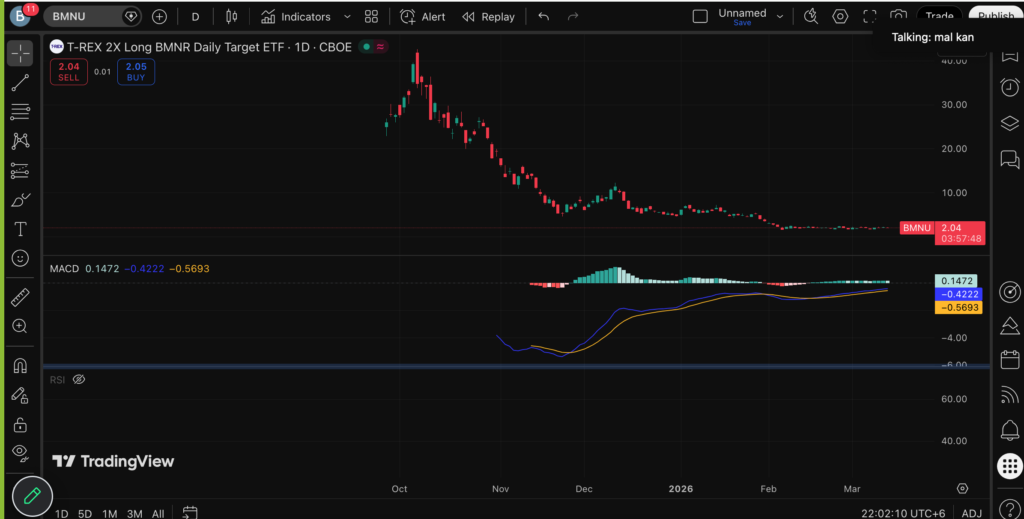
MACD has been under its signal line, consistent with bearish momentum, though the histogram may be showing signs of narrowing as price attempts to stabilize around the high‑1s. If MACD lines begin to converge and eventually cross to the upside while price holds above recent support, that could indicate fading downside momentum and the start of a short‑term recovery phase.
Volume in BMNU tends to expand dramatically during high‑volatility days in the underlying BMNR, with some prior sessions showing seven‑figure share turnover when price moved multiple points in a single day. More recently, volumes have been modest but still elevated relative to many traditional ETFs, with occasional spikes on down days, indicating active speculative interest and a tendency for traders to react quickly to underlying news or crypto‑related sentiment shifts.
Short‑Term Outlook for BMNU in March 2026
Putting the price action and indicators together, BMNU in March 2026 is in a fragile technical state: price is depressed after a steep decline, short‑term trend is weakly down, and moving averages are still stacked bearishly above current levels. At the same time, the instrument is highly sensitive to any sharp moves in BMNR or the broader crypto‑mining space, meaning rapid rallies and equally rapid reversals are always possible.
Until BMNU can reclaim and hold above its nearest resistance in the low‑2s and ideally move closer toward its falling 20‑day moving average, traders may continue to treat bounces as short‑term trading opportunities rather than evidence of a sustained trend change. A decisive break below the recent support band in the mid‑1s, especially on heavy volume, could open the door to another leg lower, while a strong upside move on rising volume might indicate that speculative appetite in BMNR has returned.
What traders are watching:
- Reaction to nearby support just below recent lows in the mid‑1s area and whether that zone continues to attract buyers.
- A potential daily close above recent swing highs near the low‑2s and the short‑term 20‑day moving average.
- Changes in RSI (move into oversold or a break above the 50 line) and any bullish MACD crossover that could hint at a momentum shift.
- Volume spikes tied to news about BMNR or broader crypto‑mining sentiment, which often drive outsized single‑day moves in this 2x leveraged ETF.
- Macro events affecting risk assets, such as shifts in interest‑rate expectations or crypto regulatory headlines, which can quickly alter volatility in leveraged thematic products.
Risks and Important Notes
BMNU’s objective is to deliver 2x the daily move of BMNR, which means it is generally designed for short‑term trading rather than long‑term buy‑and‑hold investing. Daily compounding and volatility can cause longer‑holding period returns to diverge significantly from 2x the cumulative move of the underlying, especially when BMNR is choppy or trending lower.
Technical levels such as support, resistance, and indicator signals can and do fail, particularly around unexpected company‑specific news for BMNR, crypto‑market shocks, regulatory announcements, or macro events like central‑bank decisions. Traders should consider their own time frame, risk tolerance, and diversification rather than treating any single level or indicator as a guarantee of future price movement.
This analysis is for educational purposes only and should not be considered personalized financial advice or a recommendation to buy or sell BMNU or any other security. Each trader should do their own research and, if needed, consult a qualified financial professional before making trading decisions.
suggestions
For traders following leveraged crypto‑mining and high‑beta tech exposures, BMNU’s current chart offers a useful case study in how support, resistance, and momentum behave in a 2x daily product. You may also want to review recent technical analysis on similar leveraged single‑stock or sector ETFs, such as other T‑REX or Tuttle products, crypto‑mining equity ETFs, and broader technology or semiconductor ETFs, to compare volatility profiles and risk‑management approaches.