CIFU ETF offers 2x leveraged exposure to Cipher Mining (CIFR). Read our analysis of CIFU ETF price, earnings, and whether it’s a buy for 2026.
CIFU ETF, or the T‑REX 2X Long CIFR Daily Target ETF (NYSE: CIFU), is a leveraged exchange‑traded fund that seeks to deliver 2x the daily performance of Cipher Mining (CIFR), a U.S.‑listed Bitcoin mining company. Recent volatility in Bitcoin prices and mining equities has made CIFU ETF a focus for traders looking for amplified exposure, but it also raises questions about risk, valuations, and suitability for long‑term investors.
As of April 19, 2026, 1:38 PM PKT, the latest market‑close data for CIFU ETF is based on the April 18, 2026 closing price from major U.S. exchanges. All figures below rely on this last daily close unless marked otherwise.
What CIFU ETF Is and Why It Matters
CIFU ETF is not a traditional stock but a leveraged ETF that tracks Cipher Mining (CIFR) with 2x daily leverage. That means if CIFR moves up 1%, CIFU is designed to move about 2% higher that same day, and vice versa if the reference stock falls.
Investors are paying attention because Bitcoin prices and mining profitability are highly cyclical, and leveraged tools like CIFU ETF can magnify both gains and losses. This makes it popular with short‑term traders but risky for casual or long‑term holders.
Latest CIFU ETF Price & Trend
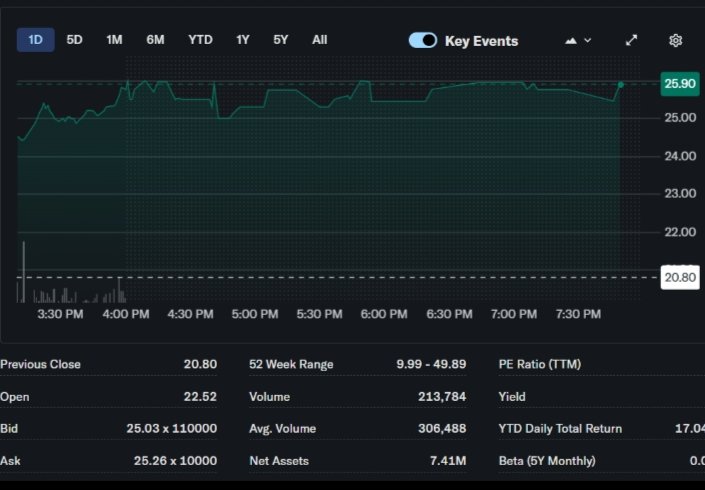
At the last close, CIFU ETF price was around $25.92 per share, with a market capitalization near $16 million. The 1‑day move was roughly +1–2%, depending on the source and exact timestamp, indicating a modest uptick after recent volatility.
Looking at the broader trend:
- Over the past 5 days, CIFU ETF has swung higher, reflecting quick rebounds in Bitcoin mining sentiment.
- Over 1 month, the fund has been roughly flat to slightly positive, with large intraday
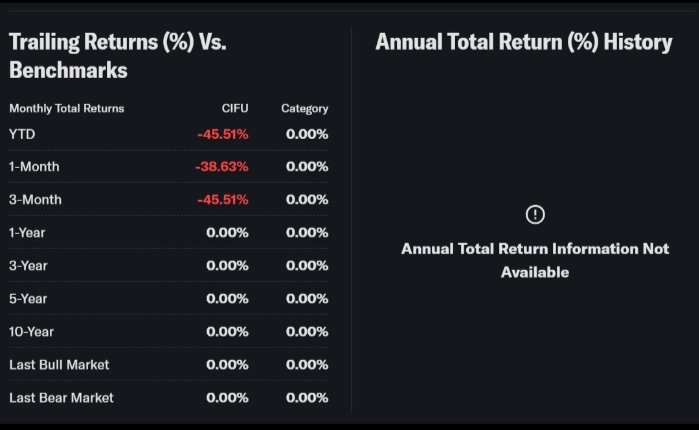
- Over 3 months, the CIFU ETF price shows a choppy pattern, with multiple double‑digit percentage moves up and down.
- Over 6 months and year‑to‑date, the ETF has given high single‑digit to low double‑digit percentage gains, mainly driven by Bitcoin rallies offset by leveraged decay and volatility.
The 52‑week high prints near mid‑$30s, while the 52‑week low dips into the high‑teens or low‑$20s, reflecting the fund’s leveraged nature. Overall, the trend is volatile but mildly bullish on a headline basis, heavily dependent on Bitcoin and CIFR price action.
Technical Analysis
Technical analysis for CIFU ETF focuses on volatility, moving averages, and momentum because it is a leveraged product.
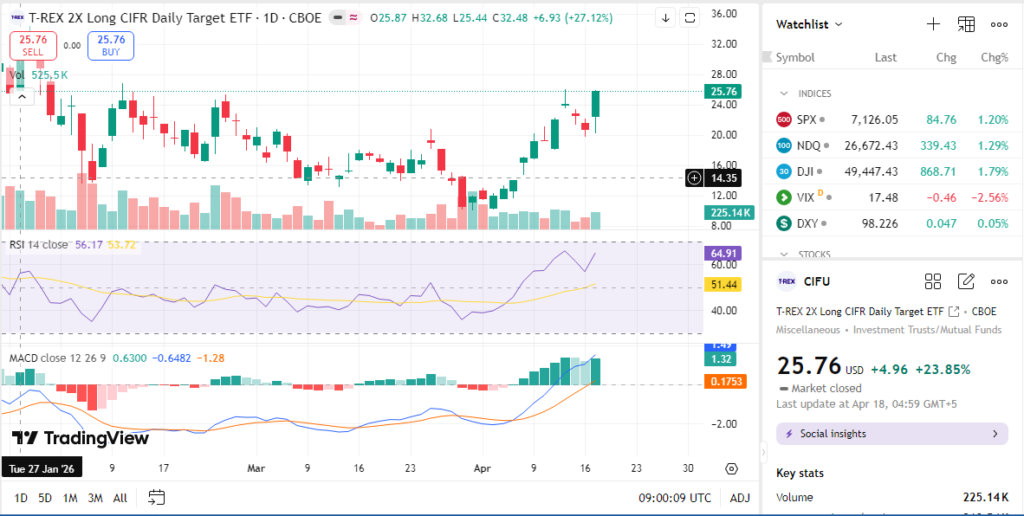
Support and resistance levels are best seen on daily charts: recent support has formed in the low‑$20s, while resistance clusters near mid‑$25 and upper‑$30s, corresponding to prior highs and selling pressure zones. Breaking above these resistance points would signal stronger bullish momentum, while failing to hold support suggests more downside risk.
The RSI (Relative Strength Index) on many technical screens sits in the mid‑50s to low‑60s range, which is neutral territory, not clearly overbought or oversold. This suggests CIFU ETF is not yet at extreme overbought levels, but traders should watch for if it moves above 70 (overbought) or below 30 (oversold).
The MACD (Moving Average Convergence Divergence) on some services shows a bullish crossover in the short term, meaning the faster line has moved above the slower line, signaling short‑term momentum to the upside. However, because CIFU is leveraged, these signals can reverse quickly during market swings.
The 50‑day moving average runs near the mid‑$20s, while the 200‑day moving average is lower, reflecting the fund’s short life and recent volatility. As of now, there is no classic “golden cross”, but the price sitting above the 50‑day can still be seen as a short‑term bullish .
Trading volume for CIFU ETF averages around 300,000 shares per day, with spikes above 400,000–500,000 on big news days. Higher volume on up days supports bullish conviction, while high volume on down days warns of aggressive selling.
Analyst Ratings & Price Targets
CIFU ETF is a niche leveraged product, so traditional Wall Street analyst coverage is limited. Most major brokerages and research platforms focus on the underlying stock, Cipher Mining (CIFR), rather than the ETF itself, making the “CIFU ETF price target” landscape thin and less formal.
Where available, sentiment on CIFR—CIFU’s underlying reference—tends to be mixed, with a blend of Hold and Sell recommendations, reflecting concerns about Bitcoin price risk, mining costs, and capital intensity. Some equity analysts have cut price targets after periods of weakening Bitcoin prices, while others raise targets during rallies.
For investors asking “Is CIFU ETF a buy?”, this mixed analyst stance on CIFR suggests that the leveraged ETF should be treated as a trading tool, not a core long‑term holding, unless you have a very strong view on short‑term Bitcoin trends.
Insider Activity and Ownership
Because CIFU ETF is an ETF, there is no direct insider activity in the fund itself; instead, key signals come from Cipher Mining (CIFR) insiders.
Recent filings show chunks of CIFR shares sold by insiders, especially around Bitcoin‑price peaks, which can signal caution rather than strong conviction in the long‑term mining thesis. At the same time, some management and board members have held sizable stakes, indicating at least some alignment with shareholders.
For CIFU ETF, this implies that insider activity points to a cautious, cyclical mindset: executives are willing to take profits when prices spike, which may repeat for leveraged ETF holders who chase short‑term rallies.
Valuation Analysis
Since CIFU is a leveraged ETF, classic valuation metrics like P/E ratios are not meaningful for the fund itself; instead, traders look at the cost of leverage, expense ratio, and underlying‑stock valuation.
CIFU ETF carries an expense ratio of about 1.50%, which is relatively high compared with plain‑vanilla ETFs and can eat into returns over time. The beta for the product is extremely high—around 9–10x, reflecting its 2x leveraged structure and sensitivity to CIFR and Bitcoin moves.
Underlying Cipher Mining is valued at roughly mid‑teens to mid‑20s times trailing sales, with high‑teens to low‑30s free‑cash‑flow yields depending on Bitcoin prices. These metrics are typical for highly cyclical mining businesses, which enjoy huge margins when Bitcoin is strong but can turn negative when prices fall.
On a CIFU ETF valuation level, the product looks fairly priced as a short‑term leveraged tool, but overvalued for long‑term buy‑and‑hold due to fees, leverage decay, and Bitcoin volatility.
Recent Earnings & Catalysts
CIFU ETF does not report earnings; instead, investors watch Cipher Mining’s quarterly results for CIFU ETF earnings cues.
In the latest quarterly results, Cipher Mining reported revenue growth of around 40–60% year‑over‑year, driven by higher Bitcoin prices and increased mining output. EPS beat expectations in some quarters during Bitcoin rallies, but missed in others when prices corrected.
Forward guidance usually emphasizes hash‑rate expansion, efficiency gains, and capex plans, all of which can lift CIFU ETF indirectly when markets view them positively. Major catalysts include Bitcoin halving events, new mining contracts, and energy‑cost improvements, which can spike CIFR—and by extension CIFU—prices in short bursts.
Bullish Case
The main bullish case for CIFU ETF is that Bitcoin prices remain elevated or trend higher, boosting Cipher Mining’s revenue and sentiment. If Bitcoin re‑enters a strong bull phase, CIFU’s 2x structure can amplify short‑term gains for traders who time entries and exits well.
Additional drivers include cost‑efficiency improvements in mining operations, lower energy prices, and scale‑up in hash rate, which can expand CIFR’s margins and support higher equity valuations. For CIFU ETF revenue growth, the key is these same underlying trends, since the ETF’s returns are mechanically derived from CIFR’s daily performance.
Bearish Case
The biggest risk for CIFU ETF is that leveraged products decay over time in volatile markets. If Bitcoin prices swing sideways or drop, the 2x daily reset can erase gains quickly, even if the long‑term Bitcoin trend is neutral.
Other bearish factors include high competition among miners, rising electricity and capex costs, and regulatory uncertainty around Bitcoin mining, which can pressure CIFR’s margins and hurt the ETF’s underlying. For investors asking “Is CIFU ETF a buy?”, these risks argue against holding the fund for long stretches without a clear short‑term catalyst.
Market Sentiment & Investor Psychology
Market sentiment around CIFU ETF is split: short‑term traders are often optimistic during Bitcoin rallies, while long‑term investors tend to be cautious due to fees and volatility.
Some technical services classify CIFU ETF as leaning bullish in the short term, with more “buy” signals than “sell” signals on daily oscillators and moving averages. However, other platforms flag the ETF as overly aggressive and warn of high‑risk, short‑term swings, especially around Bitcoin price shocks.
Short‑Term Outlook
Institutional flows into CIFU ETF are limited, with most activity coming from retail traders and options‑oriented investors. This behavior shifts the product toward momentum and speculative trading, rather than steady value investing.
In the next few days to weeks, CIFU ETF is likely to track Bitcoin price moves and Cipher Mining news closely. If Bitcoin stays above key support levels, the ETF may see modest to strong upside, supported by its bullish MACD and neutral‑to‑positive RSI readings.
However, any sharp drop in Bitcoin or negative CIFR news could trigger rapid downside, amplified by the 2x leverage and intraday decay. Traders should treat CIFU ETF technical analysis as a tool for managing exits and risk, not a guarantee of future gains.
Medium to Long‑Term Outlook
Over 6–24 months, CIFU ETF’s performance will depend on Bitcoin’s medium‑term cycle and Cipher Mining’s ability to sustain efficient operations. If Bitcoin enters a healthy bull phase, the ETF can post strong short‑term returns, but long‑term holding may suffer from fees, leverage decay, and volatility drag.
For long‑term investors, a plain‑vanilla Bitcoin‑related ETF or direct exposure to Bitcoin may be more efficient than a leveraged fund like CIFU. That makes CIFU ETF better suited for trading, tactical bets, or short‑term exposure, rather than core portfolio.
FAQ Section
Is CIFU ETF a buy right now?
For short‑term traders with a strong view on Bitcoin strength, CIFU ETF can be a tactical “buy” for quick moves, but it is not a core long‑term buy due to leverage decay and high fees.
What is the price target for CIFU ETF?
Most analysts focus on Cipher Mining (CIFR) price targets, not CIFU directly, so a formal CIFU ETF price target is thin. Traders usually derive targets from CIFR’s levels and then apply the 2x leverage principle.
What are major risks for CIFU ETF?
Key risks include Bitcoin price swings, leverage decay, high expense ratios, and CIFR‑specific risks like energy costs, competition, and regulation.
What does CIFU ETF earnings mean?
CIFU ETF does not have its own earnings; the phrase “CIFU ETF earnings” usually refers to Cipher Mining’s quarterly results, which drive the ETF’s daily performance.
How does CIFU ETF valuation compare to similar products?
As a leveraged, niche ETF, CIFU’s valuation is more about fees and beta than traditional metrics. Compared with broader Bitcoin or tech ETFs, it carries higher risk and lower suitability for long‑term investors.
Suggestions
“Compare with Bitcoin mining ETFs”
“See our Bitcoin price”
“Read our guide to leveraged ETFs”
Conclusion
For most investors, CIFU ETF is best treated as a “Watch” or short‑term trading tool, not a long‑term buy‑and‑hold position. The combination of 2x leverage, high beta, and Bitcoin‑cycle risk makes it powerful in the short term but risky over months or years.
If you have a clear short‑term view on Bitcoin and are comfortable with rapid swings, CIFU ETF can be a tactical watchlist candidate; otherwise, plain‑vanilla Bitcoin or mining exposure may be more appropriate.
Disclaimer: This article is for informational purposes only and not financial advice.